China's mBridge Threatens SWIFT, XRP, XLM and the Dollar's Role in Cross-Border Payments
Share
Key Takeaways
China is commercializing mBridge, a CBDC-based cross-border payments network.
The platform has processed about $69 billion in transactions, mostly using the digital yuan.
mBridge could compete with Ripple and Stellar by enabling direct CBDC settlement without XRP or XLM.
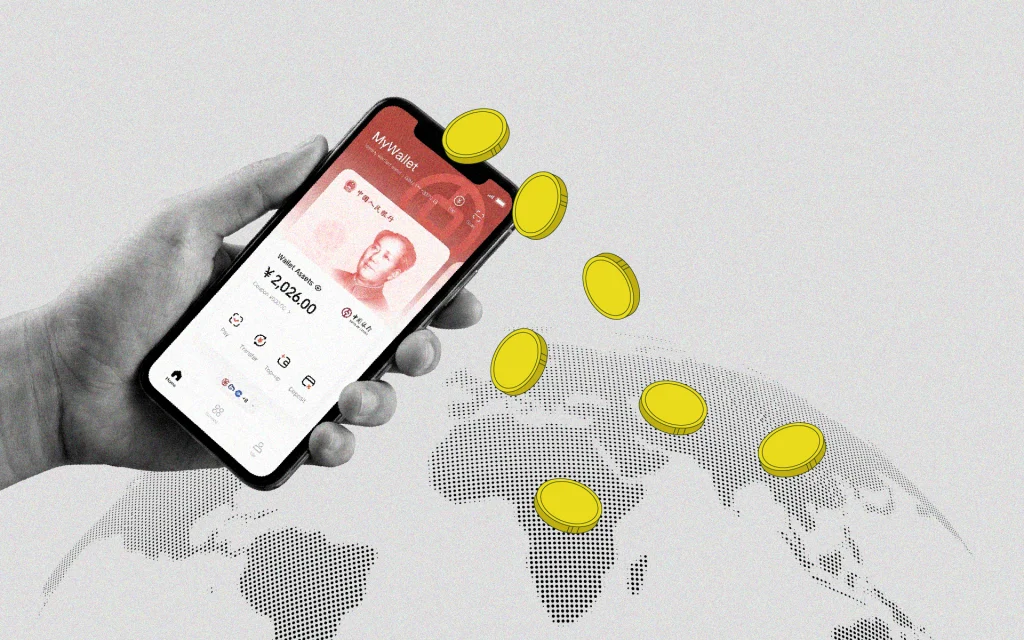
Beijing is moving to commercialize Project mBridge through a Hong Kong-based entity, advancing a yuan-settled alternative to correspondent banking just as Ripple and Stellar push their own cross-border payment networks toward institutional adoption, the Financial Times reported on Saturday.
Central banks from China, Hong Kong, Thailand, the United Arab Emirates, and Saudi Arabia back the platform, and the commercial version would charge fees roughly half those of standard international payment systems, sources told the FT.
LATEST: 🇨🇳 China is preparing a commercial rollout of Mbridge, a blockchain-based CBDC settlement network that has processed 470B yuan in volume and is seen as a direct rival to SWIFT. pic.twitter.com/ZdXsPqElwY
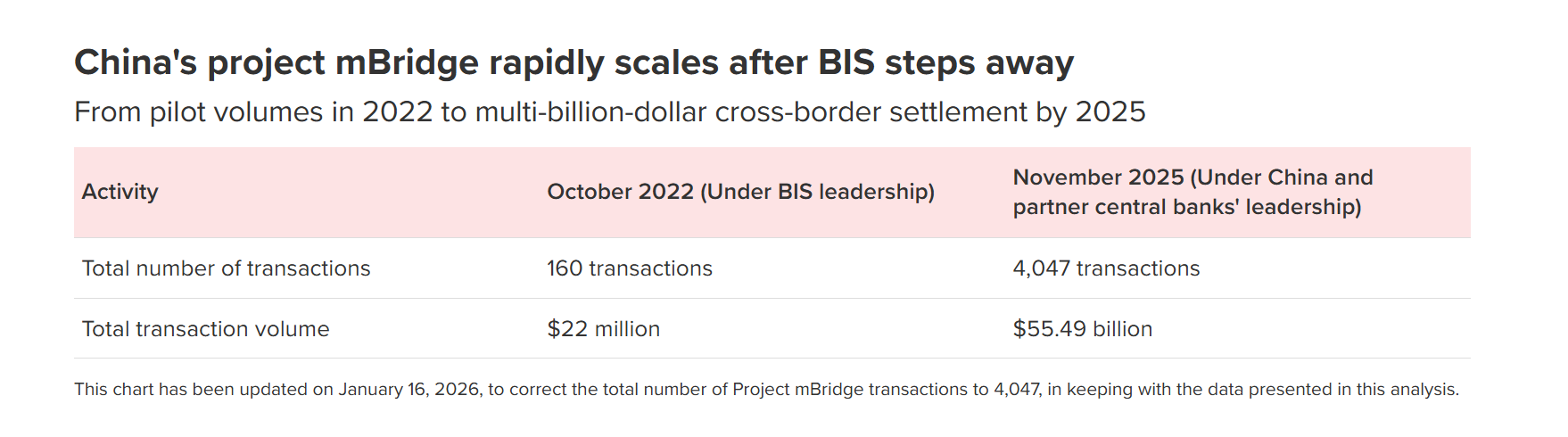
mBridge has processed roughly 470 billion yuan, or about $69 billion, in cumulative cross-border settlement, up from the $55.49 billion the Atlantic Council tracked through last November across more than 4,000 transactions. e-CNY, China’s digital yuan, accounts for roughly 95 percent of that volume, according to Atlantic Council data published in January.
Governance of mBridge moved from the Bank for International Settlements, which piloted the project from 2021, to participating central banks in October 2024, distancing the BIS from speculation that the platform could allow sanctioned states to bypass dollar-based systems.
China already runs the Cross-Border Interbank Payment System for conventional yuan transfers, launched in 2015. mBridge extends that infrastructure onto distributed ledgers, giving Beijing a settlement rail that competes with SWIFT on cost and with token-based networks on finality, without banks needing to hold cryptocurrency.
Dollar Erosion, Not Displacement
Atlantic Council associate director Alisha Chhangani wrote that mBridge is unlikely to challenge dollar dominance outright but “may incrementally erode it across specific corridors, sectors, and use cases” as Beijing builds parallel settlement rails rather than seeking direct displacement.
China’s mBridge project performance after the BIS stepped back. | Source: Atlantic Council
This framing puts mBridge on a collision course with the pitch Ripple and the Stellar Development Foundation have made to banks for years: faster, cheaper settlement than correspondent banking routed through SWIFT messaging.
Where XRP and XLM Fit
Ripple’s On-Demand Liquidity service processed more than $15 billion in cross-border payments in 2024 and reached a cumulative volume of $95 billion by January, according to industry data.
XRP Ledger processed 769,646 transactions on June 16, with payments leading at 427,000, as the network sustains consecutive sessions above 750,000 daily transactions and closes in on the 1 million mark. DEX offer creation added 243,408 transactions, the second-largest activity driver, while Ripple targets a $1 billion annualized revenue run rate by the end of 2026, against a backdrop of rising ledger throughput and a $1.72 billion RLUSD market cap.
Stellar processed $5.5 billion in payment volume in the first quarter of 2026, up 72% from a year earlier.
Both tokens cleared a regulatory hurdle in March, when the SEC and CFTC issued a joint commodity classification covering XRP and XLM alongside Bitcoin (BTC) and Ethereum (ETH).
Stellar separately struck a tokenization partnership with the Depository Trust and Clearing Corporation in late May, sending XLM up 28% on a day when broader crypto markets fell.
mBridge differs from both networks structurally.
Ripple’s XRP Ledger uses XRP as a bridge asset between currency pairs, and Stellar transactions can settle through XLM or through assets issued by network anchors. mBridge instead enables direct settlement between participating central banks’ digital currencies, with no token intermediary required.
Whether banks outside the founding members adopt mBridge at scale, and whether that adoption draws volume from corridors XRP and XLM have targeted for institutional settlement, is the open question as the platform shifts from pilot to commercial rollout.
Try Our Recommended Crypto Exchanges
Sponsored
Disclosure
We sometimes use affiliate links in our content, when clicking on those we might receive a commission at no extra cost to you. By using this website you agree to our terms and conditions and privacy policy.
Disclaimer:
The information provided in this article is for informational purposes only. It is not intended to be, nor should it be construed as, financial advice. We do not make any warranties regarding the completeness, reliability, or accuracy of this information. All investments involve risk, and past performance does not guarantee future results. We recommend consulting a financial advisor before making any investment decisions.
Dr. Guneet Kaur is a senior editor at CCN.com and a Science Fellow at Exponential Science. She is a fintech and blockchain expert with extensive experience in digital finance education, blockchain ecosystems, and cryptocurrency markets. She has worked with global media such as Cointelegraph, as well as education and blockchain platforms, to design and lead strategic content and learning initiatives. As an educator and assessor for top-tier executive programs, she bridges real-world fintech trends with academic insight.
Dr. Kaur is also a published researcher and peer reviewer across fintech and data science journals, including Financial Innovation Journal and International Journal of Big Data Intelligence and Applications. Her work spans data-driven analysis, Web3 innovation, and technical content development. With a strong foundation in both industry and academia, she translates complex financial technologies into practical applications, empowering learners, professionals, and institutions across the rapidly evolving digital finance landscape.