Adam Livingston believes a historic transfer of Bitcoin from early holders to higher-cost investors has created the foundation for a move to $200,000.
Bitcoin’s subdued price action resembles its late-2022 consolidation, the analyst said.
Benjamin Cowen remains cautious, arguing that Bitcoin could fall toward $40,000.
Bitcoin’s extended period trading around $63,000 has divided analysts over whether it is getting ready to surge or preparing for another leg lower.
Bitcoin (BTC) was trading at approximately $63,300 at the time of writing, having remained subdued after falling almost 50% from its late-2025 record high above $124,000.
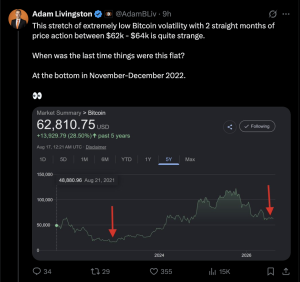
Bitcoin analyst Adam Livingston believes the low-volatility environment resembles the market’s behavior around the November–December 2022 bear-market bottom.
His bullish argument also claims that Bitcoin’s price could be preparing to surge to $200,000 and above.
But other analysts, including Benjamin Cowen, have warned that Bitcoin’s four-year cycle and poor economic conditions could still drag the price toward $40,000.
Try Our Recommended Crypto Exchanges
Sponsored
Disclosure
We sometimes use affiliate links in our content, when clicking on those we might receive a commission at no extra cost to you. By using this website you agree to our terms and conditions and privacy policy.
In a lengthypost on X, Livingston argued that Bitcoin’s 340-day period around six figures represented the largest “changing of the guard” in its history.
Bitcoin closed near $101,000 on Dec. 8, 2024, and was again trading at approximately $101,000 on Nov. 12, 2025.
Although the two endpoints were almost identical, Livingston said Bitcoin’s realized price increased from $38,233 to $56,194 during the period.
Realized price values each Bitcoin at the price recorded when it last moved on-chain.
Why are we at $63,000 Bitcoin in 2026… and why will it be $200k soon?
Let me tell you.
Because the move above $100,000 was the largest economic changing of the guard Bitcoin has ever seen.
And almost everyone is looking at the aftermath backwards.
According to Livingston, the 47% increase indicated that early investors were transferring coins acquired at considerably lower prices to buyers prepared to commit fresh capital near $100,000.
Livingston said this process effectively “recapitalized” the network.
Despite Bitcoin subsequently falling toward $63,000, its realized price has remained elevated.
“If realized price climbs toward $70,000 during the next expansion, $200,000 Bitcoin would represent about 2.86x realized price,” Livingston wrote.
Is Bitcoin Repeating Its 2022 Bear-Market Bottom?
Livingston also compared Bitcoin’s current consolidation with its behavior following the FTX-driven market crash in November 2022.
“This stretch of extremely low Bitcoin volatility with 2 straight months of price action between $62k – $64k is quite strange,” Livingston wrote.
Bitcoin traded largely sideways around 16,000–17,000 during November and December 2022.
At the time, the flat price action reflected weak demand and widespread disinterest following a year-long bear market.
The bullish interpretation is that Bitcoin may once again be experiencing volatility compression near a long-term bottom.
If sellers have largely exhausted their supply, even a modest improvement in demand could produce an outsized move.
Could Bitcoin Price Still Fall to $40,000?
Livingston has acknowledged that Bitcoin could trade lower, but he does not expect a significant extension of the decline.
“If we go lower, it won’t be by a lot IMHO,” he wrote in response to an X user.
Adding: “The $40k bros are smoking crack.”
Famed analyst Benjamin Cowen has regularly presented a sharply different outlook.
The analyst previously said Bitcoin could fall below $40,000 before establishing a cycle bottom later in 2026.
His thesis is based on Bitcoin’s historical four-year cycle, previous bear-market drawdowns, weak retail participation and restrictive macroeconomic conditions.
Disclaimer:
The information provided in this article is for informational purposes only. It is not intended to be, nor should it be construed as, financial advice. We do not make any warranties regarding the completeness, reliability, or accuracy of this information. All investments involve risk, and past performance does not guarantee future results. We recommend consulting a financial advisor before making any investment decisions.
Kurt Robson is a London-based reporter at CCN, specialising in the fast-moving worlds of crypto and emerging technology. He began his career covering local news in Cornwall after graduating from Falmouth University with First Class Honours in Journalism. There, he cut his teeth on everything from council meetings to missing swans.
He quickly rose through the ranks to become a frontline journalist at several of the UK’s leading national newspapers. Over the years, he has interviewed musicians and celebrities, reported from courtrooms and crime scenes, and secured multiple front-page exclusives.
Following the upheaval of the COVID-19 pandemic, Kurt shifted his focus to technology journalism—just ahead of the AI boom. With a natural curiosity and a trained eye for emerging trends, he has found a new rhythm in reporting on innovation.
At CCN, Kurt's work focuses on the cutting edge of crypto, blockchain, AI, and the evolving digital world. Drawing on his background in people-first reporting and his deep interest in disruptive tech, Kurt delivers stories that are insightful, entertaining, and human-centric.












 Bitcoin Price Below $10,000? ChatGPT Issues Warning as ‘Crypto Is Dead’ Chatter Surges