Tether Wallet Launches Bitcoin Faucet to Encourage Self-Custody: Here's How to Claim Free Sats
Share
Key Takeaways
Charles Schwab’s crypto trading rollout and educational push signal deeper mainstream adoption.
Forecasts of Bitcoin’s price reaching $140,000 highlight upside potential, but analysts remain unconvinced in the near-term.
Rising fund inflows and dip-buying reflect renewed confidence.
Bitcoin’s price is drawing renewed attention from both Wall Street and retail investors, as Charles Schwab’s new educational video and crypto trading expansion coincide with bold forecasts that it could climb as high as $140,000 this year.
While some analysts see the potential for a significant rally, others caution that risk remains elevated amid slowing momentum and an increasingly contested near-term outlook.
Sponsored
Disclosure
We sometimes use affiliate links in our content, when clicking on those we might receive a commission at no extra cost to you. By using this website you agree to our terms and conditions and privacy policy.
US finance giant Charles Schwab has entered the crypto conversation with a newly circulated educational video on Bitcoin, emphasizing a cautious and risk-based framework for portfolio allocation.
In the video, Schwab illustrates how even small allocations to Bitcoin can significantly increase overall portfolio risk due to the asset’s volatility.
A “moderate” investor with a traditional 60/40 portfolio might limit Bitcoin exposure to around 2.7% of total holdings to keep crypto at roughly 10% of total portfolio risk, it said.
For more aggressive investors, the video suggests Bitcoin allocations could rise to just under 7%, assuming a higher tolerance for risk.
The firm stressed how crypto is “complicated and confusing for beginners” and should be approached with discipline and education.
“Bitcoin’s volatility means it has an outsized risk… small increases in Bitcoin holdings can lead to larger increases in overall risk exposure,” the video notes.
Mixed Reactions Online
The video quickly gained traction on social media, where many framed it as a major endorsement of Bitcoin adoption by a traditional financial giant.
One widely shared post claimed Schwab was telling its tens of millions of clients “it’s time to start adding Bitcoin to portfolios,” highlighting the higher allocation scenarios presented.
However, others pushed back, arguing that such interpretations overstated Schwab’s position.
Critics noted that the firm’s research characterizes crypto as a speculative “satellite” asset and emphasizes that there is no single correct allocation.
“The headline is doing a lot of work here,” one X user responded.
“The 60/40 being dead is a fair debate to have, but it is not what this report is saying,” they added. “Worth reading the actual paper before using it as a narrative.”
Still, some observers said the fact that Schwab was publishing detailed Bitcoin allocation frameworks in the first place signaled a win.
Schwab Rolls Out Crypto Trading
The debate comes as Schwab last week announced plans to launch Schwab Crypto, a spot trading service that will provide retail clients with direct access to Bitcoin and Ethereum.
The offering, set for a phased rollout in the coming weeks, will allow users to trade cryptocurrencies alongside traditional investments via Schwab’s platforms.
“We know our clients want to conduct more of their financial lives at Schwab,” said Jonathan Craig, Head of Retail Investing at the firm.
The move builds on Schwab’s existing exposure to digital assets, with clients already holding roughly 20% of spot crypto exchange-traded products.
Schwab added that the offering would also include educational resources, research insights and 24/7 customer support.
Bullish Bitcoin Price Forecasts Persist
Even as Bitcoin trades well below its October peak of around $126,000, some analysts remain optimistic about its long-term trajectory.
Dominic Basulto, a crypto analyst at The Motley Fool, noted that investment bank TD Cowen sees the possibility of Bitcoin reaching $140,000 by the end of the year.
According to Basulto, historical performance offers some support for such projections.
Bitcoin rose 157% in 2023 and 125% in 2024, demonstrating what the analyst described as a pattern of sharp rallies following downturns.
However, prediction market data suggests more tempered expectations.
Platforms such as Kalshi and Polymarket currently assign less than an 11% probability to Bitcoin reaching $140,000 this year.
Basulto added that volatility remains a key concern, warning that the crypto “could drop much further before it recovers.”
Cautious Bitcoin Price Optimism
Broader market dynamics are also reinforcing the cautiously optimistic outlook for crypto, according to Joel Kruger, Markets Strategist at LMAX Group.
Kruger said the crypto market has shown resilience in recent sessions, with Bitcoin holding near recent highs and Ethereum “tracking closely alongside.
“Price action has been characterized by consistent dip-buying, suggesting that market participants are growing more confident in the near-term outlook, even as broader macro risks remain present,” he said.
He attributed part of the improved tone to easing geopolitical concerns, particularly around the Middle East.
Kruger also noted that the crypto market has largely absorbed recent decentralized finance (DeFi) exploits without significant disruption.
“The contained reaction reflects a growing distinction between protocol-specific vulnerabilities and the broader asset class,” he said.
Inflows Grow
The improving sentiment highlighted by analysts is also being reflected in capital flows, with data pointing to a rebound in investor demand for across the crypto market.
Crypto investment products drew roughly $1.4 billion in inflows last week, the largest weekly intake since early 2026, marking a third straight week of gains and pushing total assets under management to around $155 billion.
Bitcoin continued to dominate allocations, drawing the vast majority of capital and reinforcing its role as the primary entry point for institutional investors.
Strong inflows into Bitcoin-linked products have pushed its year-to-date totals close to $2 billion, supported in part by sustained demand for spot exchange-traded funds.
At the same time, a smaller but notable increase in flows into short-Bitcoin products suggests that some investors are positioning defensively.
Ethereum also attracted renewed interest, posting solid weekly inflows after a weaker start to the year.
However, it remains one of the few major digital assets still showing net outflows on a year-to-date basis, indicating that investors are returning cautiously.
CCN Bitcoin Price Outlook
This point is also shown in short-term market signals.
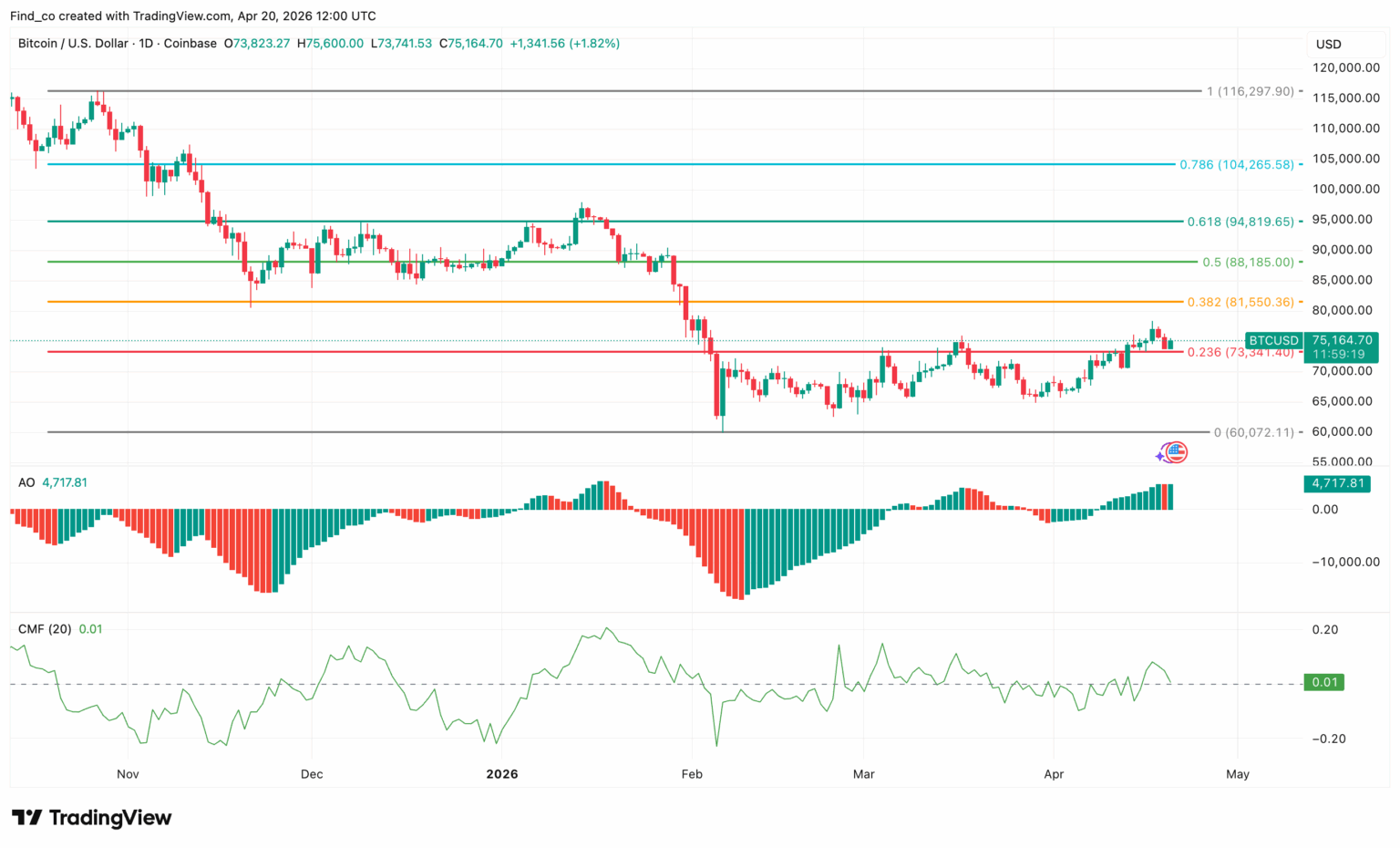
According to CCN analyst Victor Olanrewaju, Bitcoin’s recent rally is showing signs of slowing, with the price consolidating around the $75,000 level after failing to break decisively above resistance near $78,000–$80,000.
Momentum indicators such as the Relative Strength Index and MACD suggest a pause rather than a reversal, with the broader uptrend still intact but lacking strong upward pressure.
BTC/USD Daily Chart | Credit: TradingView
At the same time, however, declining volatility point to the potential for a larger move ahead.
“Crucially, Bitcoin is now pressing against the $76,000 resistance, which aligns with a previous breakdown level,” Olanrewaju said.
If it manages to break above this level, it could see a price increase towards $81,550.
“On the downside, a lack of momentum could drag Bitcoin’s price back toward $70,500 or even $60,072,” Olanrewaju added.
Kurt Robson is a London-based reporter at CCN, specialising in the fast-moving worlds of crypto and emerging technology. He began his career covering local news in Cornwall after graduating from Falmouth University with First Class Honours in Journalism. There, he cut his teeth on everything from council meetings to missing swans.
He quickly rose through the ranks to become a frontline journalist at several of the UK’s leading national newspapers. Over the years, he has interviewed musicians and celebrities, reported from courtrooms and crime scenes, and secured multiple front-page exclusives.
Following the upheaval of the COVID-19 pandemic, Kurt shifted his focus to technology journalism—just ahead of the AI boom. With a natural curiosity and a trained eye for emerging trends, he has found a new rhythm in reporting on innovation.
At CCN, Kurt's work focuses on the cutting edge of crypto, blockchain, AI, and the evolving digital world. Drawing on his background in people-first reporting and his deep interest in disruptive tech, Kurt delivers stories that are insightful, entertaining, and human-centric.