Grayscale says Bitcoin is oversold after a record 411-day bear market, but AI uncertainty and persistent institutional outflows threaten its recovery. | Credit: CCN.com
Share
Key Takeaways
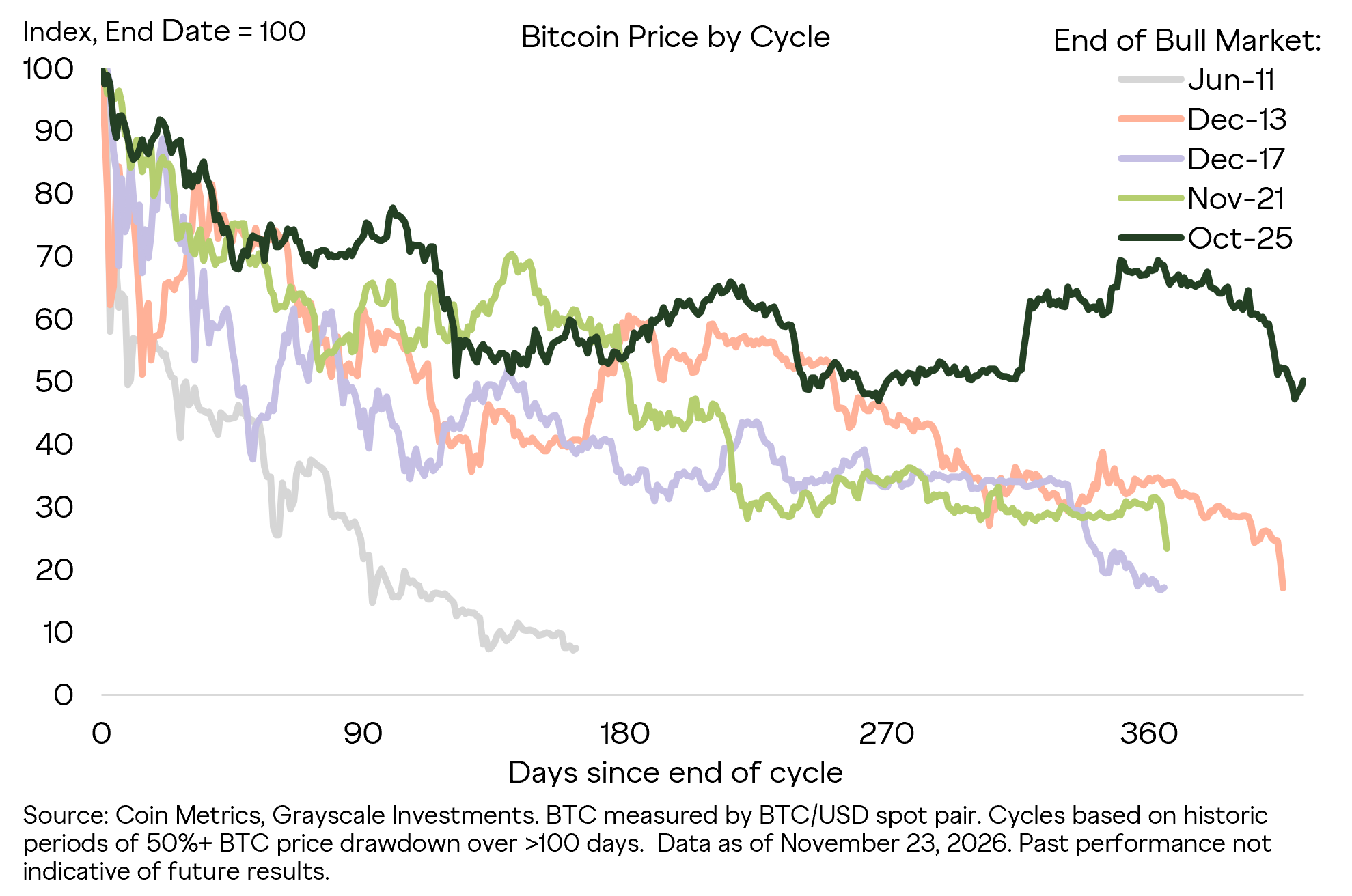
Bitcoin’s bear market has lasted at least 411 days, the longest on record according to Grayscale, despite a relatively shallow 56% drawdown.
Grayscale believes Bitcoin and other major cryptocurrencies are oversold, with current valuations offering potential long-term opportunities.
Global crypto ETPs recorded more than $2 billion in weekly outflows, while declining futures open interest signals weakening investor confidence.
Bitcoin (BTC) and other major cryptocurrencies are showing signs of oversold conditions after another week of heavy selling, but uncertainty surrounding the artificial intelligence (AI) sector could prevent a sustained market recovery, according to Grayscale Research.
The digital asset manager believes that public blockchain fundamentals remain largely intact despite deteriorating investor sentiment, persistent capital outflows and growing demand for downside protection.
Zach Pandl, head of research at Grayscale, argued that developments in the AI industry could exert a greater influence on cryptocurrency prices in the near term than blockchain-specific factors.
The assessment comes as Bitcoin struggles to regain momentum following a historically prolonged downturn, with institutional investors continuing to reduce their exposure to digital assets.
New Trending Crypto Wallet Offers
Sponsored
Disclosure
We sometimes use affiliate links in our content, when clicking on those we might receive a commission at no extra cost to you. By using this website you agree to our terms and conditions and privacy policy.
According to Grayscale, the decline extended the current bear market to at least 411 days, making it the longest in the firm’s historical comparison.
However, the current downturn also remains the shallowest in that comparison, with a 56% decline from Bitcoin’s October 2025 peak.
Bitcoin subsequently recovered to approximately $62,000 before slipping below $60,000 again on Tuesday, highlighting the fragility of the rebound.
Bitcoin’s longest but shallowest bear market. Credit: Grayscale
The relatively smaller drawdown compared with previous cycles could reflect the cryptocurrency market’s growing maturity, greater institutional participation and increasingly diversified investment infrastructure.
Nevertheless, the duration of the downturn suggests that these structural developments have not eliminated Bitcoin’s vulnerability to unfavorable macroeconomic conditions.
Grayscale believes current valuations present an attractive opportunity for investors with medium- and long-term investment horizons, although oversold conditions do not necessarily signal an imminent market bottom.
ETF Outflows and Options Markets Signal Extreme Investor Fear
Several market indicators support Grayscale’s assessment that Bitcoin and other leading cryptocurrencies have entered oversold territory.
Global cryptocurrency exchange-traded products (ETPs) recorded more than $2 billion in outflows last week, while significant stablecoin redemptions pointed to deteriorating market liquidity.
Meanwhile, Bitcoin and Ethereum futures open interest returned to levels last seen during the summer, indicating that traders have reduced their exposure to leveraged positions.
Grayscale Research believes crypto is oversold.
Options traders are paying up for downside protection, a sign of fear. The long-term case for crypto and AI looks strong, but near-term, AI uncertainty is setting the tone.
Options markets are also reflecting heightened investor anxiety. Traders are paying substantial premiums for put options, which provide protection against further price declines, while short-term implied volatility significantly exceeds longer-term expectations.
Additional data from Farside Investors showed that US spot Bitcoin exchange-traded funds (ETFs) recorded $4.71 billion in net outflows in November through Monday, already exceeding June’s previous monthly record of $4.51 billion.
BlackRock’s iShares Bitcoin Trust (IBIT) alone recorded $509.3 million in outflows on Monday, contributing to the fifth consecutive session of net withdrawals across US spot Bitcoin ETFs.
Although extreme bearish positioning can create favorable conditions for a relief rally, persistent capital withdrawals could undermine the sustainability of any recovery.
AI Uncertainty Could Overshadow Strong Blockchain Fundamentals
Despite the increasingly attractive valuations of digital assets, Grayscale believes uncertainty surrounding artificial intelligence represents a significant obstacle to a near-term cryptocurrency recovery.
Pandl highlighted several recent developments, including leadership turmoil at Nvidia, uncertainty surrounding US data center construction, widespread technology outages and Anthropic’s initial public offering (IPO).
These developments have increased uncertainty surrounding technology valuations and the broader economic implications of AI adoption.
Although Bitcoin operates independently of the AI industry, both cryptocurrencies and technology stocks remain sensitive to investor risk appetite, liquidity conditions and expectations surrounding future economic growth.
Undeniable truth: The US gov must borrow more every year because its uncuttable bills already exceed its income.
The AI boom was the one thing lifting tax receipts, and it is cracking while the Fed raises rates.
A deeper correction in AI-related equities could therefore trigger further cryptocurrency selling as investors reduce exposure to riskier assets across their portfolios.
However, Grayscale remains optimistic about the longer-term relationship between AI and blockchain technology.
Public blockchains could provide financial infrastructure for autonomous AI agents, facilitating automated payments, digital asset transfers and programmable transactions without conventional financial intermediaries.
For now, however, the immediate challenge for Bitcoin remains restoring investor confidence and attracting fresh capital.
While oversold market conditions increase the potential for a rebound, a sustained recovery may ultimately depend on stabilizing technology markets, improving liquidity and reversing institutional capital outflows.
Disclaimer:
The information provided in this article is for informational purposes only. It is not intended to be, nor should it be construed as, financial advice. We do not make any warranties regarding the completeness, reliability, or accuracy of this information. All investments involve risk, and past performance does not guarantee future results. We recommend consulting a financial advisor before making any investment decisions.
Giuseppe Ciccomascolo began his career as an investigative journalist in Italy, where he contributed to both local and national newspapers, focusing on various financial sectors.
Upon relocating to London, he worked as an analyst for Fitch's CapitalStructure and later as a Senior Reporter for Alliance News. In 2017, Giuseppe transitioned to covering cryptocurrency-related news, producing documentaries and articles on Bitcoin and other emerging digital currencies. He also played a pivotal role in establishing the academy for a cryptocurrency exchange website. Crypto remained his primary area of interest throughout his tenure as a writer for ThirdFloor.











 ‘Bitcoin Mania’ Is Over, Slams Critic, Claims Gold and Silver Entering ‘Biggest Bull Market in History’