Key Takeaways
- Russia’s central bank governor says Bitcoin mining has become an added support for the ruble.
- While difficult to quantify, officials acknowledge mining’s growing role in foreign exchange dynamics.
- Russia formally legalized Bitcoin mining in late 2024 after years of operating in a legal gray zone.
Bitcoin mining is rarely mentioned in the same breath as national currencies. But in Russia, that line may be starting to blur.
This week, Central Bank Governor Elvira Nabiullina acknowledged that BTC mining could be playing a small but meaningful role in supporting the ruble—an unusual admission from a central banker long known for her cautious stance on crypto.
While she stressed that the impact is difficult to quantify, Nabiullina said mining has become “an additional factor” in the currency’s recent strength.
The comments come as Russia continues to adapt its financial system under pressure from sanctions, tightening capital controls while quietly embracing parts of the digital asset economy that bring hard currency into the country.
A Measured Shift in Tone
Nabiullina was careful not to overstate the case.
She noted that Bitcoin mining did not suddenly emerge this year, meaning it cannot fully explain recent movements in the exchange rate.
At the same time, she acknowledged that mining activity, much of which operates outside traditional reporting channels, makes precise measurement difficult.
Still, her willingness to name mining as a supportive factor marks a notable shift.
For years, Russia’s central bank viewed crypto primarily as a financial risk.
Now, amid a changing geopolitical and economic environment, that view appears to be softening, at least when it comes to the mining sector.
Her remarks echoed earlier comments from Maxim Oreshkin, Deputy Chief of Staff of the Presidential Executive Office, who described Bitcoin mining as a new form of export.
In practice, that means miners convert energy into digital assets that can be sold abroad, bringing foreign currency into Russia without relying on conventional trade infrastructure.
From Gray Market to Legal Industry
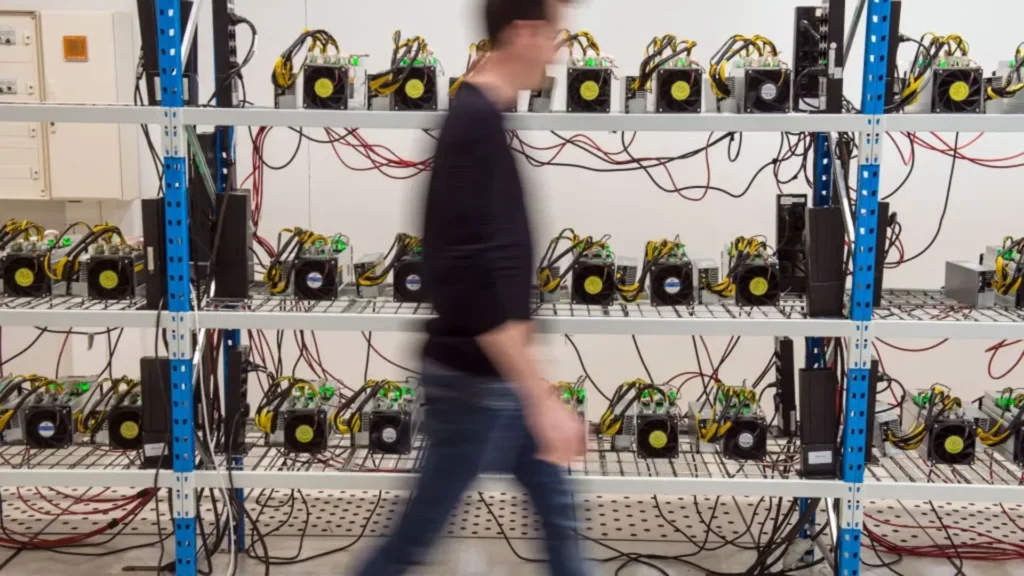
Russia’s mining sector didn’t appear overnight. The country has ranked among the world’s top contributors to Bitcoin’s hash rate for years, well before mining was legalized.
Early operations began around 2018, driven by inexpensive electricity and cold climates that are ideal for cooling hardware.
After China banned Bitcoin mining in 2021, many operators relocated to Russia, which accelerated growth but left the industry in a legal gray area.
Mining wasn’t explicitly illegal, but it wasn’t regulated either.
That changed in August 2024, when President Vladimir Putin signed legislation formally legalizing cryptocurrency mining.
The new framework, which took effect later that year, requires miners to register as legal entities or individual entrepreneurs.
Even so, problems persisted. In energy-constrained regions, illegal mining and electricity theft continued, forcing authorities to temporarily ban mining in certain areas.
More comprehensive regulations are expected in 2026, as officials aim to strike a balance between economic benefits and grid stability.
Bitcoin: A Quiet Economic Lever for the Ruble?
For now, Russia’s central bank is discussing broader cryptocurrency regulation with the Ministry of Finance and anti-money laundering authorities.
Any future trading framework is likely to route activity through licensed institutions rather than open retail markets.
Bitcoin mining may never become a central pillar of Russia’s economy. But Nabiullina’s comments suggest it has moved from the margins into policymakers’ calculations—a quiet, unconventional lever in a financial system under pressure.
And for a country navigating sanctions, capital controls, and shifting trade dynamics, even small sources of support can matter.

Prashant Jha is a seasoned crypto journalist based in Delhi, India, with a Bachelor’s Degree in Computer Science Engineering. Passionate about the evolving world of blockchain and cryptocurrencies, he has been a dedicated voice in the industry since 2018. Prashant’s expertise lies in regulatory reporting, where he unravels complex legal and financial developments with clarity and precision. Before joining CCN in 2024, he honed his craft at Cointelegraph, establishing himself as a trusted name in crypto journalism.
His coverage spans major industry events, including the high-profile collapses of FTX, Three Arrows Capital (3AC), and LUNA, offering readers insightful analyses of their regulatory and market implications. Prashant’s technical background enables him to bridge the gap between intricate blockchain technology and its real-world applications, making his work accessible to novices and experts.
Beyond his professional pursuits, Prashant is an avid music enthusiast, often exploring diverse genres to unwind. A sports lover, he has a particular passion for cricket and frequently engages in discussions about the game. His multifaceted interests and sharp journalistic instincts make him a valuable contributor to CCN, where he continues shaping the crypto landscape's narrative.