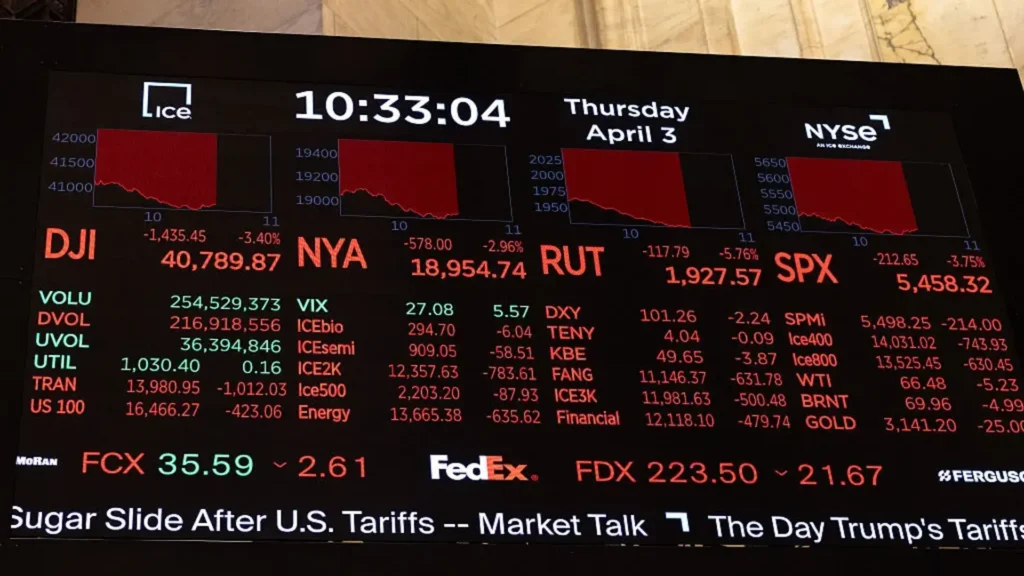
Global markets plunged into turmoil as Trump’s sweeping tariffs take shape. | Credit: Michael M. Santiago/Getty Images
Share
Key Takeaways
President Trump’s sweeping tariffs triggered the worst global market drop since 2008.
JPMorgan now sees a 60% chance of a global recession by year-end.
Oil prices fell sharply, with Morgan Stanley slashing its Brent forecast to $65 and warning of a dip to the $50s in a recession.
CEOs are beginning to speak out, with Elon Musk pushing for free trade and criticizing White House advisers.
Global markets unraveled over the weekend as President Donald Trump’s sweeping tariffs ignited a trade war with international consequences.
What followed wasn’t just a selloff—it was a historic rupture in investor confidence, rattling economies from Wall Street to Asia and wiping out trillions in market value.
Recession fears are intensifying, and corporate leaders are starting to break their silence, raising the question: Can the storm be contained, or is this just the beginning of a deeper economic crisis?
Wall Street Suffers Historic Losses as Tariff War Escalates
The global economy faced one of its most pivotal weeks in decades as President Trump’s tariffs pushed the markets into turmoil.
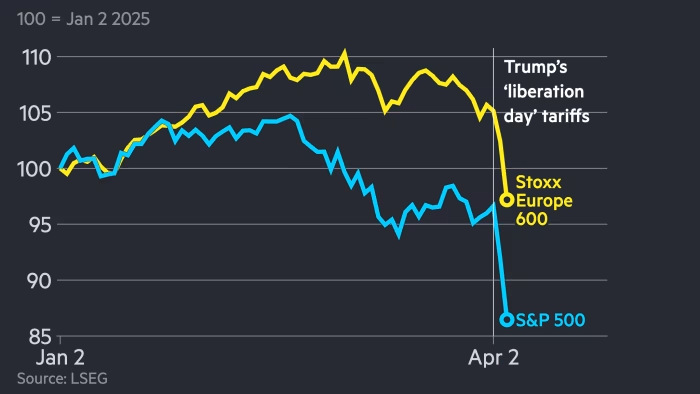
The Nasdaq entered a bear market, while the S&P 500 dropped 6%, erasing $5 trillion in market value. These declines were driven by the U.S.’s highest tariff increases in over a century, marking a dramatic departure from previous trade policy.
On the heels of Trump’s tariff hikes, China retaliated with 34% duties on U.S. imports, escalating the trade war.
Traders are now expecting at least four rate cuts by year-end, with some predicting the first cut could come as soon as May.
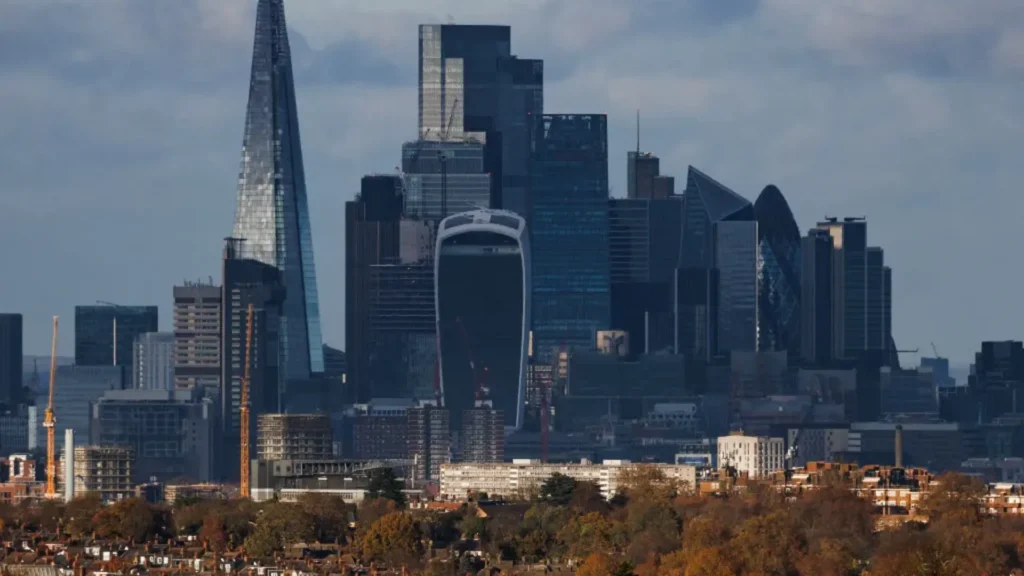
Wall Street wiped out $5 trillion last week as Trump announced tariffs on trade partners. | Credit: London Stock Exchange Group
With fears of a global recession now at the forefront, both developed and emerging markets are bracing for the ripple effects of the ongoing trade conflict.
On Monday morning, futures on the S&P 500 were down 4%, those on the Dow dropped by 3.8%, and futures on Nasdaq 100 E-minis decreased by 4.6%.
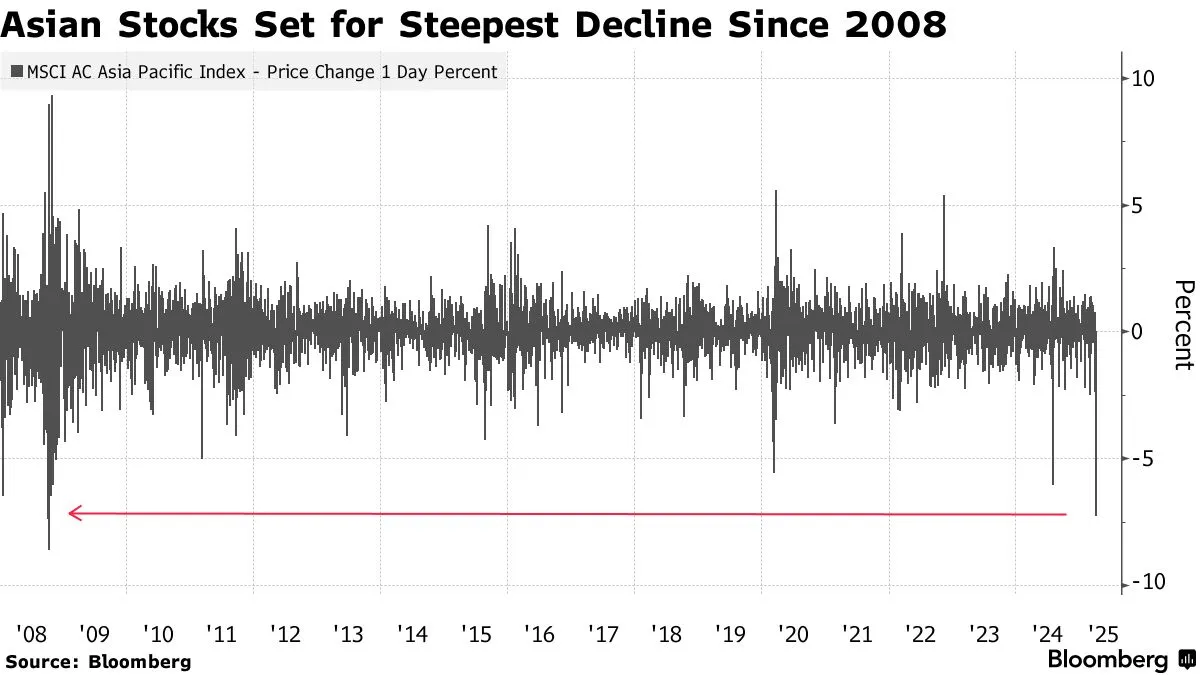
Asian markets also opened with the worst selloff since the 2008 global financial crisis.
Asian Markets Plunge to Worst Levels Since the Financial Crisis
The MSCI Asia Pacific Index dropped by as much as 7.9%, with sharp losses in TSMC, Tencent, and Sony. Hong Kong’s Hang Seng Index plummeted over 10%, leaving all regional markets in negative territory.
The market rout followed President Trump’s tariff hikes, exacerbated by China’s retaliatory tariffs. “This is proper capitulation,” said Jun Bei Liu of Ten Cap Pty.
Asian markets saw massive losses. | Credit: Bloomberg
Taiwan’s Taiex slumped 9.7%, its largest drop on record. Japan’s Topix fell 7%, South Korea’s Kospi dropped 5%, and India’s Nifty 50 declined by 4%.
Other markets also saw heavy losses: Australia (-4.4%), New Zealand (-3.4%), Malaysia (-4.3%), and the Philippines (-4%). Markets were closed in Indonesia, Thailand, and Vietnam.
Despite the steep declines, some analysts see opportunities. BNP Paribas’s Wei Li suggested China’s market could show resilience in the medium term.
JPMorgan echoed a similar sentiment and recommended buying into India, China, and Singapore, anticipating a market rebound.
Commodities and Treasury Yields Take a Hit
Other assets weren’t immune to the overall downtrend.
The 10-year U.S. Treasury yield dropped by 6.4 basis points, while WTI crude fell 2.7%, settling at $60 a barrel. The euro rose 0.2%, and the dollar index remained largely unchanged as investors flocked to safe havens.
Yields on two-year Treasuries, the most sensitive to policy shifts, plunged by as much as 22 basis points, with the yen and Swiss franc gaining strength.
Following Goldman Sachs, Morgan Stanley lowered its Brent crude forecast by $5 to $65 a barrel for this quarter. In a recession scenario, it warned that Brent could dip into the mid-$50s as oil demand growth slows to zero.
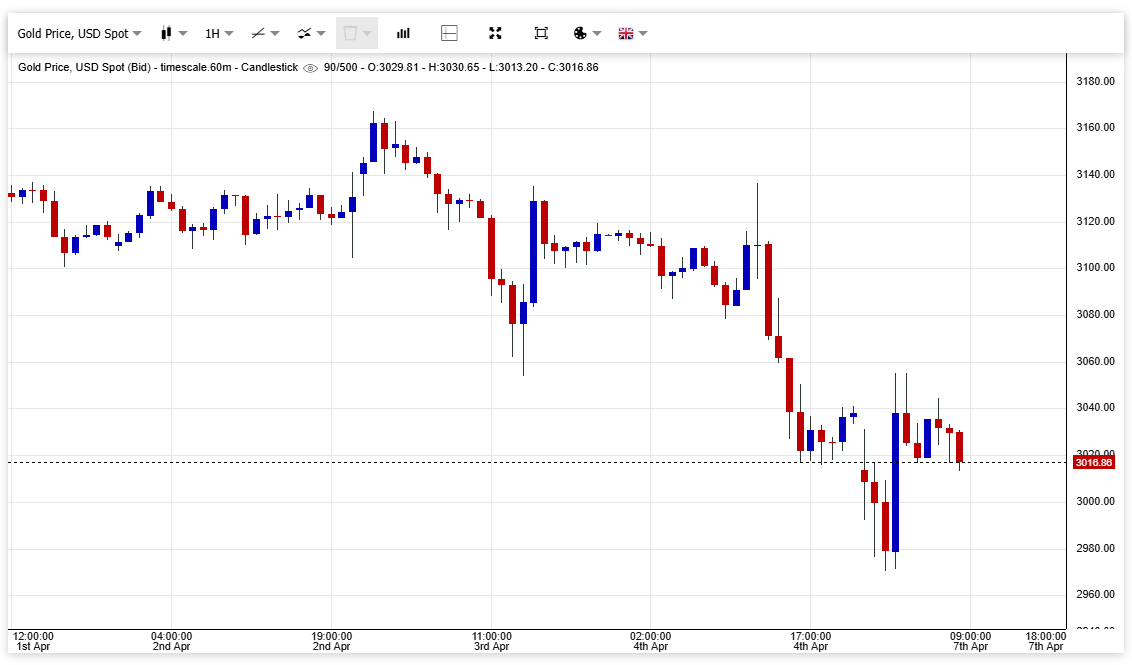
Gold, though among the decliners, maintained its safe-haven appeal. | Credit: Gold Price
Commodities continued to face pressure, with crude, iron ore, and others falling.
Gold remained flat, while copper saw a slight increase, though it remained fragile. The Bloomberg Commodity Spot Index may soon erase all its year-to-date gains after a nearly 6% drop last week—the worst since 2022.
Copper traders are watching for a potential dead-cat bounce, as futures rose about 1% in London following an 8% drop earlier in the session and a 10% weekly loss.
Billionaire investor Bill Ackman, once a supporter of Trump, warned that the U.S. was heading toward a self-inflicted “economic nuclear winter” due to the President’s tariff policies.
Ackman criticized the broad 10% tariffs on imports from over 180 countries, calling it an economic war that could erode global trust in the U.S.
“Business is a confidence game. The President is losing the confidence of business leaders around the globe,” said Ackman, warning that low-income Americans, already under pressure, will be hit hardest.
The hedge fund manager urged Trump to pause and renegotiate trade terms, warning otherwise of severe economic fallout.
Elon Musk, one of Trump’s closest supporters, called for a “zero-tariff” zone between the U.S. and Europe, taking aim at White House trade advisor Peter Navarro.
Musk’s comments echo growing dissatisfaction among CEOs, many of whom had previously remained silent to avoid political fallout.
The Business Roundtable, a group of influential U.S. CEOs, has warned that the tariffs could severely harm both U.S. businesses and consumers, with some suggesting that a 10-50% tariff could push the economy into a full-blown recession.
However, Treasury Secretary Scott Bessent dismissed these concerns, maintaining that the market downturn was temporary and that the financial infrastructure remained solid.
Giuseppe Ciccomascolo began his career as an investigative journalist in Italy, where he contributed to both local and national newspapers, focusing on various financial sectors.
Upon relocating to London, he worked as an analyst for Fitch's CapitalStructure and later as a Senior Reporter for Alliance News. In 2017, Giuseppe transitioned to covering cryptocurrency-related news, producing documentaries and articles on Bitcoin and other emerging digital currencies. He also played a pivotal role in establishing the academy for a cryptocurrency exchange website. Crypto remained his primary area of interest throughout his tenure as a writer for ThirdFloor.