Trump announced new tariffs, sparking fears of a trade war. Gold hits a record high, while stocks, crypto, and bonds react to uncertainty. | Credit: Chip Somodevilla/Getty Images
Share
Key Takeaways
U.S. stock futures fell sharply after Trump’s surprise tariff announcement.
Cryptocurrencies also felt the pressure, with the global crypto market cap falling by 0.9%.
Gold surged to a record high as investors sought safety amid economic uncertainty.
Global markets were plunged as U.S. President Trump unveiled a sweeping new round of tariffs, sending stock futures tumbling and investors rushing for safety.
Equities, crypto, and bonds reacted sharply, while gold emerged as the only clear winner, soaring to record highs.
As fears of a trade war’s adverse effects intensify, analysts warn of unpredictable economic fallout, and investors are already shifting strategies to weather the storm.
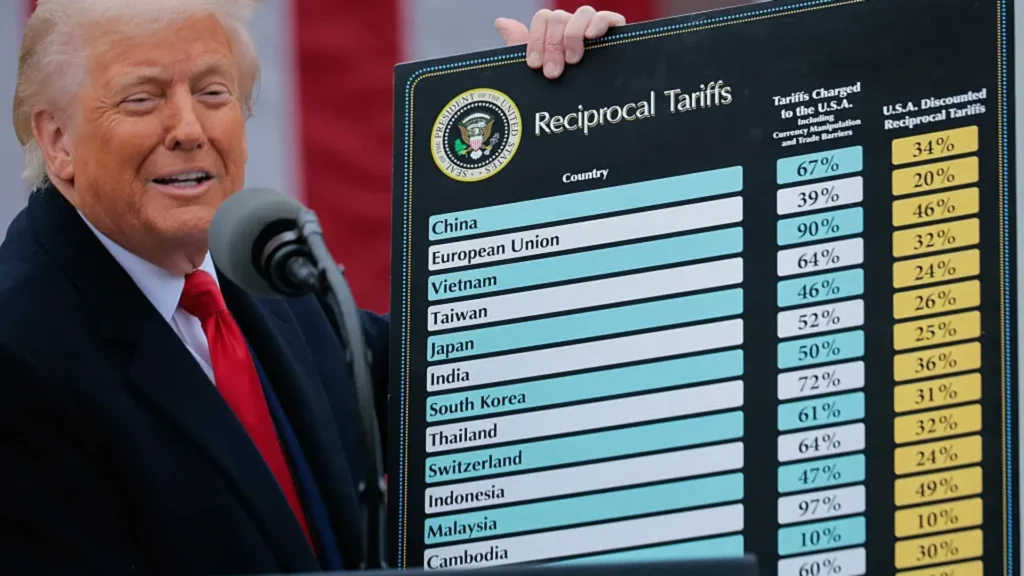
U.S. stock futures fell late on Wednesday after President Trump announced reciprocal tariffs at a White House “Liberation Day” event.
S&P 500 futures dropped by 1.7%, Nasdaq 100 futures fell by 2.5%, and Dow Jones Industrial Average futures declined by 0.7%.
Earlier, stocks had rebounded, with the S&P 500 gaining 0.7%, the Dow rising 0.6%, and the Nasdaq climbing 0.9% after early losses of over 1%.
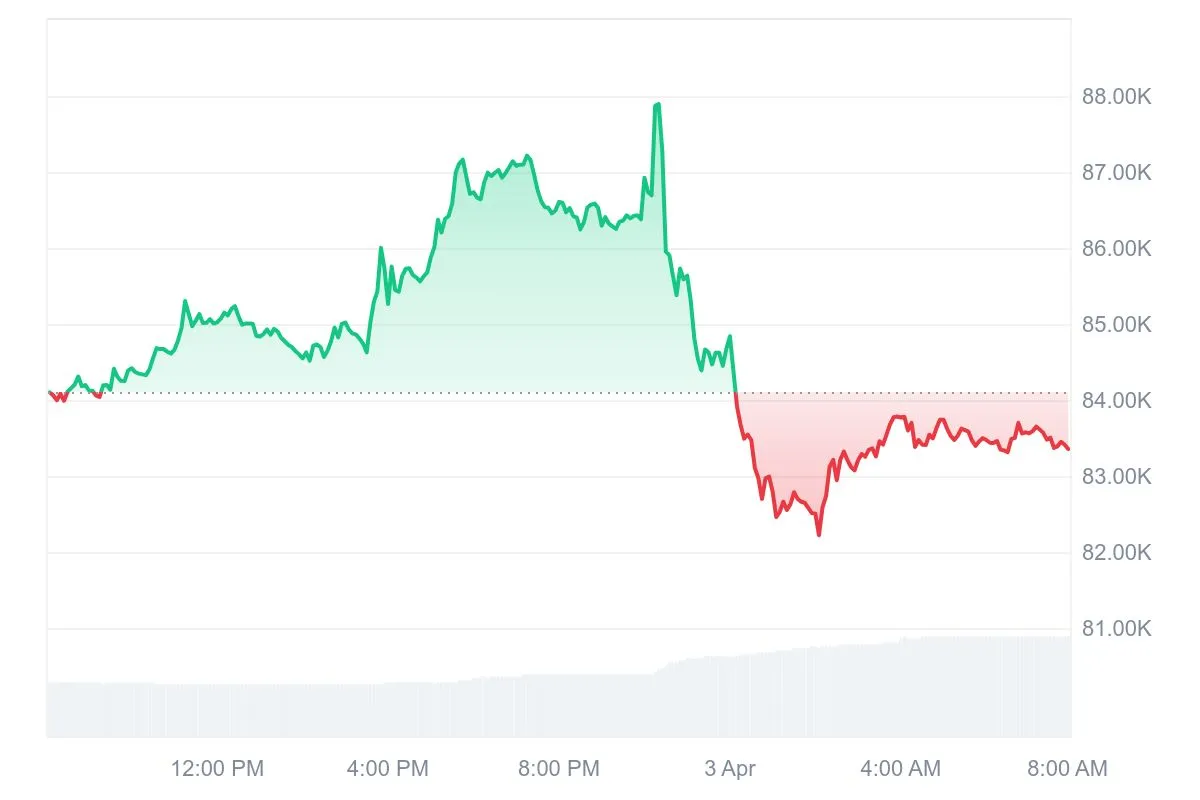
Bitcoin decreased by 0.9% after Trump announced tariffs. | Credit: CoinMarketCap
The 10-year Treasury yield (TNX) increased by four basis points to 4.19%, recovering from a six-month low.
The crypto market didn’t avoid the drop, even if it was smaller than equities. The global crypto market cap decreased by 0.9% to $2.68 trillion, Bitcoin only lost 0.9% to $83,000, and Ethereum dipped by 1.5% to $1,820.
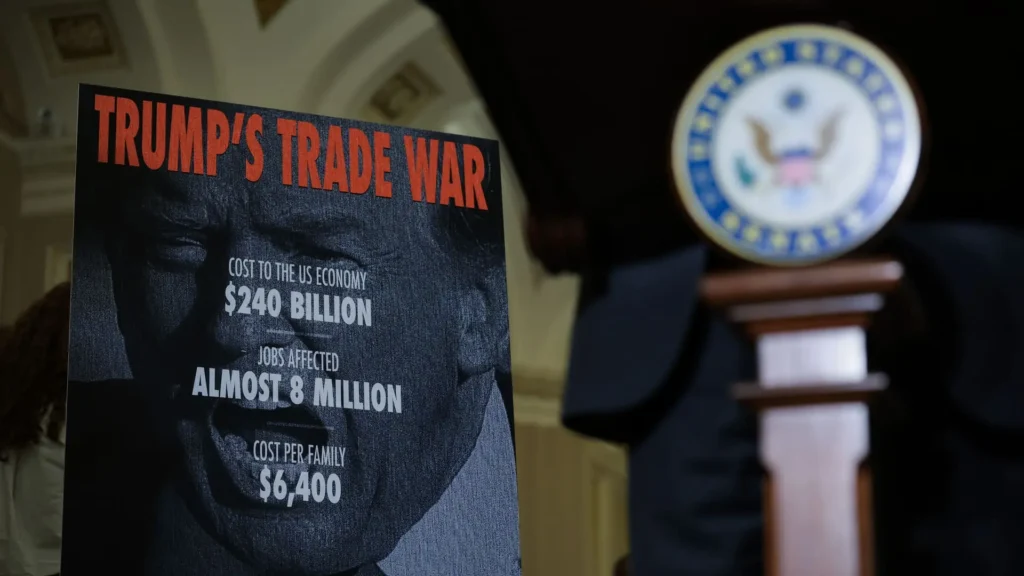
Markets remain uncertain about the scope of the tariffs and fear potential retaliatory measures that could escalate into a trade war.
Gold Is the Only Winner
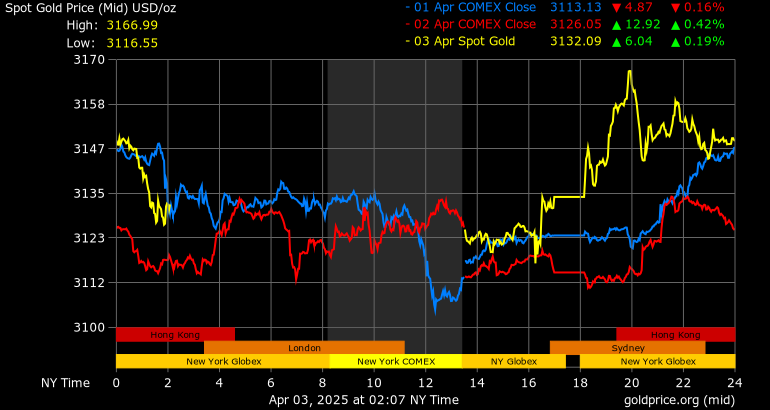
Gold has reached a record high of $3,167 per ounce and is now hovering near $3,148 as global markets react to a significant U.S. policy shift.
The surge in gold prices is primarily fueled by the Trump administration’s decision to impose new tariffs on imports from major economies such as China, India, Vietnam, Brazil, and several European nations.
Investors see this as the start of a significant shift in global trade dynamics, prompting heightened caution across financial markets.
Gold set a new record high as investors flock to safe-haven assets. | Credit: goldprice.org
Linh Tran, Market Analyst at XS.com, told CCN, “The market’s immediate reaction was a widespread shift into defensive mode, with capital flowing out of equities and risk assets and into gold — the traditional safe-haven asset.”
Major gold ETFs like SPDR have recorded significant net inflows for three consecutive sessions, indicating that investors are buying gold not only due to inflation or interest rate concerns but also for its role as a systemic risk hedge, similar to past periods of political and economic turmoil.
“In this environment, gold will likely continue attracting capital and potentially reach higher price levels soon. As policy risks become increasingly unpredictable, the precious metal is naturally reclaiming its role as the preferred haven — not only for individual investors but also for major central banks,” the analyst added.
How to Invest During a Trade War
Just hours after the announcement, the long-term effects of tariffs are unpredictable, so investors are rushing to adjust their portfolios to better counter the impact of a trade war.
Susannah Streeter, head of money and markets at Hargreaves Lansdown, told CCN that it’s essential to monitor long-term investment horizons during volatile times.
“Investors should ensure they are well diversified, without too much concentration on a particular market, and with money spread across different asset classes and geographies,” she said.
“Time in the market and diversification have consistently been the foundations of successful investing strategies. For investors owning quality companies over the long term, big bumps in the road are part of the journey.”
Streeter states, “The strategy of drip-feeding investments by gradually allocating funds can also help mitigate risks and pay off in uncertain times. It means investors may be able to take advantage of lower prices and benefit during recovery, helping smooth out sharp market movements over the longer term.”
Giuseppe Ciccomascolo began his career as an investigative journalist in Italy, where he contributed to both local and national newspapers, focusing on various financial sectors.
Upon relocating to London, he worked as an analyst for Fitch's CapitalStructure and later as a Senior Reporter for Alliance News. In 2017, Giuseppe transitioned to covering cryptocurrency-related news, producing documentaries and articles on Bitcoin and other emerging digital currencies. He also played a pivotal role in establishing the academy for a cryptocurrency exchange website. Crypto remained his primary area of interest throughout his tenure as a writer for ThirdFloor.