Crypto stocks staged a strong comeback in April, powered by a 15% rise in Bitcoin.
Major names like Strategy, Galaxy Digital, and Coinbase outpaced the S&P 500 and gold.
Despite April’s rally, many crypto stocks remain in the red for 2025.
After a bruising start to the year, crypto stocks staged a dramatic comeback in April, defying broader market jitters and riding the renewed momentum of Bitcoin’s (BTC’s) rally.
With U.S. equity markets under pressure and traditional safe havens like gold showing only modest gains, the digital asset space reasserted its volatility-fueled dominance.
This also signals a potential shift in investor sentiment amid fiscal and geopolitical uncertainty.
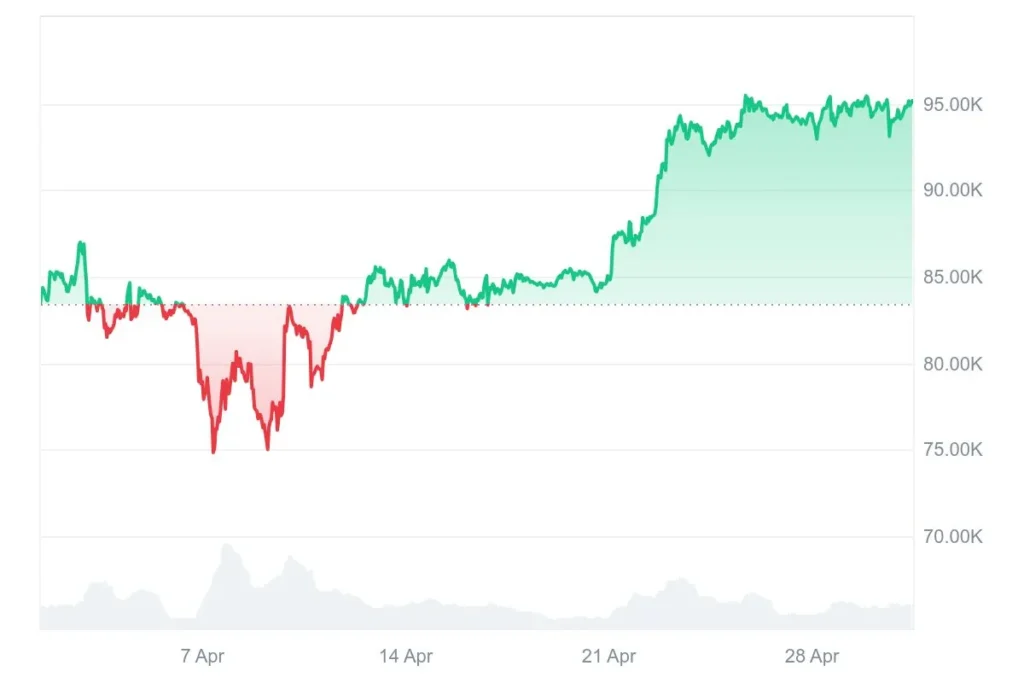
Crypto stocks staged a strong comeback in April, riding the tailwind of Bitcoin’s 15% monthly gain, even as broader U.S. equity markets lost ground.
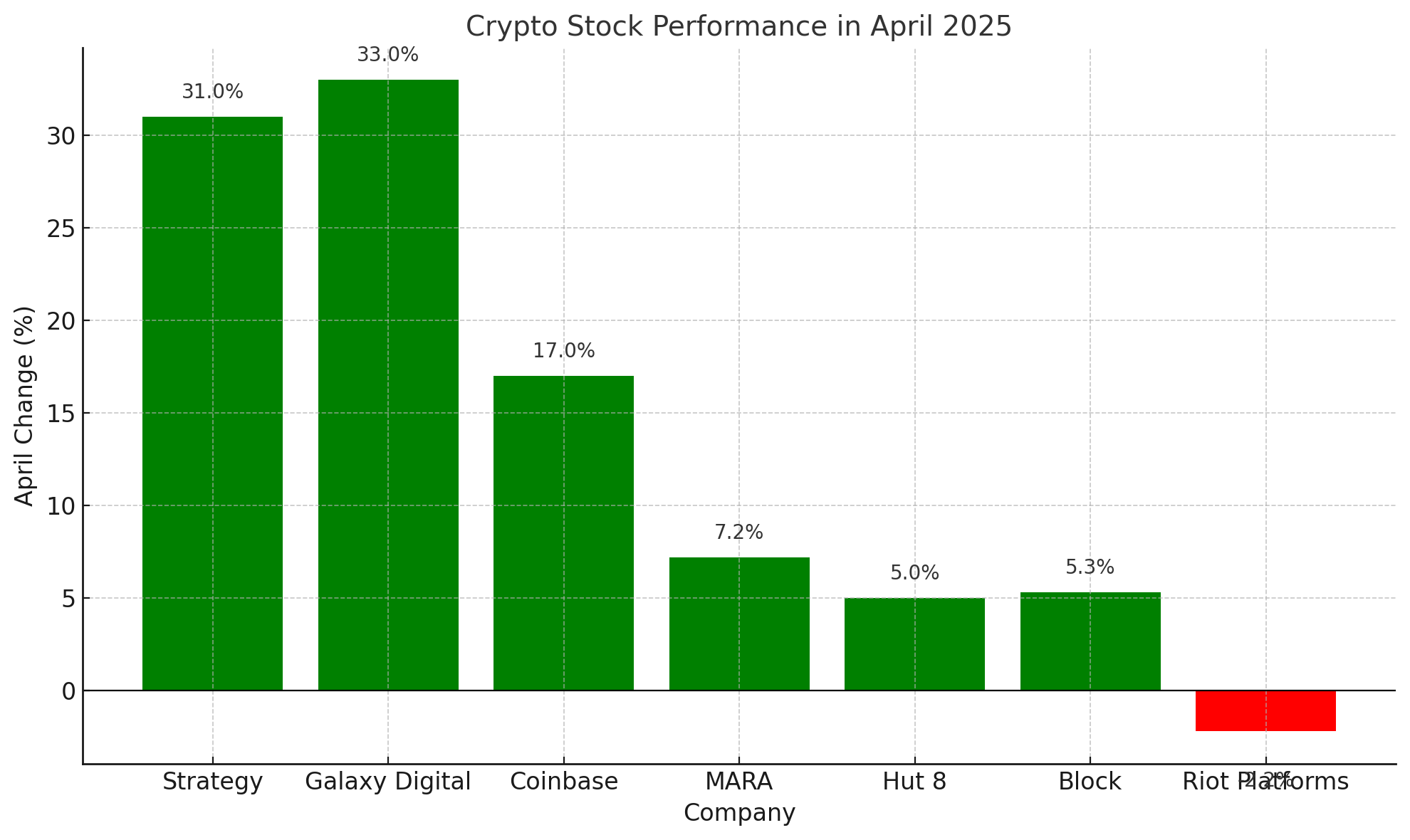
Strategy (MSTR) led the charge with a 31% jump, followed by Coinbase (COIN), which rose 17%, and MARA, which added 16%. All three outpaced the S&P 500, which slipped 0.8% for the month.
Crypto stocks’ performance in April. | Credit: CCN
Galaxy Digital saw one of the biggest moves, soaring 33% as investors cheered its planned Nasdaq listing and deepening partnership with AI cloud provider CoreWeave.
Not every crypto stock shared in the gains. Hut 8 rose 5%, Block was up 5.3%, and Riot Platforms slid 2.2%.
Bitcoin Outpaces Gold and Tech Stocks in April Rebound
Bitcoin outperformed gold and tech stocks in April, helping drive crypto-related equities higher and reigniting debate over the asset’s role as a haven during periods of market stress.
BTC rose about 15% last month, outpacing gold, which gained 6.1%, and the Nasdaq, which dipped 0.2%. The gains came in the wake of President Trump’s April 2 tariff announcement, dubbed “Liberation Day,” which shook financial markets and raised fresh concerns over U.S. fiscal policy.
Bitcoin initially dropped alongside other risk assets, but quickly reversed course as long-term Treasury yields climbed and investors looked for alternatives to U.S. dollar-denominated assets.
Demand flowed into the Swiss franc, the euro, gold—and increasingly, Bitcoin.
Bitcoin price jumped by 15% in April. | Credit: CoinMarketCap
While analysts caution that the asset’s short-term divergence from equities doesn’t prove a full decoupling, they point to Bitcoin’s relatively muted beta during the recent market stress as a sign it’s being viewed more like a long-term store of value.
Bitcoin’s 30-day correlation with equities remains around 0.6.
Investor interest surged in April, with $2.9 billion in inflows into U.S.-listed Bitcoin spot ETFs, reversing outflows of $811 million in March and $3.6 billion in February.
Mixed Year-to-Date Performance
Despite a strong rebound in April, many crypto stocks remain deep in the red for the year, dragged down by a rocky first quarter marked by falling token prices and rising operational costs.
Coinbase shares are down 18% year-to-date, MARA has lost 20%, and Hut 8 has dropped 40%. Riot Platforms also remains underwater, down 29% since the start of 2025.
The lone bright spot has been Strategy, up 31% year-to-date, thanks to a sharp April rally and growing interest in its Bitcoin-tied stock thesis.
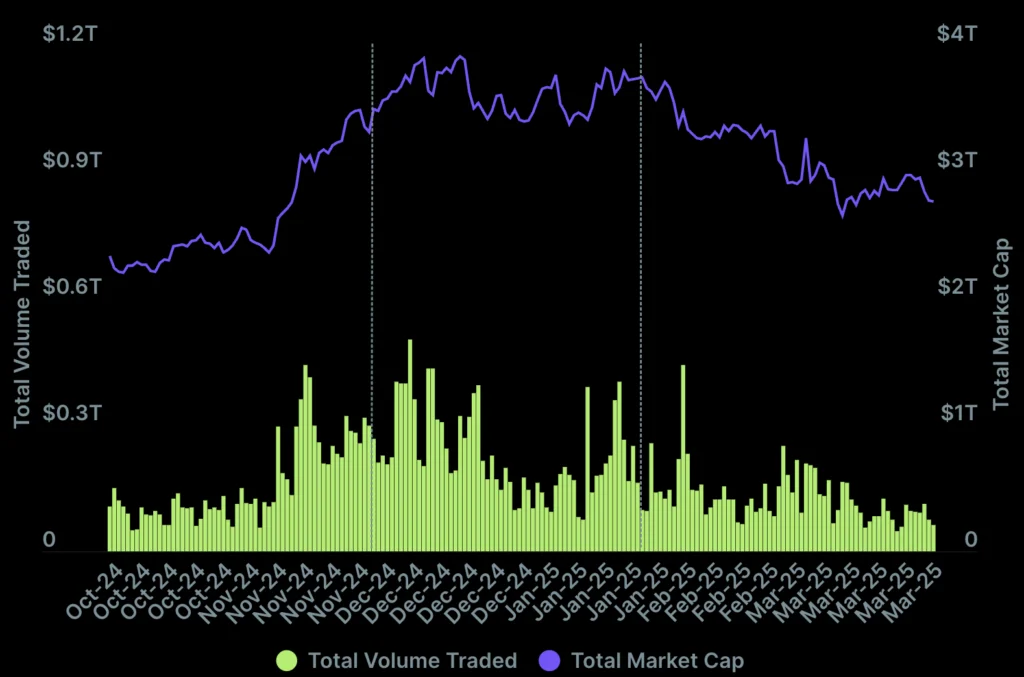
A recent CoinGecko report showed that early optimism in 2025 led to a sharp contraction in trading activity and overall market capitalization.
The total crypto market cap fell by 19% in Q1, from a January high of $3.8 trillion to $2.8 trillion by the end of March, shortly after President Trump’s inauguration.
First-quarter total crypto market cap and trading volume. | Credit: CoinGecko
Giuseppe Ciccomascolo began his career as an investigative journalist in Italy, where he contributed to both local and national newspapers, focusing on various financial sectors.
Upon relocating to London, he worked as an analyst for Fitch's CapitalStructure and later as a Senior Reporter for Alliance News. In 2017, Giuseppe transitioned to covering cryptocurrency-related news, producing documentaries and articles on Bitcoin and other emerging digital currencies. He also played a pivotal role in establishing the academy for a cryptocurrency exchange website. Crypto remained his primary area of interest throughout his tenure as a writer for ThirdFloor.