What Is USDCx on Aleo? How Circle’s Stablecoin Enables Privacy-First Payroll and Vendor Transaction
Share
Key Takeaways
USDCx is a dollar-denominated stablecoin on Aleo backed 1:1 by USDC held through Circle’s xReserve infrastructure.
Zero-knowledge cryptography keeps payment details confidential while preserving verifiability and audit pathways.
Privacy-first settlement supports payroll, vendor payments, aid distribution, and cross-border transfers without public exposure of financial data.
Privacy-preserving stablecoins differ from privacy coins such as Monero and Zcash, which face stricter exchange restrictions in several countries.
USDCx on Aleo is a USDC-backed stablecoin designed for confidential onchain payments using zero-knowledge cryptography.
Public blockchains expose balances, payment flows, and counterparties to anyone who searches a wallet address. That level of transparency limits adoption for payroll, procurement, and treasury operations. USDCx aims to close that gap by combining regulated stablecoin reserves with privacy-preserving settlement.
Understanding how USDCx works requires a look at Aleo’s privacy architecture, Circle’s reserve model, regulatory expectations under modern stablecoin frameworks, and the global treatment of privacy-focused digital assets.
What USDCx on Aleo Means for Digital Dollars
USDCx is a dollar-denominated token issued on the Aleo network and fully backed by USDC reserves held under Circle’s xReserve framework.
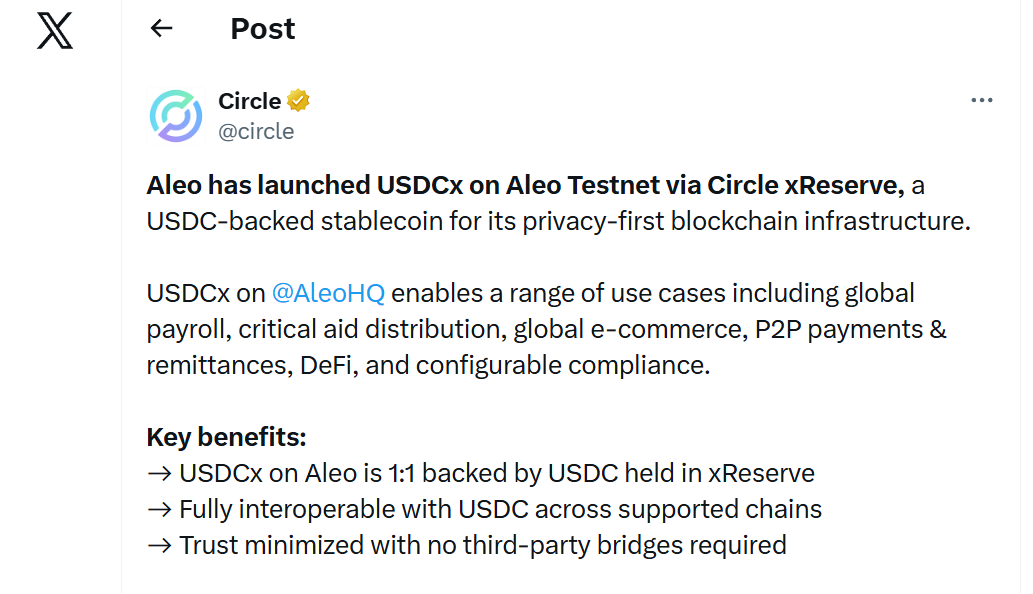
Circle announces the launch of USDCx on Aleo Testnet using its xReserve infrastructure. | Source: @circle on X.
Aleo is a layer-1 blockchain built around zero-knowledge proofs. Zero-knowledge systems allow network validators to confirm that transactions follow protocol rules without revealing amounts, sender addresses, or recipient addresses on the public ledger.
Under that design, business payments can settle on-chain while sensitive financial data remains encrypted.
USDCx currently operates within Aleo’s ecosystem with support for private transfers and application-level privacy. Public roadmaps indicate progression from early network phases toward broader production use, with wallet and developer tooling expanding alongside network maturity.
How Circle xReserve Supports USDCx Backing
Stablecoin credibility depends on reserve quality and redemption reliability. Circle’s xReserve infrastructure handles those functions for USDCx.
USDC deposits enter smart contracts managed under Circle’s reserve framework. When reserves increase, mint attestations allow equivalent USDCx issuance on Aleo. When USDCx burns occur, corresponding reserves unlock on supported networks.
Key characteristics of xReserve include:
One-to-one reserve backing
Programmatic mint and burn attestations
Interoperability with USDC across supported chains
Reduced reliance on third-party bridge operators
That structure links private settlement on Aleo with the broader USDC liquidity network, allowing value movement without fragmenting stablecoin markets across disconnected chains.
Why Privacy Matters for Business Payments
Financial transparency protects consumers in many contexts, yet open ledgers create operational risks for commercial activity.
Public payroll transactions reveal compensation structures and staffing levels. Vendor payments disclose pricing strategies and supplier relationships. Treasury transfers signal liquidity conditions to competitors and counterparties.
Confidential settlement addresses those issues while preserving cryptographic verification. Zero-knowledge proofs confirm payment validity without exposing business intelligence.
That combination supports:
Protection against targeted financial surveillance
Reduced risk of competitive intelligence leakage
Lower probability of social engineering attacks using payment metadata
Privacy-first settlement therefore aligns with common corporate expectations around financial confidentiality rather than replacing regulatory oversight.
Real-World Use Cases Enabled by USDCx
USDCx focuses on transaction types where confidentiality matters more than public auditability.
Aleo confirms USDCx is live on mainnet using Circle’s xReserve to support private payroll and vendor payments. | Source: @AleoHQ on X
Global Payroll
Cross-border salary payments can settle in stable value without broadcasting employee compensation on public ledgers. Encrypted transfers protect workers from targeting and reduce internal data exposure.
Vendor and Contractor Settlement
Procurement contracts often involve negotiated pricing. Confidential settlement prevents competitors from mapping supplier networks or reverse-engineering cost structures.
Aid Distribution
Humanitarian organizations frequently operate in high-risk environments. Confidential transfers reduce exposure of recipients and field teams while preserving accounting integrity.
Peer-to-Peer Remittances
Family transfers and community support benefit from privacy similar to cash while retaining blockchain settlement speed and global reach.
Programmable Business Workflows
Developers can automate invoicing, escrow, and milestone payments while keeping sensitive parameters encrypted within application logic.
How Confidential Settlement Remains Verifiable
Privacy systems introduce concerns around regulatory compliance and auditability.
Aleo’s zero-knowledge architecture supports selective disclosure. Transaction data remains hidden from the public but can be revealed to authorized parties when legal or regulatory review requires documentation.
That model differs from full anonymity systems. Verification occurs through cryptographic proofs that confirm correctness without exposing data by default.
For regulated businesses, that design supports financial privacy alongside obligations related to accounting, taxation, and sanctions screening.
GENIUS Act Alignment and Stablecoin Regulation
The United States enacted the GENIUS Act in 2025 to establish federal standards for payment stablecoins.
Core provisions include:
Full reserve backing with high-quality liquid assets
Transparent reserve attestations
Oversight of issuers and custodians
Consumer redemption protections
USDCx inherits reserve backing through USDC held within Circle’s xReserve framework. Reserve assets and attestation processes follow standards developed for USDC itself.
USDCx does not function as an independently issued retail stablecoin under separate licensing. Instead, value representation depends on USDC reserves managed through Circle’s regulated infrastructure.
That structure aligns with GENIUS Act objectives related to backing and redemption, though privacy-preserving settlement layers remain an evolving area of regulatory interpretation across jurisdictions.
How USDCx Differs From Privacy Coins
Privacy-focused stablecoins and privacy coins solve different problems.
Monero and Zcash prioritize transaction anonymity at the protocol level. Default privacy prevents third-party observation of amounts and participants. That design limits traceability, which raises concerns among regulators and compliance departments.
Several jurisdictions restrict exchange support for privacy coins. Delistings occurred across parts of Europe, East Asia, and Australia following anti-money-laundering guidance that emphasizes traceability of financial flows.
USDCx follows a different approach. Confidentiality protects business data from public exposure while allowing controlled access for lawful review. Compliance frameworks can integrate with selective disclosure rather than relying solely on blockchain analytics.
That distinction allows privacy-preserving stablecoins to operate within regulated financial systems rather than existing outside formal compliance structures.
Countries That Restrict Privacy Coins
Regulatory treatment varies, but multiple countries limit trading access for fully private cryptocurrencies.
Notable examples include:
As of January 12, 2026, Dubai (via DFSA and VARA) has officially banned privacy coins and anonymity-enhanced tools, such as XMR and ZEC, on regulated exchanges within its jurisdiction.
Japan, where exchanges removed privacy coins following Financial Services Agency guidance.
South Korea, which implemented exchange restrictions tied to transaction monitoring requirements.
Several European Union member states, where exchange platforms limit listings due to anti-money-laundering standards.
Australia, where major exchanges removed privacy coin support to meet regulatory obligations.
Restrictions typically target exchange activity rather than private wallet usage, yet liquidity access becomes constrained under such policies.
Privacy-preserving stablecoins that support auditability may avoid similar treatment, though regulatory interpretations continue to evolve.
How To Get USDCx on Aleo
USDCx acquisition follows reserve mint procedures rather than open market issuance.
After broader network deployment, acquisition generally involves:
Holding standard USDC on a supported network such as Ethereum.
Depositing USDC into Circle’s xReserve infrastructure.
Receiving USDCx on Aleo through supported wallets integrated with Aleo and xReserve.
Wallet providers supporting Aleo privacy transactions handle local key management and encrypted balances. Ecosystem tooling continues to expand as network adoption grows.
Because USDCx issuance depends on reserve deposits, market liquidity develops alongside integration by payment platforms and application developers rather than through exchange order books alone.
Risks and Trade-Offs for Privacy-First Stablecoins
Compliance complexity, since audit pathways require careful governance.
Key security requirements, because private balances increase reliance on secure management of private keys.
Liquidity development timelines, as early ecosystems depend on application adoption rather than exchange trading.
Regulatory uncertainty, since privacy technology continues to receive policy scrutiny.
None of those factors eliminate the use case for confidential payments, though each affects adoption speed and integration across financial institutions.
Why Privacy-First Stablecoins Matter for Digital Finance
Public blockchains enabled global settlement, yet transparency limited enterprise participation. Confidential stablecoins address that structural barrier by enabling private transactions without abandoning verifiability or reserve backing.
For payroll systems, vendor settlement, humanitarian finance, and institutional treasury management, privacy becomes a requirement rather than a feature.
USDCx on Aleo represents one approach to merging regulated stablecoin reserves with cryptographic confidentiality. Broader adoption depends on wallet support, application development, and regulatory clarity around privacy-preserving payment rails.
Digital finance continues to move beyond speculative trading toward operational utility. Confidential settlement plays a central role in that transition.
Circle Payments Network Adds Euro and Rupee Payouts Through Saber
In addition to privacy-first stablecoins, Circle’s Circle Payments Network (CPN) has continued expanding its real-world utility by enabling local euro and Indian rupee payouts in partnership with Saber.
Now open on Circle Payments Network (CPN): EU and India payouts with @Sabermoney
Saber expands CPN coverage across key corridors, connecting stablecoins to local payment rails in Europe and India.
This integration means that businesses and institutions connected to CPN can now execute EU payouts via SEPA for euro-denominated local settlement and India payouts through domestic rails such as IMPS, RTGS, and NEFT for near-instant INR transfers, all without needing multiple bilateral integrations with each local partner.
The move underscores CPN’s goal of turning stablecoins into programmable settlement rails that reduce dependency on fragmented legacy networks while supporting compliance, transparency, and near-real-time settlement globally.
USDCx is a USDC-backed stablecoin issued on the Aleo network that uses zero-knowledge cryptography to keep payment details confidential while preserving verifiable settlement.
How does USDCx remain compliant while offering privacy?
Zero-knowledge proofs hide transaction data from the public while allowing selective disclosure for authorized audit and regulatory review, supporting confidentiality without removing accountability.
Is USDCx regulated under the GENIUS Act?
Reserve backing follows USDC compliance standards through Circle’s xReserve infrastructure, aligning with GENIUS Act principles for payment stablecoins, while privacy features operate at the settlement layer.
Why do privacy coins face exchange restrictions in some countries?
Full anonymity limits transaction monitoring required under anti-money-laundering rules, leading several jurisdictions to restrict exchange listings for privacy coins such as Monero and Zcash.
Disclaimer:
The information provided in this article is for informational purposes only. It is not intended to be, nor should it be construed as, financial advice. We do not make any warranties regarding the completeness, reliability, or accuracy of this information. All investments involve risk, and past performance does not guarantee future results. We recommend consulting a financial advisor before making any investment decisions.
She is a fintech writer based in Canada with an academic background in psychology and project management. She has previously contributed to crypto media platforms, including Cointelegraph. Her professional experience includes work as a relationship manager in the telecommunications industry, and her writing since 2020 has focused on digital assets, blockchain technology, and artificial intelligence, with attention to their interaction with traditional finance.


 Easy
Easy