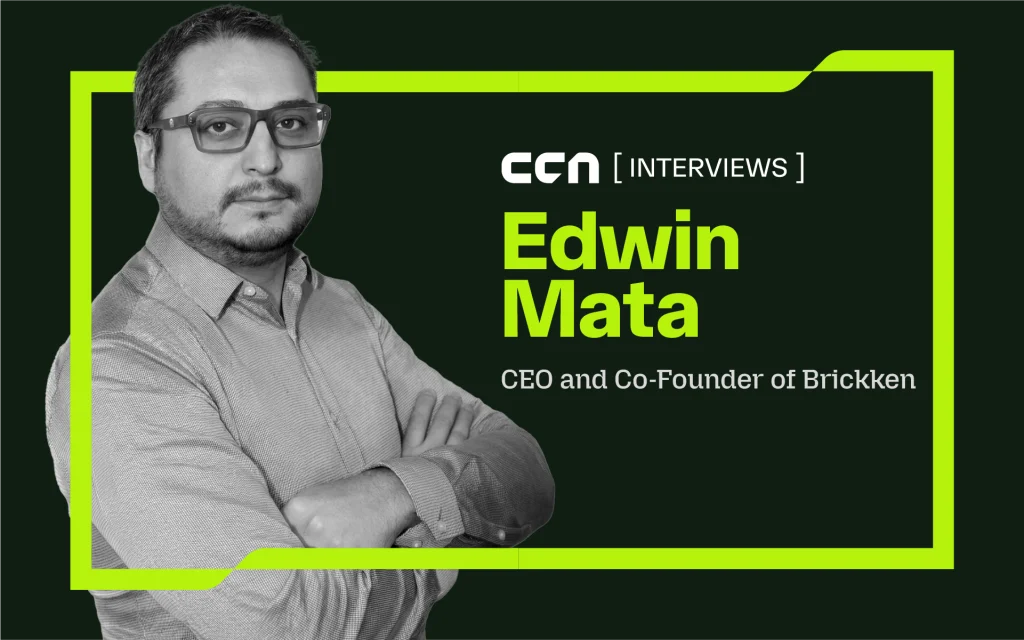
“Mata has a clear aim in mind: helping to tokenize the world.” | Image credit: CCN
Share
Key Takeaways
Real-world asset tokenization is gaining momentum as crypto markets shift back toward financial use cases, with institutions focusing on efficiency, transparency, and compliance.
Stablecoin adoption will determine how large the RWA market becomes, as wider usage drives familiarity with digital assets and supports global integration.
Regulation creates a competitive advantage when companies comply, as it reduces risk and builds trust among institutional clients.
Brickken plans to expand beyond software into liquidity, custody, and brokerage layers, aiming to support full-scale tokenization across global markets.
Real-world asset (RWA) tokenization is gaining traction as crypto markets shift away from speculative trends and return to financial use cases.
Institutional interest continues to grow, driven by demand for compliant infrastructure, transparent systems, and more efficient ways to move value across borders.
Speaking to CCN journalist Max Moeller at Consensus 2026, Brickken CEO and Co-Founder Edwin Mata said the next phase of blockchain adoption will depend on stablecoin usage, regulatory clarity, and infrastructure connecting traditional finance with on-chain systems.
Markets have already started to reflect this shift. While earlier cycles focused on non-fungible tokens (NFTs), memecoins, and experimental use cases, attention is now moving toward tokenized debt, equity, commodities, and funds.
This transition highlights a broader change in how blockchain technology integrates with existing financial systems rather than attempting to replace them.
From M&A Law to Blockchain: Solving Real-World Inefficiencies
Mata entered crypto after working in mergers and acquisitions, where cross-border deals often created friction.
“It’s very horrible to move across jurisdictions to measure value on the company’s assets,” he said.
Traditional systems rely on fragmented processes that slow transactions and create inconsistencies in valuation and settlement. Blockchain introduced a transparent structure that could improve how value moves across borders.
“Through a public ledger, fully transparent, real-world, you can really update and optimize a lot of the pains that we have,” Mata said.
He added that blockchain did not offer a complete solution at the start, but it pointed toward a more efficient financial system.
Why Real-World Assets Matter More Than Hype Cycles
Mata stayed focused on financial use cases while much of the market followed trends.
Mata said the industry shifted toward experimental trends rather than focusing on blockchain’s original financial purpose.
Bitcoin started as a peer-to-peer financial system, and that foundation continues to guide long-term development.
“It was always meant to be a transaction between parties… a financial instrument, a financial system,” Mata said.
Tokenization brings blockchain back to that purpose by focusing on assets that already hold value in traditional markets.
Regulation as a Competitive Advantage
Mata views regulation as a factor that strengthens trust when applied correctly.
“If you manage to comply with it and play by the rules, then you don’t take a risk,” he said.
Clear compliance reduces uncertainty for clients, especially institutions that require predictable legal frameworks.
“Clients don’t like risk… they don’t want to worry that there can be a risk factor,” Mata added.
Companies that meet regulatory standards can position themselves as more reliable, which creates a direct commercial advantage.
Open Standards, Proprietary Infrastructure
Brickken co-developed EIP-7943, an open tokenization standard aligned with current frameworks.
“We open source the standard, not the full stack,” Mata said.
The company shares its technical foundation while keeping its platform proprietary. This approach supports ecosystem growth while maintaining product differentiation.
Estimates for the Real World Assets (RWA) market rangefrom $4 trillion to $30 trillion by 2030. Mata identified stablecoins as the key factor in determining how far the market expands.
“Stablecoin adoption,” he said.
Stablecoins serve as the primary medium of exchange in blockchain systems and as an entry point for new users.
“This is the money of Web3… the more people start getting accustomed to stablecoins, the more they’re going to get accustomed to digital assets,” Mata explained.
Wider adoption would support faster integration of tokenized assets across global markets.
Multi-Chain Strategy and Client Trust
Brickken operates across multiple blockchain networks, allowing clients to choose their preferred infrastructure.
“We give them guidance and then they decide,” Mata said.
As a software-as-a-service provider, the company focuses on flexibility rather than prescribing specific solutions.
“In the end, they’re chains… a client wouldn’t notice using one from the other,” he added.
What’s Next: From Software to Liquidity Provider
Brickken plans to expand its global presence, with increasing focus on the United States as regulatory clarity improves.
“In three to five years, we’re probably going to be working more in the United States,” Mata said.
The company aims to move beyond software and build a broader infrastructure stack.
“Our full stack is going to go from a software to a liquidity provider,” he said.
This shift includes expanding into custody, brokerage, and liquidity services.
“More liquidity, more presence worldwide… and basically helping tokenize the world,” Mata said.
Education Remains Central to Adoption
Mata emphasized that education will shape adoption as more users and institutions enter the space.
Brickken continues to invest in educational content focused on tokenization.
“Follow us. We’re very much active in the education field around tokenization,” he said.
Mata said that clear information and accessible tools will support long-term growth across the ecosystem, with a clear aim: to tokenize the world.
Disclaimer:
The information provided in this article is for informational purposes only. It is not intended to be, nor should it be construed as, financial advice. We do not make any warranties regarding the completeness, reliability, or accuracy of this information. All investments involve risk, and past performance does not guarantee future results. We recommend consulting a financial advisor before making any investment decisions.
Dr. Lorena Nessi is an award-winning journalist and media technology expert with 15 years of experience in digital culture and communication. Based in Oxfordshire, UK, she combines academic insight with hands-on media practice.
She holds a PhD in Communication, Sociology, and Digital Cultures, and an MA in Globalization, Identity, and Technology.
Lorena has taught at Fairleigh Dickinson University, Nottingham Trent University, and the University of Oxford. She is a former producer for the BBC in London, with additional experience creating television content in Mexico and Japan.
Her research focuses on digital cultures, social media, technology, capitalism, and the societal impact of blockchain innovation.
She has written extensively on digital media and emerging technologies, with her work featured in both academic and media platforms. Her Web3 expertise explores how blockchain technologies shape culture, economics, and decentralized systems.
Outside of work, Lorena enjoys reading science fiction, playing strategic board games, traveling, and chasing adventures that get her heart racing. A perfect day ends with a relaxing spa and a good family meal.
Max Moeller is a Chicago‑based writer and video editor passionate about games, tech, and crypto. Whether it’s crafting clear, insightful articles or piecing together engaging video retrospectives, he’s driven by curiosity and takes pride in keeping things human. Since 2017, Max has been published in a variety of notable crypto magazines.


 Easy
Easy