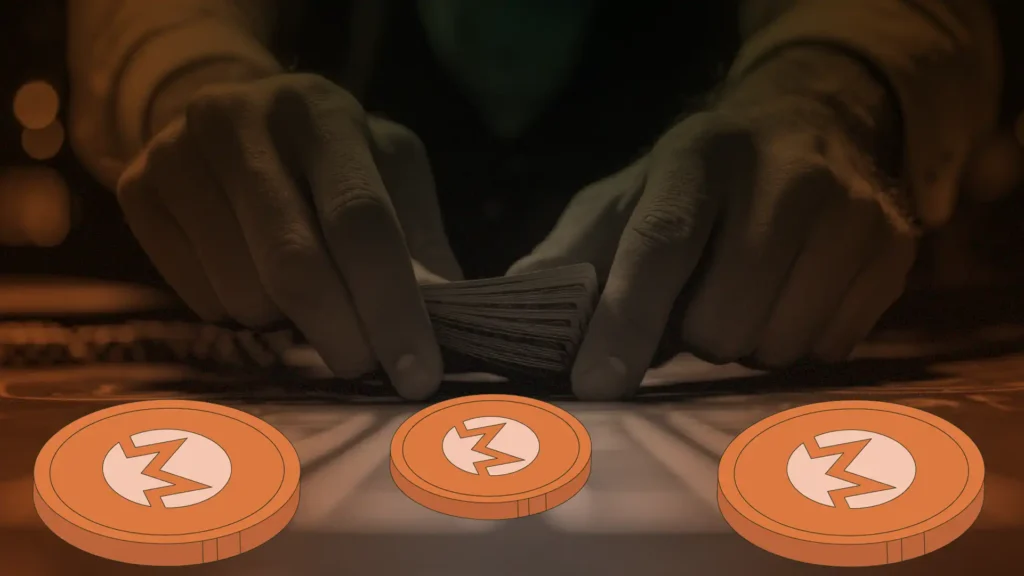
Explore Monero’s record 18-block blockchain reorganization (Sep 2025) in a suspected 51% attack. | Credit: CCN.com
Share
Key Takeaways
Qubic’s claim of majority control forced Kraken to pause Monero deposits.
No proven 51% attack occurred, but Monero’s vulnerabilities became clear.
Pool centralization and fragile hashrate remain the weakest points in proof-of-work systems.
Dogecoin is now in focus, showing the risks extend beyond Monero.
Monero faced one of its major crises in August 2025 when Qubic, an AI-driven blockchain, claimed to have launched a 51% attack and seized control of over half of its network’s computing power.
The shutdown of public APIs prevented independent verification of Qubic’s claimed hashrate dominance, casting doubt on the assertion.
Qubic has reached over 51% of Monero's hashrate, effectively giving it control of the network.
Qubic chose not to launch the takeover yet, proving a powerful theory by action.
But this story isn’t over yet. What's next for Qubic and the future of PoW chains?
However, the community was shocked and shaken. Kraken responded by halting Monero (XMR) deposits.
‼️ Kraken suspends Monero deposits
Kraken has temporarily suspended (https://t.co/6Ne1CJ9MQf) Monero deposits after the Qubic pool gained control of more than 50% of the network’s hashrate.
👉 The exchange said the move is a precautionary step to protect user funds, while… pic.twitter.com/zNzcHQPukc
This article explains Qubic’s economic-driven takeover, why Kraken acted swiftly, the market and community fallout, and what lies ahead for Monero and other cryptocurrencies.
Monero’s Design and the 51% Threat
Monero stands out for its privacy. It hides user data by using ring signatures, stealth addresses, and confidential transactions. With a $4.92 billion market cap, it ranks as the 27th largest cryptocurrency.
New Trending Crypto Wallet Offers
Sponsored
Disclosure
We sometimes use affiliate links in our content, when clicking on those we might receive a commission at no extra cost to you. By using this website you agree to our terms and conditions and privacy policy.
Its RandomX algorithm, launched in 2019, encourages mining with standard CPUs and GPUs to spread power across many users and resist specialized hardware like ASICs.
Most Monero miners join pools to combine computing power and share rewards, which makes the network efficient but also creates centralization risks if one pool grows too large.
This risk became reality in August 2025, when Qubic amassed what has been claimed as more than half the network’s hash rate, carrying out a 51% attack.
Some Monero supporters openly questioned Qubic’s claim of a genuine 51% attack, suggesting Qubic’s hash rate didn’t truly reach majority control.
7 day history of all other pools indicates an average of ~4.2GH/s.
In order to 51% they would need to add ~4.5GH/s to the network.
So far we've only seen ~2.6GH/s. (assuming that's even correct).
Meanwhile, Binance framed the situation as a serious security threat, accounting for 52% of the global Monero hash rate.
A 51% attack occurs when one group controls over half a blockchain’s hash rate, allowing them to rewrite transaction records, cancel payments, or double-spend coins.
Regardless of the specific size, a 51% attack undermines trust in the network.
Other blockchains, such as Ethereum Classic in 2020 and Bitcoin Gold in 2018, faced similar incidents.
Bitcoin Gold (BTG): 51% attack in January 2020
BTG counterattack: January–February 2020
Vertcoin (VTC): 51% attack in December 2019
Expanse (EXP): 51% attack in July 2019
Litecoin Cash (LCC): 51% attack in July 2019
Monero’s design aimed to prevent this, but Qubic’s takeover exposed clear vulnerabilities.
Monero’s Vulnerabilities Exposed
Qubic’s move revealed weak points in Monero’s design that had long been theoretical but never fully tested.
Mining pool centralization: Pool dominance showed how efficiency can quickly turn into control.
Hashrate fragility: RandomX spreads power among users, but coordinated actors still concentrate it.
Attack feasibility: A high threshold proved reachable despite Monero’s defenses.
Trust erosion: Privacy features remain intact, but confidence in network security was shaken.
These flaws raised urgent questions, forcing exchanges like Kraken to act decisively. They also echoed earlier concerns from researchers who found weaknesses in Monero’s privacy mechanisms.
According to an “Empirical Analysis of Traceability in the Monero Blockchain,” mixins, which act as decoy coins added to transactions to hide the real one, have weaknesses in choosing them.
The study found that about 62% of transactions can be exposed through “chain-reaction” analysis, where the genuine input is revealed by elimination.
A second flaw comes from the age of coins: the newest input is usually the real one, and this method identifies it with 80% accuracy. Even after removing mining pool activity, many privacy-sensitive transactions remained exposed, including those tied to AlphaBay, the defunct darknet market.
The researchers suggested new sampling methods to strengthen Monero’s privacy in future transactions.
Kraken’s Response to the Monero Attack
Kraken acted quickly once Qubic’s dominance over Monero’s hash rate became clear. The exchange laid out its steps in stages to protect users and maintain market stability.
Discussion about Monero and Kraken | Source: Reddit.
August 15, 2025: Kraken paused Monero (XMR) deposits after detecting that a single mining pool controlled more than 50% of the network’s hash rate, creating risks of double-spending.
Trading and withdrawals: Both remained fully operational throughout the precautionary pause.
August 18, 2025 (04:30 UTC): Deposits were re-enabled but required 720 confirmations before crediting, far higher than usual.
Ongoing caution: Kraken warned it could halt deposits again at any time, depending on the stability of Monero’s network.
Did Qubic Actually Perform a 51% Attack on Monero?
It was not a confirmed 51% attack, but it was a credible demonstration of how close Monero came to one.
Qubic declared on August 12 that it controlled more than half of Monero’s hash rate. Its uPoW design, which rewarded miners with stacked revenue streams, pushed hashpower from Monero into its system until Qubic claimed to pass the 51% line.
The shutdown of public APIs blocked verification, while experts at SlowMist and Ledger argued that no real 51% attack could be proven without a double-spend or chain reorganization. Orphaned blocks, valid blocks dropped from the main chain when competing ones win, suggested stress on the network but not evidence of malicious control.
Qubic insisted it was not attacking Monero but running an “acquisition experiment.” Community figures like tuxpizza dismissed the claim as marketing rather than proof.
In the end, Qubic reached important control but stopped short of using it. The incident was not a confirmed 51% attack, but it was a credible warning that Monero’s defenses could not prevent one.
From Monero to the Next Target: Dogecoin
Even after Qubic was accused of not performing a “real” 51% attack on Monero, the fallout didn’t stop. The controversy sparked fresh attempts to frame the incident as either a wake-up call or a scare tactic for marketing.
The battle continues through community debates, campaigns, and warnings aimed at other projects.
On August 17, 2025, Qubic announced Dogecoin as its next target, highlighting another PoW chain with massive cultural weight. As a consequence, the price of DOGE may fall.
Qubic’s shift from Monero to Dogecoin shows that no PoW chain is off the radar. Additionally, it shows that mining pools and hash rate concentration remain the weakest points across networks.
Dr. Mark Tehrani on Monero’s 51% Attack, AI Threats, and the Race to Post-Quantum Security
Given the rising frequency of attacks on PoW blockchains, CCN reached out to Dr. Mark (Madjid) Tehrani, founder of CyberSeQ, professor of cybersecurity, and an expert in quantum machine learning, cryptography, and blockchain security, to provide his analysis of the Monero–Qubic incident and the broader risks facing PoW systems.
Cybersecurity Risks in Proof-of-Work Systems
According to Dr.Tehrani, “a 51% takeover undermines the probabilistic trust guarantees of proof-of-work, enabling adversarial control over block reorganizations, double spends, and transaction censorship.”
He added that such events quickly erode user confidence, push exchanges to adopt stricter confirmation thresholds, and ultimately depress market value.
“This was evident when Monero lost approximately 20% during the Qubic pool event,” Dr. Tehrani noted.
Quantum Computing and the Urgency of Post-Quantum Migration
Dr. Tehrani warned that migration to post-quantum cryptography is becoming increasingly urgent. He explained that “Monero currently relies on RSA-2048 (171 instances), ECDSA P-256 (5 instances), AES (512 instances), SHA-256 (108 instances), and Ed25519 (5 instances) — all of which are slated for deprecation under NIST’s post-quantum roadmap (FIPS 203/204/205). By 2035, these algorithms will be disallowed.”
He emphasized that organizations like ETSI and ENISA, along with national cyber authorities such as the UK’s NCSC, Germany’s BSI, and France’s ANSSI, are already pushing for proactive migration.
“Careful cryptographic asset discovery and wallet migration are essential to avoid sudden breaks in cryptography,” Dr. Tehrani stressed.
AI’s Double-Edged Role in Blockchain Security
Artificial intelligence is another area where Dr. Tehrani sees both opportunity and danger. “Emerging technologies introduce both risks and opportunities. Reinforcement-learned strategies could optimize selfish mining or eclipse attacks, lowering the threshold for profitability,” he explained.
At the same time, AI can also strengthen blockchain resilience. “AI can enhance anomaly detection based on stale block rates, reorganization depth, and propagation delays,” Dr. Tehrani said.
He also pointed to new concepts such as Proof-of-Useful-Work (PoUW): “PoUW schemes demonstrate that mining efforts can be redirected to neural network training with acceptable accuracy (80% and above), where verifiers validate mini-batch updates against hidden test sets. This approach ties block validity to productive computation, reducing wasteful hashing and increasing resistance to brute-force nonce grinding.”
Safeguards for Monero and Other PoW Cryptocurrencies
Looking forward, Dr. Tehrani highlighted a series of safeguards he believes PoW-based cryptocurrencies must prioritize:
Decentralization of mining pools.
Dynamic confirmation policies based on real-time hashrate concentration.
Transparent dashboards tracking the Nakamoto coefficient and reorganization metrics.
Investment in anomaly detection systems.
A structured roadmap for PQC migration of wallets and transaction primitives.
Joint security operation centers to monitor and respond to state-sponsored attacks on financial infrastructure, particularly as cryptocurrency adoption scales.
Conclusion
Monero’s clash with Qubic in August 2025 was not a confirmed 51% attack, but it showed how concentrated mining power can be an issue.
Even without a double-spend, the risk alone forced Kraken to halt deposits and raised doubts about Monero’s security model.
The event also exposed how economic incentives can pull hashpower away from one network into another. Qubic’s design rewarded miners with multiple revenue streams, making Monero’s defenses less effective. That shift turned a long-standing theoretical risk into a visible problem.
By announcing Dogecoin as its next target, Qubic widened the debate. The episode underlined that some networks face vulnerabilities.
uPoW allows miners to earn from multiple tasks simultaneously, including AI training and crypto mining.
Why did Kraken pause Monero deposits?
Kraken acted after one pool passed 50% control, creating double-spending risks.
How long did Kraken keep Monero deposits paused?
Deposits were paused for three days in mid-August 2025 before being re-enabled with stricter rules.
Why is Dogecoin considered vulnerable to similar threats?
Dogecoin has concentrated mining power through merged mining with Litecoin, making it easier for large players to dominate.
Disclaimer:
The information provided in this article is for informational purposes only. It is not intended to be, nor should it be construed as, financial advice. We do not make any warranties regarding the completeness, reliability, or accuracy of this information. All investments involve risk, and past performance does not guarantee future results. We recommend consulting a financial advisor before making any investment decisions.
Dr. Lorena Nessi is an award-winning journalist and media technology expert with 15 years of experience in digital culture and communication. Based in Oxfordshire, UK, she combines academic insight with hands-on media practice.
She holds a PhD in Communication, Sociology, and Digital Cultures, and an MA in Globalization, Identity, and Technology.
Lorena has taught at Fairleigh Dickinson University, Nottingham Trent University, and the University of Oxford. She is a former producer for the BBC in London, with additional experience creating television content in Mexico and Japan.
Her research focuses on digital cultures, social media, technology, capitalism, and the societal impact of blockchain innovation.
She has written extensively on digital media and emerging technologies, with her work featured in both academic and media platforms. Her Web3 expertise explores how blockchain technologies shape culture, economics, and decentralized systems.
Outside of work, Lorena enjoys reading science fiction, playing strategic board games, traveling, and chasing adventures that get her heart racing. A perfect day ends with a relaxing spa and a good family meal.


 Easy
Easy