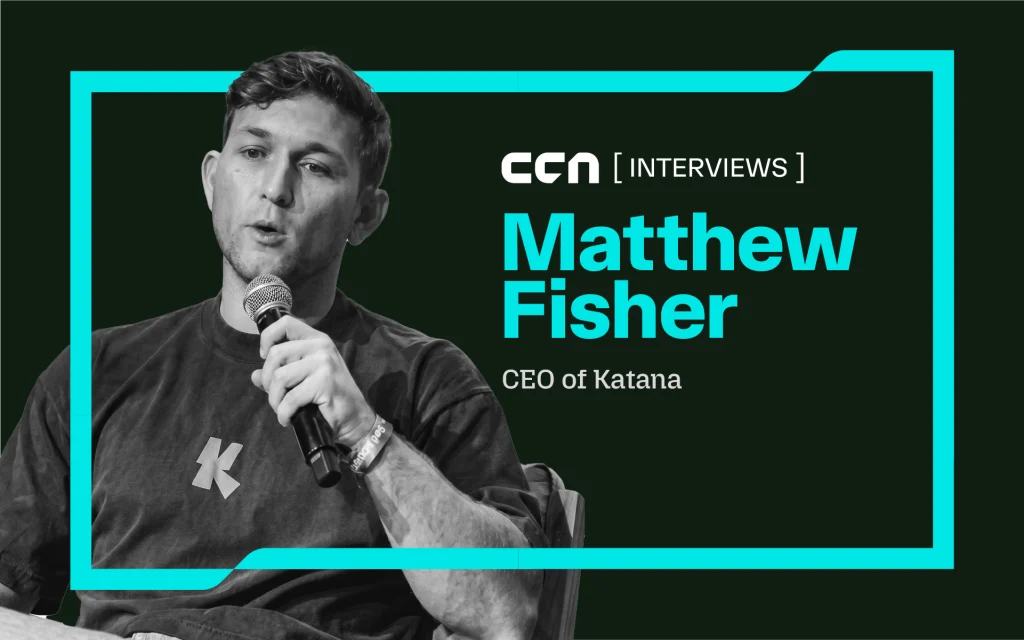
“The question is like why should I come take my funds on chain just to earn a lower yield for more risk” | Image credit: CCN
Share
Key Takeaways
DeFi yields have dropped as leverage demand weakened, token incentives faded, and users became more cautious after multiple protocol exploits.
Matt Fisher said early DeFi growth depended heavily on token emissions, while the next phase of the industry will require sustainable revenue generated through real economic activity.
Institutional investors increasingly prefer battle-tested protocols such as Aave and Morpho, pushing the market toward lower-risk and more transparent products.
Katana aims to build sustainable on-chain yield by redirecting revenue from lending activity rather than relying mainly on governance token incentives.
Decentralized finance (DeFi) built much of its early momentum on double-digit yields that attracted users seeking returns far above those in traditional markets.
Many of those yields have fallen below US Treasury benchmarks, forcing users and institutions to reassess how DeFi generates value and whether the risks remain justified.
In an interview with CCN, Katana CEO Matt Fisher said the decline reflects a broader shift across the industry.
Lower leverage demand, market uncertainty, protocol exploits, and changing investor behavior have pushed the sector away from aggressive token incentives and toward models based on sustainable revenue.
“I think when people look at the yields today, they don’t know if the risk-reward is worth it for them,” Fisher said.
That shift comes as DeFi matures and institutional participants demand safer and more transparent products.
At the same time, the industry still struggles to price risk consistently, especially across newer protocols.
Fisher said the next phase of DeFi will depend less on inflated token emissions and more on infrastructure capable of generating what the industry calls “real yield” through actual economic activity.
Teaser: Matt Fisher on CCN | Source: X @CCNCitizens
Lower Yields Reflect a Different Market Environment
DeFi yields surged during previous bull markets as borrowing demand and leverage expanded rapidly across crypto.
As market conditions changed, those returns became harder to maintain.
“When the market starts to shift, and the sentiment shifts and the demand for leverage reduces, that definitely puts the downward spiral on yields,” Fisher said.
Geopolitical uncertainty and protocol exploits added further pressure on the market.
Fisher pointed to recent incidents involving Resolv and Drift as examples of events that forced investors to reevaluate risk exposure.
“What that kind of does is it forces investment funds and capital allocators to reevaluate the risk-reward of the different opportunities,” he said.
These events also reduced confidence in certain lending structures and weakened liquidityflows into DeFi markets.
Token Emissions Helped Bootstrap Growth
Much of DeFi’s early yield came from token incentives rather than sustainable cash flow.
Protocols distributed governance tokens to attract liquidity and build trust during their early stages.
“Token emissions have been the force function to get people to come check it out,” Fisher said.
The strategy worked during periods of optimism, especially when token prices kept rising. Over time, however, many users started questioning whether advertised yields reflected real value.
“People have kind of sobered up to what has been the advertised yields,” he said.
At the same time, repeated exploits pushed users toward safer products with lower returns.
“People are more comfortable taking lower yields, but also reducing the risk while they’re doing that,” Fisher added.
DeFi Still Struggles to Price Risk
In traditional finance, higher returns usually signal higher risk. In DeFi, that relationship often remains unclear.
Fisher said parts of the market still underestimate risk until major failures expose weaknesses.
“Risk can be thrown out the window and then the market reminds you that things need to be carefully underwritten,” he said.
Institutional demand has increasingly shifted toward battle-tested protocols such as Aave and Morpho, where users feel more confident about security and infrastructure reliability.
“For newer protocols, that is a more complicated underwrite for capital allocators,” Fisher said.
That distinction has become more important as overall yields decline. Investors now compare DeFi returns directly against traditional alternatives such as Treasury bills.
Real Yield Comes From Economic Activity
Fisher separated DeFi yield into two categories: native yield and token incentives.
Native yield is generated by on-chain activity, such as borrowers paying lenders.
“That can look like borrowers paying lenders, which is probably the simplest form of that,” he said.
The higher yields commonly advertised during earlier cycles often depended on token emissions rather than on the token itself.
“That’s where you kind of get to that 20 % that is advertised in DeFi,” Fisher explained.
As token incentives fade, protocols now need stronger sources of organic demand.
“One thing that DeFi needs to solve for right now is bringing a lot of borrowers on-chain and showing that the rates on-chain are better than off-chain,” he said.
Watch the full interview here:
Institutions Want Safer On-Chain Products
Traditional finance has started moving closer to DeFi infrastructure, especially through stablecoins and lending products.
Fisher described this shift as inevitable.
“I think it was probably inevitable at some point for crypto to kind of win, per se,” he said.
He noted that stablecoins have become an entry point for institutions testing blockchain infrastructure before moving deeper into DeFi.
At the same time, on-chain yields now often sit below Treasury yields, creating a difficult question for investors.
“The question is like why should I come take my funds on chain just to earn a lower yield for more risk,” Fisher said.
Despite that gap, he argued that blockchain infrastructure still offers structural advantages, including constant market access and faster capital movement.
“You can’t just kind of have your assets sitting in Treasury bills on Saturday night… and go capitalize on opportunities,” he added.
Risk Evaluation Remains Fragmented
DeFi still lacks a universal risk evaluation system.
Instead, users rely on a combination of transparency tools, risk curators, and on-chain monitoring systems.
According to Fisher, protocols such as Morpho allow risk managers to decide which collateral enters lending vaults, while users can monitor allocations directly on-chain.
“The end user can basically select which risk manager or vault curator they’re comfortable with,” he explained.
Crypto’s public infrastructure also quickly exposes problems.
“Crypto Twitter will be the first people to tell you when something goes wrong,” Fisher said.
Trust Still Depends on Time
For new users, determining whether a project is sustainable remains difficult.
Fisher said longevity still matters.
“Time definitely drives a lot of trust,” he said.
He pointed to established protocols such as Uniswap, Aave, and Polygon as examples of infrastructure that gained credibility through multiple market cycles.
“If people have been here for five years, I think you can trust that they’re genuinely trying to build the future of finance,” he said.
Newer projects, meanwhile, face greater skepticism because the industry still deals with scams and short-lived protocols.
Katana Focuses on Sustainable Yield
Katana positions itself around what Fisher described as structurally sustainable yield.
One of the platform’s core features involves generating yield from bridged USDC deployed through Morpho on the Ethereum mainnet.
“That yield actually goes to Katana, the foundation,” Fisher said.
The protocol then redirects a portion of that revenue back to DeFi users who actively participate on the network.
“We basically treat the users who actually use the protocols,” he said.
According to Fisher, Katana generated around $600,000 in revenue last month and several million dollars since launch.
“That has nothing to do with token emissions,” he added.
Katana Wants to Build an All-in-One DeFi Layer
Fisher described Katana as a vertically integrated ecosystem that combines lending, borrowing, spot trading, and perpetual trading into a single environment.
Users can move assets across different functions without leaving the platform.
“The idea is you can come, lend your assets, borrow assets, and then go trade,” he said.
Katana also plans to expand through infrastructure integrations that allow fintech platforms to connect to its backend yield systems.
“People can integrate Katana in the backend and still have their own distribution, their own user experience, and their own users,” Fisher said.
DeFi Moves Toward a More Selective Era
The interview reflected a broader shift across DeFi.
The industry no longer competes mainly on inflated annual percentage yields (APYs). Users increasingly focus on sustainability, transparency, liquidity, and security.
Protocols that survive the next phase may depend less on aggressive incentives and more on proving they can generate stable revenue over time.
Fisher said that the transition had already started.
“It’s just like a risk spectrum where people want to take higher risk for higher rewards and lower risk for lower yields,” he said.
As institutional participation grows and users become more selective, DeFi appears to be moving away from speculation-driven growth and toward infrastructure built around long-term capital efficiency.
Disclaimer:
The information provided in this article is for informational purposes only. It is not intended to be, nor should it be construed as, financial advice. We do not make any warranties regarding the completeness, reliability, or accuracy of this information. All investments involve risk, and past performance does not guarantee future results. We recommend consulting a financial advisor before making any investment decisions.
Dr. Lorena Nessi is an award-winning journalist and media technology expert with 15 years of experience in digital culture and communication. Based in Oxfordshire, UK, she combines academic insight with hands-on media practice.
She holds a PhD in Communication, Sociology, and Digital Cultures, and an MA in Globalization, Identity, and Technology.
Lorena has taught at Fairleigh Dickinson University, Nottingham Trent University, and the University of Oxford. She is a former producer for the BBC in London, with additional experience creating television content in Mexico and Japan.
Her research focuses on digital cultures, social media, technology, capitalism, and the societal impact of blockchain innovation.
She has written extensively on digital media and emerging technologies, with her work featured in both academic and media platforms. Her Web3 expertise explores how blockchain technologies shape culture, economics, and decentralized systems.
Outside of work, Lorena enjoys reading science fiction, playing strategic board games, traveling, and chasing adventures that get her heart racing. A perfect day ends with a relaxing spa and a good family meal.


 Easy
Easy