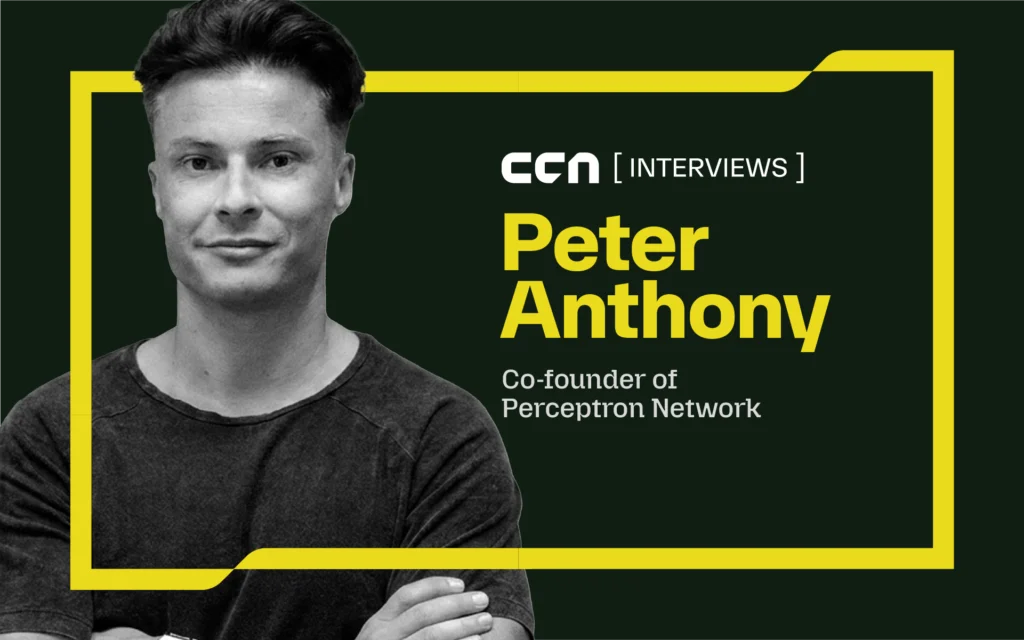
“Perceptron is a distributed intelligence network. Effectively, our motto is a thousand eyes, one vision.” | Image credit: CCN
Share
Key Takeaways
Access to high-quality data has become a major constraint in AI, as paywalls and expensive deals limit who can build and compete in the market.
AI models trained on narrow or localized data sources risk bias and incomplete understanding, as online content varies by region, platform, and user behavior.
Perceptron builds a distributed data network that collects real-time information from multiple locations, reducing reliance on single sources and limiting manipulation.
The model rewards users for contributing data based on demand and difficulty, creating a system where human input supports AI development and future use cases like finance and robotics.
Access to high-quality data has become one of the biggest constraints in artificial intelligence. What once came from the open internet now sits behind paywalls, legal limits, and exclusive deals that only a few companies can afford.
In an interview with CCN, Perceptron Network’s co-founder Peter Anthony said the issue goes beyond access. It shapes who can build AI and how those systems understand the world.
“Many companies right now are accessing data from platforms like X, Reddit, et cetera. And they’re doing it under very expensive data deals,” Anthony said.
The cost of these agreements locks out smaller players.
“That kind of creates a big problem in that it’s very centralized and it means that a number of big players have the ability to continue developing, but it’s very difficult for new language models and new AI products to enter into the market,” he added.
At the same time, data itself lacks depth. What users see online depends on location, behavior, and platform design.
“It creates its own kind of problems as well when it comes to data,” Anthony said.
AI systems trained on limited inputs often reflect a narrow view. A single platform, or even a small group of sources, cannot represent global behavior.
Anthony pointed to the difference in how information appears across regions.
“If you’re looking at your computer and you go and search on Amazon or you’re going to search for certain crypto prices… it’s a very good chance that what you see from your vantage point is different from what I see from my vantage point,” he said.
This fragmentation affects how models interpret reality. It also raises questions about accuracy and bias.
Perceptron Builds a Network of Viewpoints
Perceptron approaches the problem by collecting data from many locations at once.
The network uses user-contributed bandwidth to access publicly available information across the internet. Each participant acts as a node, providing a local perspective.
“Perceptron is a distributed intelligence network. Effectively, our motto is a thousand eyes, one vision,” Anthony said.
Instead of relying on a central dataset, the system gathers small pieces of data from thousands of sources and combines them into a larger picture.
“By creating thousands of different vantage points and feeding all of that information simultaneously in real time from everywhere all at once, it gives us an unrivaled ability to gather data,” he said.
Aggregation Reduces Manipulation
Collecting data at scale introduces new risks. Low-quality, duplicated, or manipulated information can enter the system.
Perceptron addresses this through aggregation.
“We have the ability to gather from hundreds of thousands of different locations. And by doing that, we can kind of aggregate that information,” Anthony said.
This method limits the influence of any single source.
“That then starts to kind of cancel out bad actors… and any kind of manipulated information within those data sets,” he added.
Human Input Fills Missing Data
Not all data exists online in a usable format. Many datasets require human input, especially those tied to language, culture, or local context.
Perceptron plans to expand into what it calls a “data questing” system, where users complete tasks to create or enrich datasets.
“There’s a lot of data information and data products out there that need to have human input,” Anthony said.
These tasks can range from translation to image collection.
“We need to have people… translate documents into their local language… find us pictures of local restaurants… gather ambient background sound,” he said.
He gave a simple example of a dataset that remained incomplete for months.
“There’s been a data set for the last six months that hasn’t been filled, and it’s a data set of a thousand images of women without any makeup on,” he said.
Rewards Depend on Data Demand
Perceptron uses a token-based system to reward contributors.
Users earn based on how difficult or rare a task is.
“How much reward they gain depends on different tasks… and how in demand or how difficult a particular task is,” Anthony said.
More complex datasets or those requiring specific demographics receive higher rewards.
The model connects data creation directly to market demand.
Decentralization and Bias
Bias in AI systems often comes from centralized control over data selection.
Anthony described a scenario where human input gets filtered to match client expectations, rather than reflect reality.
“You’re not allowed to write that because that’s not the right information,” he said, recalling an example from a training environment.
Perceptron attempts to reduce this by widening participation.
“We have decentralized contributors from around the world who are inputting data,” Anthony said.
This approach does not remove bias completely, but it reduces dependence on a single viewpoint.
“I believe that that’s probably a better way to gather more truthful information than taking it from one source,” he added.
Data Products Target Finance and AI
Perceptron started by supplying datasets for AI models, including image generation systems.
The focus has shifted toward real-time intelligence.
“We were using our decentralized node network to gather parcels of data,” Anthony said.
The network now targets sectors such as finance, where speed and insight matter.
He pointed to sentiment analysis as a key use case, particularly in crypto markets.
By scanning multiple platforms at once, the system can detect shifts earlier than traditional tools.
“You can gather data from telegram groups… discords… pricing… and feed all of this information into a platform,” he said.
The result is faster awareness of market trends.
“It’s basically allowing you to be the trader… who can see everything happening all at once,” he added.
Anthony said the system does not access personal data.
“We don’t use private personalized data. We only access… the webpages and things that you are able to see,” he said.
Future features may allow users to opt in to share more data, but the core model focuses on publicly available information.
AI, Automation, and Human Value
The conversation also turned to the impact of AI on jobs.
Anthony pointed to automation already visible in cities.
“Everywhere you walk around, there are cars… driving themselves… machines cleaning the streets on their own,” he said.
These changes may reduce certain roles, but they also create new forms of participation.
Perceptron frames data contribution as one of them.
“What we’re trying to do is… contribute some of that value back towards the users,” he said.
The model resembles a distributed income system in which individuals earn by supporting data infrastructure.
Robotics Will Need Real-World Data
Anthony expects robotics to increase demand for human-generated data.
Machines operating in physical environments require a detailed understanding of behavior, language, and movement.
“Robotics relies a lot more on being out in the open world,” he said.
Humans remain the primary source of that information.
“If you want to have a robot that’s talking to people, it’s very important that the robot understands how people talk to each other in the part of the world where that robot’s going to be working,” he added.
Watch the full interview here:
Data Becomes the Core Layer of AI Competition
The AI race has focused on models and computing power. Data now plays an equally important role. Access, quality, and diversity shape how systems perform.
Perceptron’s approach shifts the focus toward distribution. Instead of centralizing data collection, it spreads it across a global network of users.
That model changes who contributes to AI development and who benefits from it.
Anthony’s view remains grounded in that shift: AI may automate parts of the economy, but it still depends on human input to function.
Disclaimer:
The information provided in this article is for informational purposes only. It is not intended to be, nor should it be construed as, financial advice. We do not make any warranties regarding the completeness, reliability, or accuracy of this information. All investments involve risk, and past performance does not guarantee future results. We recommend consulting a financial advisor before making any investment decisions.
Dr. Lorena Nessi is an award-winning journalist and media technology expert with 15 years of experience in digital culture and communication. Based in Oxfordshire, UK, she combines academic insight with hands-on media practice.
She holds a PhD in Communication, Sociology, and Digital Cultures, and an MA in Globalization, Identity, and Technology.
Lorena has taught at Fairleigh Dickinson University, Nottingham Trent University, and the University of Oxford. She is a former producer for the BBC in London, with additional experience creating television content in Mexico and Japan.
Her research focuses on digital cultures, social media, technology, capitalism, and the societal impact of blockchain innovation.
She has written extensively on digital media and emerging technologies, with her work featured in both academic and media platforms. Her Web3 expertise explores how blockchain technologies shape culture, economics, and decentralized systems.
Outside of work, Lorena enjoys reading science fiction, playing strategic board games, traveling, and chasing adventures that get her heart racing. A perfect day ends with a relaxing spa and a good family meal.


 Easy
Easy