“The venue does not care how the pie is cooked. They care that they get the pie.” | Image credit: CCN
Share
Key Takeaways
Ticketing operates as a capital-driven system where major platforms act as financial institutions, which explains high fees, limited transparency, and slow innovation across the industry.
Artists and venues lack control over data and distribution due to long-term venue contracts and fragmented knowledge across ticketing, promotion, and performance layers.
KYD Labs uses blockchain to turn tickets into real-world assets, allowing venues to access upfront capital and enabling real-time repayment flows tied to ticket sales.
A shift toward decentralized financing could lower fees, expand the number of live events, and support a broader creator economy across venues, artists, and fans.
The live events industry runs on more than performances. Capital drives everything behind the scenes, from booking artists to selling tickets and managing risk across events. Few people outside the industry understand how that system works or why it results in high fees and limited transparency, while also restricting access for artists and venues.
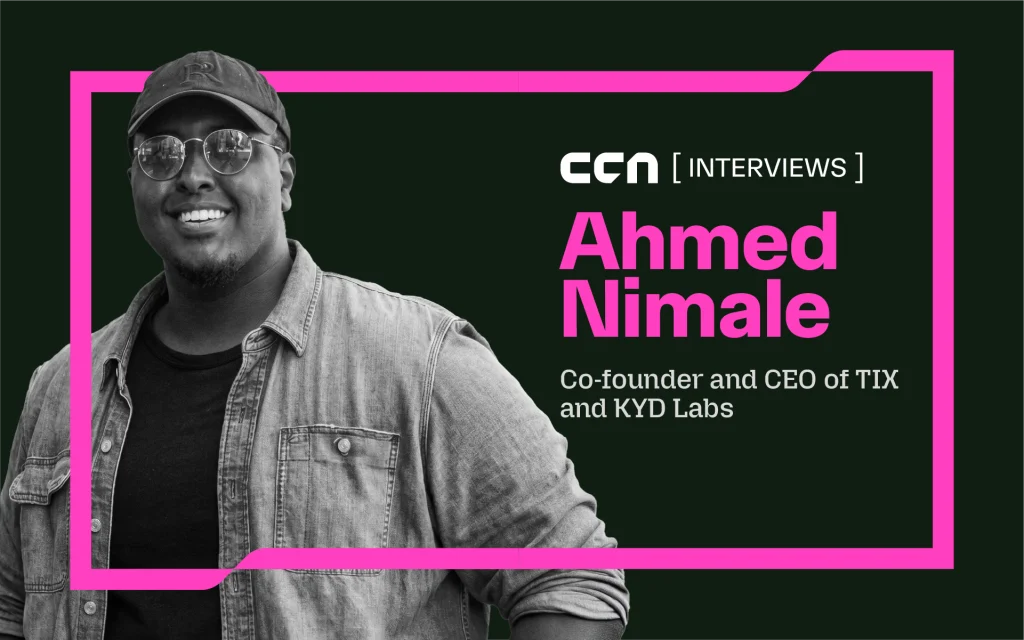
In an interview with CCN’s Max Moeller, Ahmed Nimale, co-founder and CEO of TIX and KYD Labs, explained why ticketing operates more like a financial system than a software product. His experience at Ticketmaster and resale platform Vivid Seats shaped that view and highlights why innovation has slowed while costs for fans continue to rise.
TIX builds an alternative model. The company uses blockchain to turn tickets into financial assets, allowing venues to access upfront capital and enabling new forms of revenue distribution. The goal focuses on giving venues control, helping artists access data, and creating a more efficient system for fans.
This interview explains how ticketing works today and what could change next.
Inside Ticketmaster: ‘Ticketmaster Is a Bank’
Nimale does not describe Ticketmaster as a tech company but as a financial institution built on lending and cash flow.
“Ticketmaster is a bank. When ticketing companies deploy $15 billion across 11,000 exclusive venues, and earn 30 cents per dollar they lend, they’re no longer a software business, but a financial system.”
This model explains why fees remain high and why innovation moves slowly. A company focused on capital deployment prioritizes predictable returns over product development.
Nimale links many industry frustrations to the structure rather than to one company alone.
“It’s not about who’s bad and who’s good, it’s about how, how do we make a more equitable, more profitable, more expansive live event industry.”
Why Venues and Artists Lack Control
Control over data and distribution remains one of the biggest gaps in live events. Artists often finish shows without access to fan data, while venues depend on external platforms for ticketing infrastructure.
Long-term contracts reinforce that imbalance.
“If Madison Square Garden has a 4-year deal with Ticketmaster, every artist that goes to Madison Square Garden has to use Ticketmaster.”
Different participants operate with limited visibility into the full system.
Venues: focus on booking talent and running operations.
Artists: focus on performance and production.
Ticketing companies: control financing and distribution.
This separation creates inefficiencies and limits growth across the ecosystem.
TIX approaches the problem by treating tickets as real-world assets (RWAs). The company places tickets on-chain and uses them to unlock financing for venues.
Instead of waiting for ticket revenue over time, venues receive upfront capital after signing multi-year agreements.
“By making tickets RWAs, we can underwrite venues and give them immediate capital access.”
Daily operations for venues stay the same. They book shows, manage artists, and sell tickets. The difference lies in access to funding.
Nimale simplifies the value proposition.
“The venue does not care how the pie is cooked. They care that they get the pie.”
This model supports long-term planning and reduces financial uncertainty.
Why Blockchain Matters in This Model
Blockchain enables faster capital formation, transparent underwriting, and real-time repayment flows. TIX operates at the transaction layer, similar to payment processors.
As tickets sell, funds return directly to liquidity providers.
“As tickets sell, we can pass that back to LPs (liquidity providers). They don’t need to wait for interest payments.”
This system creates a yield model tied to real-world demand.
Nimale also points to inefficiencies in traditional ticketing. Large companies hold billions in deferred revenue from future events.
“Last year, Ticketmaster, Live Nation had $4 billion in deferred revenue.”
That capital remains locked from the perspective of venues, while intermediaries generate returns from it.
TIX and KYD Labs aims to redistribute part of that value, including potential rewards for ticket holders.
“When you buy a Taylor Swift ticket, you’re gonna earn 4 to 5% just by holding it.”
Bridging Crypto Capital and Live Events
Connecting crypto liquidity with live events requires education and trust. Many lenders focus on yield but lack context about the industry.
Nimale sees strong demand when returns remain attractive.
“If onchain ticket-backed financing products give a yield of 10 to 15%, investors are going to deposit capital into them.”
Compliance: regulatory alignment remains a priority.
Narrative: clear links between capital and real-world revenue.
Live events also create a unique appeal. Investors can support concerts while earning returns tied to ticket sales.
“Imagine saying, ‘Hey, I went to Coachella and made 10% while I was there.’”
A Future With More Concerts and Lower Fees
Nimale expects a shift toward a more open and distributed event economy. Access to capital could expand the number and variety of live experiences across venues and communities.
Fans may benefit from lower fees and increased availability.
“There’s not going to be one Coachella. There’s going to be thousands of Coachellas.”
The model supports smaller venues, independent creators, and local communities. Events could take place across different formats and locations, from large festivals to intimate spaces.
Nimale connects this shift to broader changes in the digital economy.
“AI is making everything digital, hyper-commoditized. Human experiences are going to be scarce.”
Ticketing runs on capital, while distribution shapes pricing and limits access across the industry.
TIX and KYD Labs are turning tickets into financial assets to give venues upfront funding and enable real-time revenue flows.
Adoption depends on venues and capital providers, along with support from artists. If it scales, it could expand live events and improve how value flows across the ecosystem.
Disclaimer:
The information provided in this article is for informational purposes only. It is not intended to be, nor should it be construed as, financial advice. We do not make any warranties regarding the completeness, reliability, or accuracy of this information. All investments involve risk, and past performance does not guarantee future results. We recommend consulting a financial advisor before making any investment decisions.
Dr. Lorena Nessi is an award-winning journalist and media technology expert with 15 years of experience in digital culture and communication. Based in Oxfordshire, UK, she combines academic insight with hands-on media practice.
She holds a PhD in Communication, Sociology, and Digital Cultures, and an MA in Globalization, Identity, and Technology.
Lorena has taught at Fairleigh Dickinson University, Nottingham Trent University, and the University of Oxford. She is a former producer for the BBC in London, with additional experience creating television content in Mexico and Japan.
Her research focuses on digital cultures, social media, technology, capitalism, and the societal impact of blockchain innovation.
She has written extensively on digital media and emerging technologies, with her work featured in both academic and media platforms. Her Web3 expertise explores how blockchain technologies shape culture, economics, and decentralized systems.
Outside of work, Lorena enjoys reading science fiction, playing strategic board games, traveling, and chasing adventures that get her heart racing. A perfect day ends with a relaxing spa and a good family meal.
Max Moeller is a Chicago‑based writer and video editor passionate about games, tech, and crypto. Whether it’s crafting clear, insightful articles or piecing together engaging video retrospectives, he’s driven by curiosity and takes pride in keeping things human. Since 2017, Max has been published in a variety of notable crypto magazines.


 Easy
Easy