Crypto Mortgages Are Here: How Milo Lets You Buy a Home Without Selling Bitcoin
Share
Crypto and real estate rarely appear together in the same sentence.
Yet Milo, a U.S.-based fintech, has pioneered a model where digital assets such as Bitcoin and Ethereum can serve as collateral for homeownership.
This innovation challenges traditional banking norms while addressing one of crypto’s biggest criticisms: volatility.
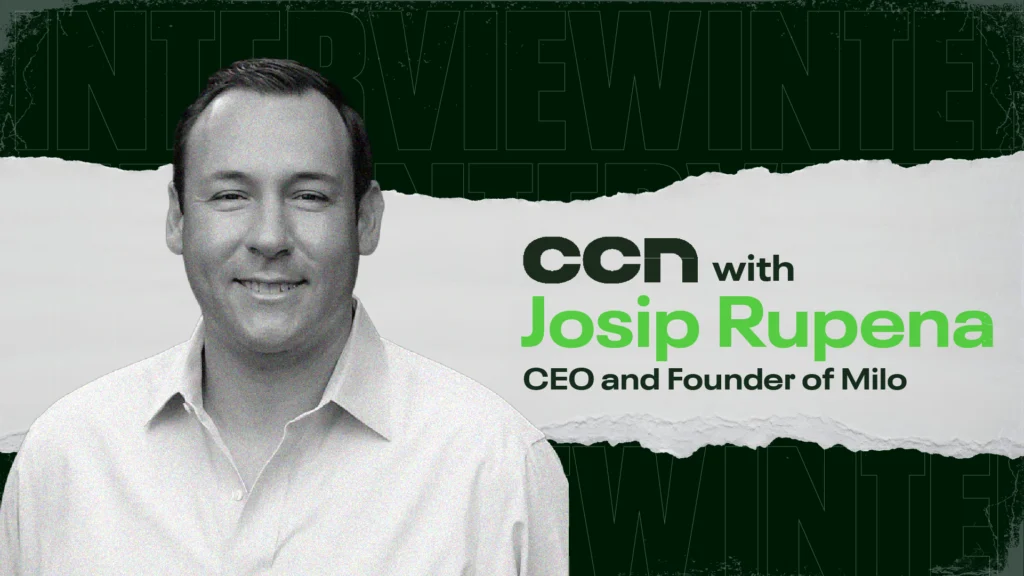
In conversation with CCN, Milo CEO Josip Rupena explained how the company’s crypto-backed mortgages work, why they target digital asset holders, and what the future may hold for tokenized property markets.
How Milo Helps Crypto Holders Buy Homes
Rupena describes Milo’s mission simply:
“I think the simplest way of basically putting it is that we help people not sell their Bitcoin when they want to buy a home. And the way we do that is we help clients be able to buy a home. We finance 100 % of the transaction for them.”
He continues, “The condition is that they have to post their Bitcoin with us in one of our qualified custodians. We work with Coinbase and we work with Bitgo. And that collateral will sit there. So in an example of someone wanting to buy a million-dollar home, they’re going to post a million dollars of Bitcoin.”
Try Our Recommended Crypto Exchanges
Sponsored
Disclosure
We sometimes use affiliate links in our content, when clicking on those we might receive a commission at no extra cost to you. By using this website you agree to our terms and conditions and privacy policy.
By doing this, Milo allows clients to avoid the opportunity cost of liquidating crypto for a down payment, preserves exposure to Bitcoin’s potential upside, and helps those who might not qualify for a traditional loan access homeownership.
Bitcoin and Ethereum as Mortgage Collateral
Milo currently supports two major digital assets. As Rupena explains:
“So we accept Bitcoin and Ethereum. I would say that the majority of the transactions have been in Bitcoin, but we do accept both assets.”
For many of Milo’s customers, these holdings represent long-term conviction, and the ability to leverage rather than sell is central to the value proposition.
Why Milo Targets Crypto Wealthy Homebuyers
Rupena, who previously worked at Morgan Stanley and Goldman Sachs, saw the opportunity as early as 2016:
“I had been in the space in buying Bitcoin from 2016 and I saw the need that at some point in time, individuals that were amassing Bitcoin wealth would have to make a decision. And that decision would have to be, do I sell my Bitcoin now to buy the things and the items that I need in my life, like a home or other significant purchases… from a concept that I drew from my previous experience working at Morgan Stanley and Goldman Sachs is that if you have high quality assets, the optimal aspect is to borrow against them and leverage them, not sell them and let them continue to appreciate.”
This insight eventually led to the founding of Milo, which formally launched its crypto mortgage product in 2022.
Managing Bitcoin Volatility in Mortgage Lending
Volatility remains the biggest question around using crypto as collateral. Rupena acknowledges this directly:
“For an individual that takes out a loan with us, you know, that individual gets to keep the upside of the Bitcoin and ultimately write the downside, right? If it goes down, the question is that what point does that change the decision that we decided to lend to this individual? And today, you know, on that million-dollar example that I used… If the Bitcoin drops 65 % and the Bitcoin’s worth $350,000, they will need to post more collateral.”
The model works both ways. In fact, Milo has already experienced cycles on both sides of the market:
“We started lending in 22 when Bitcoin was 40,000. We saw it go down to 15,000… And then on the other side, we’ve seen the loans that we did when Bitcoin was 15 and 20,000 today, Bitcoin sitting at 115,000. And for some of those clients, we’ve returned collateral and others have decided to keep the collateral with us because we’re working with great custodians that are qualified and they feel safe in that.”
US Regulation and Compliance for Crypto Mortgages
Unlike some failed crypto lenders, Milo positions itself firmly within the U.S. mortgage regulatory framework:
“I think our ability to go out and offer this product was because we were licensed and heavily licensed on a per-state basis and mortgage, right? We’re creating a mortgage. We’re putting a lien on a property, right? We’re taking a credit decision on an individual… We have over five years of audits, we report quarterly, we have lines of credit with banks. So we’re a heavily regulated and audited institution.”
Rupena views this regulatory approach as essential for trust and long-term survival.
Avoiding the Fate of BlockFi and Genesis: Why Milo Is Different
When asked about the collapses of other high-profile crypto lenders, Rupena points to focus and discipline as Milo’s key strengths:
“I think the challenge for a lot of those companies was that they had many, many, different business lines. And I think the strength of Milo is that, you know, we’re really focused on the lending side and on the mortgage side. And, you know, we have an expertise there. We understand what the risks are, but we don’t have other exposures to our business.”
For Rupena, simplicity and risk management are non-negotiable.
Tokenization of Real Estate and the Future of Mortgages
Looking ahead, Milo is exploring how blockchain could reshape the mortgage market itself:
“I think we definitely are… I see a world where almost all assets will be tokenized in some form. And then now the question is to be able to get the legal and the proper framework around them so that things can be leveraged and assets can be leveraged for things like loans with us and maybe a whole host of other companies. So I definitely see the world heading in that direction.”
At the same time, Rupena acknowledges the role decentralized finance (DeFi) could play in democratizing access to mortgage-backed assets.
For Rupena, patience and proper regulation are key, and he concluded by saying:
“By setting the right framework around them, it’s going to allow companies like ours and many others to be able to experiment safely around being able to help customers… I think it’s more important to think about the bigger picture and what it does for the future of potentially financial assets. And I think it’s all going to be very, very positive.”
As the intersection of crypto and real estate evolves, Milo’s approach highlights how digital assets may reshape traditional finance, offering new pathways for wealth holders to enter the housing market.
Disclaimer:
The information provided in this article is for informational purposes only. It is not intended to be, nor should it be construed as, financial advice. We do not make any warranties regarding the completeness, reliability, or accuracy of this information. All investments involve risk, and past performance does not guarantee future results. We recommend consulting a financial advisor before making any investment decisions.
Dr. Lorena Nessi is an award-winning journalist and media technology expert with 15 years of experience in digital culture and communication. Based in Oxfordshire, UK, she combines academic insight with hands-on media practice.
She holds a PhD in Communication, Sociology, and Digital Cultures, and an MA in Globalization, Identity, and Technology.
Lorena has taught at Fairleigh Dickinson University, Nottingham Trent University, and the University of Oxford. She is a former producer for the BBC in London, with additional experience creating television content in Mexico and Japan.
Her research focuses on digital cultures, social media, technology, capitalism, and the societal impact of blockchain innovation.
She has written extensively on digital media and emerging technologies, with her work featured in both academic and media platforms. Her Web3 expertise explores how blockchain technologies shape culture, economics, and decentralized systems.
Outside of work, Lorena enjoys reading science fiction, playing strategic board games, traveling, and chasing adventures that get her heart racing. A perfect day ends with a relaxing spa and a good family meal.


 Easy