How Air China’s Wetour Brought XRP to 60M+ Users Without Violating Crypto Ban | Credit: Austin DeSisto/NurPhoto via Getty Images.
Share
Key Takeaways
Air China’s PhoenixMiles rewards program, with over 60 million members, will support XRP payments for international travel services.
This integration carefully avoids violating China’s crypto ban by limiting XRP use to overseas services.
XRP was chosen due to its speed, low transaction fees, and suitability for cross-border payments.
The move signals China’s willingness to experiment with blockchain abroad while maintaining its strict domestic restrictions, potentially laying the groundwork for future blockchain-based developments.
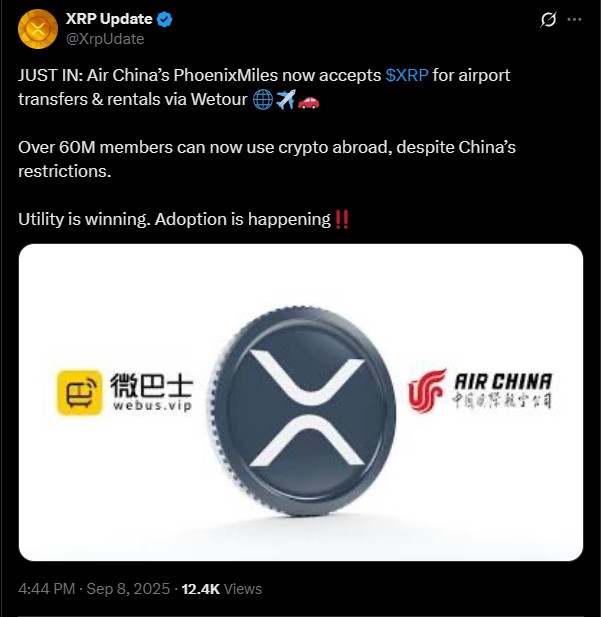
Major Chinese airline Air China has partnered with Webus International to introduce XRP payment support to the 60 million+ members of its PhoenixMiles loyalty program, according to a press release.
Webus’ travel subsidiary Wetour notes that this move only applies to overseas flights, circumventing China’s crypto ban while simultaneously promoting XRP adoption.
That’s right. Despite Air China’s prominence in its home country, cryptocurrencies are actually banned there. As a result, domestic Air China flights will not receive XRP support, while international fliers will soon be able to spend XRP on a variety of Wetour’s offerings, such as airport transfers and premium chauffeur services.
But of all the cryptocurrencies to integrate, why XRP?
Try Our Recommended Crypto Exchanges
Sponsored
Disclosure
We sometimes use affiliate links in our content, when clicking on those we might receive a commission at no extra cost to you. By using this website you agree to our terms and conditions and privacy policy.
Speedy settlements: XRP settlements typically clear in 3-5 seconds, much faster than the multi-day requirements of traditional payment services.
Tokenized rewards: Tokenizing PhoenixMiles’ rewards program means increased user ownership and potentially allows for rewards trading and expanded redemption options over time. XRP could function like frequent flier miles that never expire and are instantly redeemable worldwide.
Lower fees: XRP payments are often fractions of a cent, making them a more cost-effective alternative to the fees charged by payment processors. XRP is also international, eliminating the need for currency conversion rates.
Blockchain-enabled vouchers: Wetour’s press release describes “blockchain-enabled vouchers directly tied to their membership benefits, subject to future business development and regulatory compliance.” This could include flight packages and even partner offerings in an attempt to deepen customer loyalty.
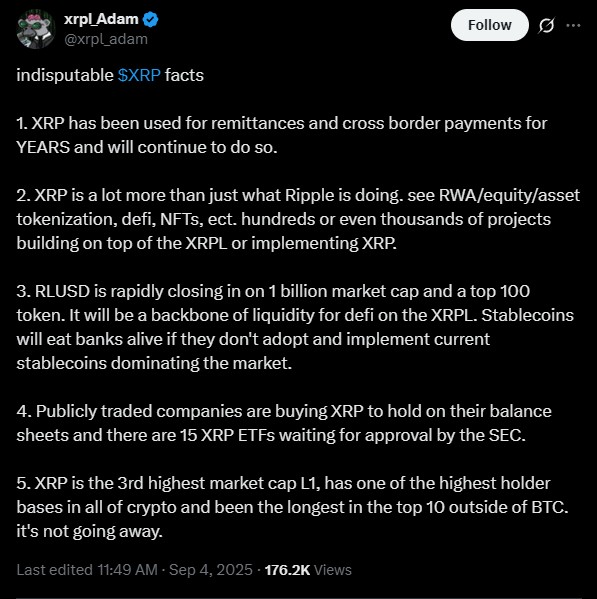
Of course, Ripple CEO Brad Garlinghouse built XRP as a cross-border payments solution. Air China’s international integration is simply the latest in a range of XRP-powered solutions, including its use in financially underserved regions like Latin America and Southeast Asia.
Japanese financial institution SBI Holdings partnered with Ripple to launch its RLUSD stablecoin in the country in 2026, while SBI’s cryptocurrency exchange arm, SBI VC Trade, launched the ability to redeem credit card rewards points for XRP in July 2025.
Also, it is rumored that Swift, the underlying network behind most of the world’s international transfers, is now testing XRP integration as well.
XRP is used in various ways. | Source: @xrpl_adam on X
All this to say, Webus’s choice of XRP was anything but spontaneous. Just as an international passport enables you to move across borders, XRP integration serves as a financial passport, allowing money to move seamlessly between borders and currencies without issue. But it takes money and time to deliver such a service.
How XRP’s New Upgrades Fit the Travel Industry
In June 2025, Webus also made a $300 million agreement with SEC-registered investment advisor Samara Alpha to further develop and promote XRP’s technology. This collaboration, alongside recent updates to the XRP Ledger (XRPL), such as XLS-70 in September 2024 (on-chain digital credentials) and XLS-80 in October 2024 (permissioned domains for institutional entities), positions XRP as an ideal candidate for travel companies.
“We are proud to partner with Webus on this long-term mandate. Our institutional approach to digital asset management combines rigorous risk management with specialized expertise in this evolving asset class,” said Chief Investment Officer at Samara Alpha, Adil Adublali, at the time.
These upgrades can be especially relevant for the aviation and travel industries, where compliance and customer security are vital.
XLS-70’s digital credentials, for example, could streamline boarding processes and frequent flyer verification, while XLS-80 can ensure that international entities (like Air China) utilizing Ripple will still abide by local and international regulations.
XRP as a Bridge for China’s Global Travelers
Webus’s successful collaboration with one of China’s largest airlines bodes well for the future of Chinese entities. It enables an economy as massive as China’s to participate in the development of crypto without putting its citizens at financial risk or interfering with its regulatory stance. This approach makes XRP the perfect fit for Air China’s innovations. The asset is a tool for international customers while remaining invisible to the domestic financial system.
Despite the country’s tough stance on crypto, it still plans to explore a yuan-based stablecoin. In practice, international Chinese travelers may treat money like a relay race baton.
It starts with the yuan stablecoin at home, passing it to XRP through PhoenixMiles while abroad, exchanging the XRP for local currency at their destination, and converting all back to yuan upon their return. All instantly and with minimal fees.
That said, Wetour’s XRP integration remains limited, at least for now. Future use cases may include passengers redeeming XRP to pay for airline tickets or enjoying premium deals and discounts via PhoenixMiles partners. Such innovations could make PhoenixMiles one of the first truly blockchain-powered airline loyalty programs, and bring XRP to more hands than ever before.
If the program proves successful, other Chinese airlines, such as China Eastern or China Southern, may adopt a similar approach. Additionally, Air China is part of the Star Alliance network, a global airline alliance that offers rewards through a unified program to all its members across various airlines.
While Air China’s Wetour integration with XRP is innovative, several risks could limit its success:
Regulatory uncertainty: China’s strict stance on crypto remains unchanged. Any policy shifts, either tightening or loosening, could affect the program’s long-term viability.
User adoption: Many PhoenixMiles members may prefer traditional payment methods, slowing XRP’s practical use.
Global compliance: International regulations on crypto payments vary, which could complicate adoption in certain regions.
Technology dependence: Smooth performance depends on XRPL’s stability and ongoing upgrades. Technical setbacks could undermine confidence.
Conclusion
Air China’s Webus partnership highlights how XRP can function as a global payments bridge without clashing with China’s crypto ban.
By limiting XRP use to international services, the program demonstrates a practical model for cross-border blockchain adoption in highly regulated markets.
With XRPL upgrades like XLS-70 and XLS-80, XRP shows strong potential for enhancing compliance, efficiency, and customer experience in travel.
Why doesn’t the partnership allow XRP payments for domestic flights in China?
China has an active ban on cryptocurrency trading and payments within its borders. By limiting XRP transactions to international services, Air China and Webus abide by China’s domestic regulations.
Is XRP the only cryptocurrency being considered for PhoenixMiles?
As of September 2025, XRP is the only cryptocurrency mentioned in Wetour’s press release. However, tokenized loyalty points or other blockchain-based assets could be considered in future phases, depending on the program’s success, government regulations, and overall crypto adoption rates.
Does Wetour's XRP integration mean China is softening its stance on cryptocurrencies?
Not necessarily. This initiative is designed to avoid tampering with China’s existing cryptocurrency regulations. That said, it provides an opportunity for Chinese companies to experiment with cryptocurrencies.
What risks could limit the success of XRP’s integration?
Adoption may be slow if PhoenixMiles members don’t see the value in paying with XRP instead of traditional methods. Regulatory changes, both in China and other countries, can also restrict how far this program expands.
Disclaimer:
The information provided in this article is for informational purposes only. It is not intended to be, nor should it be construed as, financial advice. We do not make any warranties regarding the completeness, reliability, or accuracy of this information. All investments involve risk, and past performance does not guarantee future results. We recommend consulting a financial advisor before making any investment decisions.
Max Moeller is a Chicago‑based writer and video editor passionate about games, tech, and crypto. Whether it’s crafting clear, insightful articles or piecing together engaging video retrospectives, he’s driven by curiosity and takes pride in keeping things human. Since 2017, Max has been published in a variety of notable crypto magazines.


 Easy
Easy