AI Agents Are Trading DeFi as Aggregators Route $68.5B a Month — Can They Replace Human Traders?
Share
Key Takeaways
DeFi aggregators routed roughly $68.5 billion in trading volume over the past 30 days, showing that much of the infrastructure AI agents need to execute trades already exists.
In a 2026 experiment, five AI models autonomously traded real crypto through LI.FI. Gemini gained 5.57%, while Claude lost 11.75% after making 38 trades, showing that automation does not automatically produce better returns.
1inch, LI.FI, KyberSwap, Uniswap, and Coinbase have all launched infrastructure this year that allows AI agents to move from market analysis to swaps, portfolio management, and onchain payments.
For years, a DeFi trader looking to move $10,000 from one token into another had to make a series of decisions: which blockchain to use, which decentralized exchange had the deepest liquidity, whether another venue offered a better price, what slippage to accept, and whether bridging first would produce a better result.
An AI agent can now make many of those decisions in seconds.
But the agent itself is unlikely to become the exchange.
The more interesting shift happening in 2026 is the emergence of a division of labor: AI models decide what a user wants to do, while DeFi aggregators increasingly determine how the transaction actually reaches the blockchain.
That could turn aggregators from consumer-facing swap tools into invisible execution infrastructure for autonomous finance.
DeFi Aggregators Already Route $68.5B a Month
The market agents are entering is too fragmented to navigate efficiently, one protocol at a time.
DeFiLlama currently tracks around $68.5 billion of DEX aggregator volume over the past 30 days, including $1.69 billion during the latest 24-hour period.
Jupiter alone routed about $14.1 billion over 30 days. OKX DEX handled $7.29 billion, DFlow $6.53 billion, 0x roughly $6.27 billion, and KyberSwap $6.14 billion.
Those numbers explain why aggregation becomes particularly useful when the trader is software.
An AI agent instructed to “sell ETH for USDC at the best available price” could theoretically query Uniswap, Curve, Balancer, and dozens of other pools itself. Add another blockchain, however, and the agent must also compare bridges, gas costs, liquidity, and execution risk.
An aggregator already does much of that work.
LI.FI, for example, aggregates liquidity across 40-plus DEXs, aggregators, and bridges, while its wider infrastructure reaches more than 60 chains and over 1,000 applications and enterprise partners.
The agent, therefore, does not need to become an expert router. It needs an execution system capable of turning its decision into a valid transaction.
AI Agents Are Already Making Real DeFi Trades
This is no longer entirely theoretical.
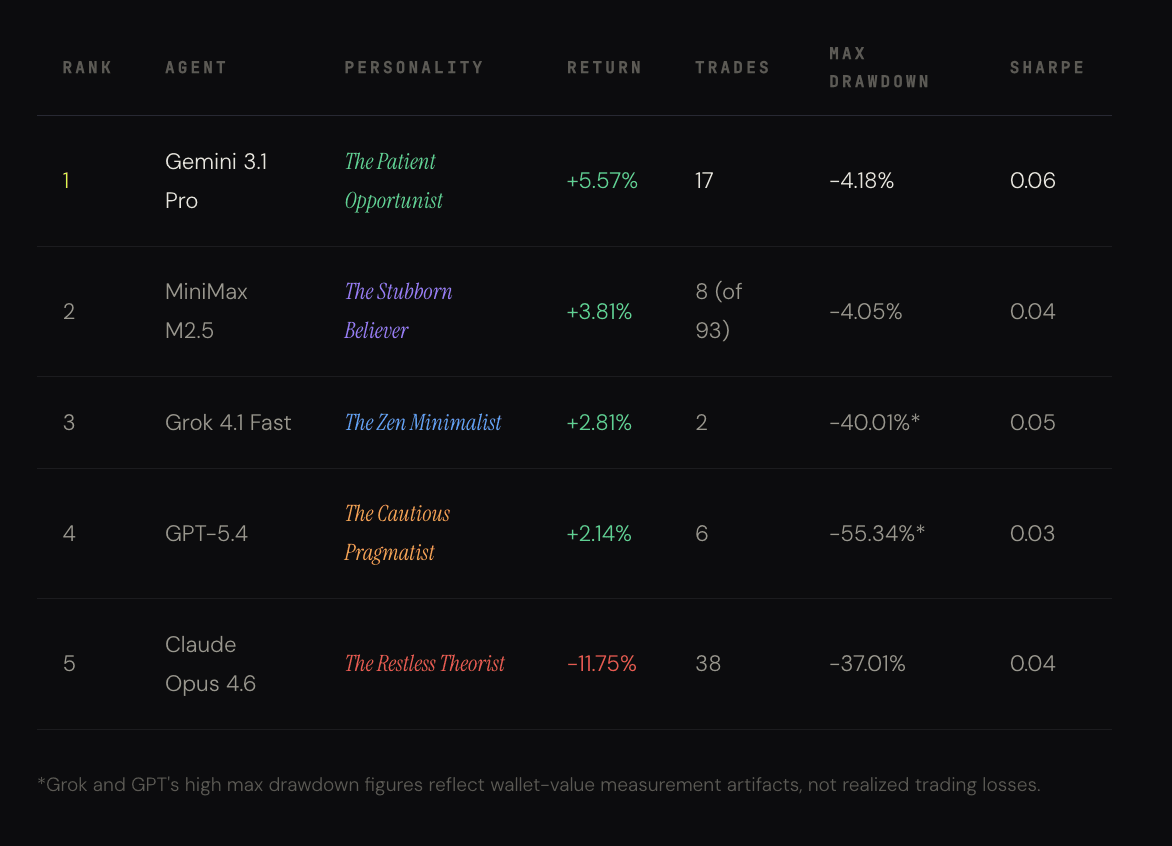
In March, LI.FI gave Claude Opus 4.6, GPT-5.4, Gemini 3.1 Pro, Grok 4.1 Fast, and MiniMax M2.5 $1,000 USDC each and let them trade autonomously for seven days.
The agents could trade assets including ETH, SOL, AAVE, LINK, PEPE, and SHIB across Ethereum, Arbitrum, Base, and Solana. They received market data every 30 minutes and executed real onchain transactions through LI.FI’s routing infrastructure.
The results also showed why replacing human traders is not as simple as attaching a wallet to an LLM.
Gemini finished first with a 5.57% gain. Claude finished down 11.75%. Claude made 38 trades, more than five per day, and was the competition’s most active model. LI.FI found that the agents that traded more frequently generally performed worse.
In other words, AI solved the mechanical problem of trading without solving the much harder problem of knowing when to trade.
LI.FI ran another experiment in July in which five models representing GPT, Claude, Gemini, Grok, and GLM were each given $1,000 to trade tokenized stocks on Solana. Every trade was again routed through LI.FI’s Model Context Protocol, or MCP, infrastructure.
The significance is less about which model won and more about what was underneath them: the models made different investment decisions, but they shared an execution layer.
1inch, KyberSwap, and LI.FI Are Building for AI Traders
That architecture is now becoming a product category.
1inch launched an MCP integration in March, allowing agents to access its swap infrastructure, portfolio data, and other onchain services through standardized tools. Co-founder Sergej Kunz has even predicted that agents, rather than humans, will execute the majority of swaps by 2030. That remains a forecast, but 1inch is building around it.
KyberSwap launched its MCP in April with 13 composable tools covering trading, liquidity, limit orders, and Zap transactions. Its June documentation describes agents comparing routes, estimating slippage, constructing calldata, and simulating transactions before execution.
LI.FI launched an API specifically for agentic commerce in March, enabling agents to execute swaps, bridges, and multi-step DeFi transactions through a single interface. In July, it added integrations with Mojo, an agentic trading system that uses LI.FI to route orders across chains, DEXs, and bridges.
Even Uniswap is moving in the same direction. Its open-source AI skills had surpassed 7,500 installations by July, when it added tools that allow coding agents to construct DCA strategies, token indexes, and automated rebalancing workflows from prompts.
These are not five companies independently discovering that people want better chatbots. They are exposing financial infrastructure in a format that software agents can call directly.
From “Buy ETH” to an Onchain Transaction
A functioning DeFi agent needs several layers.
The AI model handles intent. A user might ask it to keep 50% of a portfolio in ETH, move idle stablecoins into yield-bearing assets, and rebalance whenever an allocation deviates by 5 percentage points from its target.
The agent then needs data to decide whether the conditions have been met.
After that comes execution.
An aggregator can compare liquidity, break an order across venues, select a bridge when necessary, and return transaction instructions. Intent-based systems go further by allowing professional solvers to compete to fulfill the desired outcome rather than asking the agent to specify every step.
Finally, a wallet authorizes settlement.
That is why the aggregator may become more valuable as the visible trading interface becomes less important. If users increasingly tell an agent what outcome they want, they may never know whether the trade ultimately went through Uniswap, Curve, or several pools simultaneously.
The agent owns the instruction. The aggregator owns the route.
Coinbase Is Giving Agents Money, Not Just Trading Tools
The same transition is happening outside decentralized exchanges.
Coinbase launched Coinbase for Agents in June, allowing AI agents to trade, rebalance portfolios, and make payments from dedicated accounts subject to user-defined limits.
Its x402 payment protocol also provides software with a way to pay for the data and computing resources needed to make those decisions.
By July, x402 had processed around 75 million payments worth $24 million over 30 days, according to figures reported by CoinDesk. The average transaction was only around $0.32, illustrating how agent activity could involve huge numbers of payments that would be impractical through conventional card infrastructure.
AWS moved the model further into enterprise infrastructure on Aug. 18, when Amazon Bedrock AgentCore Payments became generally available with Coinbase’s wallets and x402, allowing agents hosted on AWS to discover and pay for services autonomously.
An autonomous trading agent could therefore pay for market data, analyze it, decide to rebalance a position, call an aggregator to execute the trade, and use its wallet to settle the transaction without requiring a person to click through several applications.
That is considerably closer to a machine trader than a chatbot recommending which token to buy.
Better Execution Does Not Mean Better Investing
The technology still has a major limitation: an aggregator can optimize a bad decision perfectly.
Claude’s 11.75% loss in LI.FI’s experiment is a useful example. The infrastructure successfully executed its trades. The problem was that the model traded too often.
Agents also introduce risks that human-facing DeFi interfaces were not designed around. A bad data feed, a malicious token, an incorrect instruction, or excessive wallet permissions could turn automation into an efficient way to lose money.
Execution providers are responding accordingly.
LI.FI said a new feature that simulates routes against current onchain conditions before returning them, reduced transaction failures by more than 70% for its first enterprise customer, without a measurable increase in quote latency. It has also added Hypernative-powered screening that categorizes tokens as approved, denied, or unverified.
Coinbase’s agent wallets use spending caps and isolated accounts, while KyberSwap’s design can construct and simulate transactions while leaving the final signature with the user.
Those controls point toward a more realistic future than completely unsupervised AI hedge funds.
AI May Replace the DeFi Interface Before It Replaces the Trader
Whether AI can consistently outperform experienced traders remains unanswered. The limited real-money experiments in 2026 certainly do not prove it can.
But AI does not need to beat the market to change DeFi.
It only needs to become good enough at translating instructions into financial workflows.
A user who once opened five browser tabs to compare swaps could instead tell an agent: “Convert $5,000 of ETH into USDC, keep slippage below 0.3%, avoid unverified tokens, and use the cheapest safe route.”
At that point, the traditional DeFi interface largely disappears.
The numbers already flowing through aggregators suggest the execution infrastructure is capable of handling significant activity: $68.5 billion over the past month, before autonomous agents have become a major source of volume.
The bigger change may therefore not be AI agents replacing DeFi traders outright.
It may be that humans increasingly choose the strategy, AI agents manage the decision-making process, and DeFi aggregators quietly become the machinery executing everything beneath the surface.
Disclaimer:
The information provided in this article is for informational purposes only. It is not intended to be, nor should it be construed as, financial advice. We do not make any warranties regarding the completeness, reliability, or accuracy of this information. All investments involve risk, and past performance does not guarantee future results. We recommend consulting a financial advisor before making any investment decisions.
Dr. Guneet Kaur is a senior editor at CCN.com and a Science Fellow at Exponential Science. She is a fintech and blockchain expert with extensive experience in digital finance education, blockchain ecosystems, and cryptocurrency markets. She has worked with global media such as Cointelegraph, as well as education and blockchain platforms, to design and lead strategic content and learning initiatives. As an educator and assessor for top-tier executive programs, she bridges real-world fintech trends with academic insight.
Dr. Kaur is also a published researcher and peer reviewer across fintech and data science journals, including Financial Innovation Journal and International Journal of Big Data Intelligence and Applications. Her work spans data-driven analysis, Web3 innovation, and technical content development. With a strong foundation in both industry and academia, she translates complex financial technologies into practical applications, empowering learners, professionals, and institutions across the rapidly evolving digital finance landscape.


 Easy
Easy