Will ZEC price trade higher? | Credit: Hameem Sarwar
Share
Key Takeaways
Zcash’s price has formed a cup-and-handle pattern on the 4-hour chart.
Prominent industry figures have reiterated a long-term price of $10,000.
Indicators like the MACD have produced their first bullish crossover in months.
Zcash (ZEC) is not one cryptocurrency that has been quietly sitting still.
After delivering one of the more impressive rallies among established privacy coins in late 2025, Zcash entered 2026 with real bullish momentum.
That momentum is now being tested as atlcoin has dropped over 50% from its local top last December. But so far, the verdict is encouraging.
At the time of writing, Zcash’s price has refused to surrender the $200 level, and for long-term believers in the asset, that defense is reigniting one of crypto’s most ambitious and enduring theses: ZEC to $10,000.
But will this be the case? Let’s find out.
Zcash Coin Attempts to Recover
Price levels carry different weights depending on their structural representation. For the Zcash coin, the $200 zone is not simply a round number.
It is a historically significant demand area where long-term holders have repeatedly absorbed selling pressure. So, defending it in recent days suggests the altcoin has enough strength to withstand an extended correction.
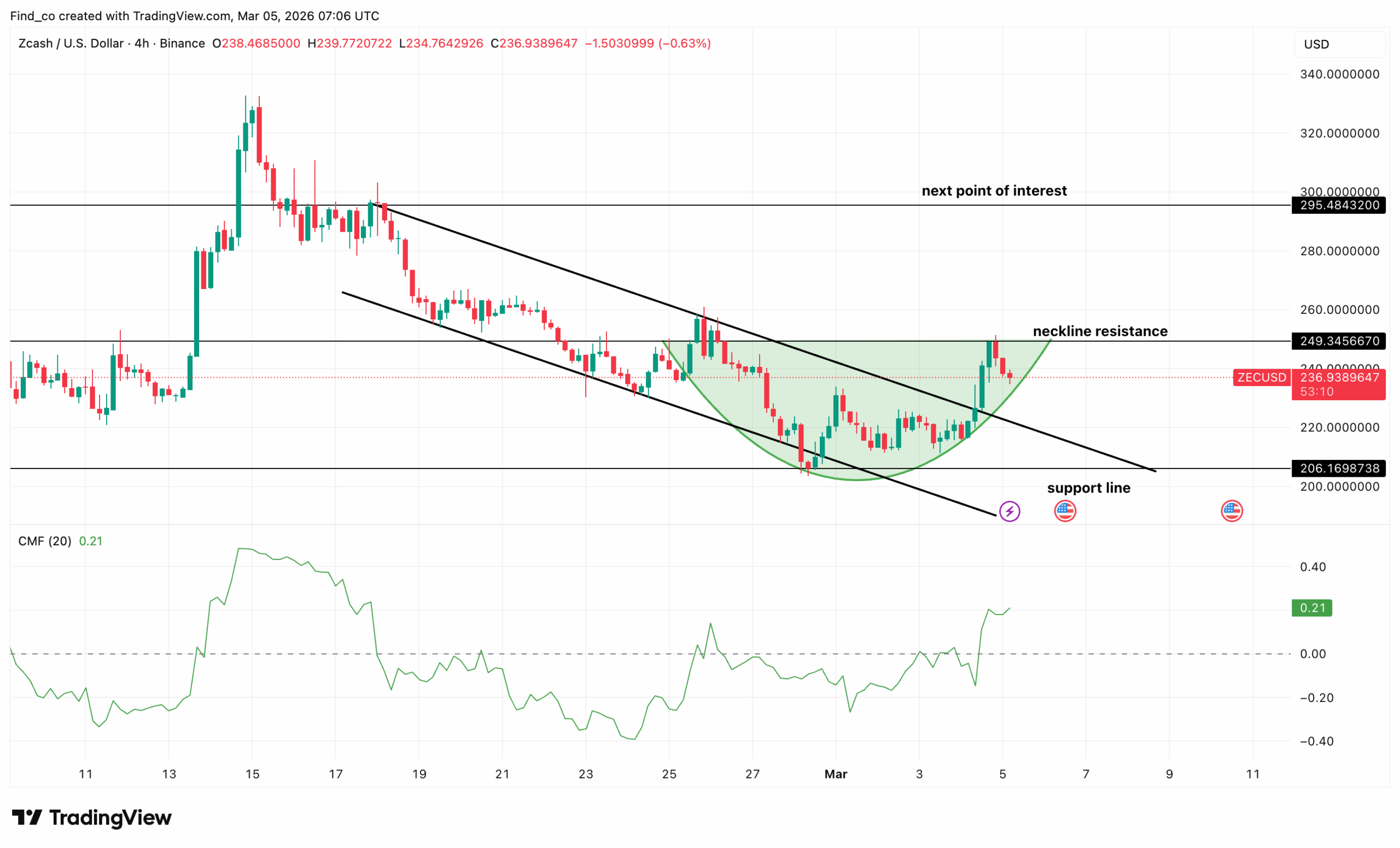
From a technical perspective, CCN observed a cup-and-handle forming on the 4-hour chart.
As seen below, the Zcash price is pressing against the neckline resistance at $249.35.
Get These Top Crypto Casino Offers Now!
Sponsored
Disclosure
We sometimes use affiliate links in our content, when clicking on those we might receive a commission at no extra cost to you. By using this website you agree to our terms and conditions and privacy policy.
Notably, the support line below at $206.17 is the invalidation level. If lost, Zcash might fail the current pattern.
But currently, this might not be the case.
A Brief History: The All-Time High and the Long Road Down
To understand where the Zcash coin could go, it is worth understanding where it has already been.
ZEC’s price reached its all-time high of approximately $3,191 in October 2016.
This happened just days after its public launch. This occurred due to an extraordinary combination of launch scarcity, intense speculative demand, and the novelty premium of the first production-grade zero-knowledge privacy coin.
However, the drawdown that followed was as severe as the launch. A combination of factors erased the earlier gains over the subsequent years.
According to CCN’s findings, regulatory hostility toward privacy coins and the delisting of multiple major exchanges, including Bittrex, contributed to downward pressure on the Zcash price.
However, sentiment around ZEC has changed since last year. In particular, this was one of the reasons the market value soared to close to $800 at some point.
Amid this, several crypto analysts have opined that the Zcash coin price could hit $10,000.
Fronting this is Mert Mumtaz, CEO of Helius Labs, who has remained steadfast on the target despite the drawdowns.
“What’s cool is that the shielded ZEC supply is still near ATHs meaning privacy is as strong as ever and it was short-term people doing short-term things you need an insane base of long-term believers and this chart proves it $10,000,” He reiterated on Jan. 9.
However, Mumtaz is not the only public figure backing a ZEC price spike. Arthur Hayes, former CEO of BitMEX, has also stated that he expects fireworks from the cryptocurrency in the months and years to come.
ZEC Monthly Chart Analysis
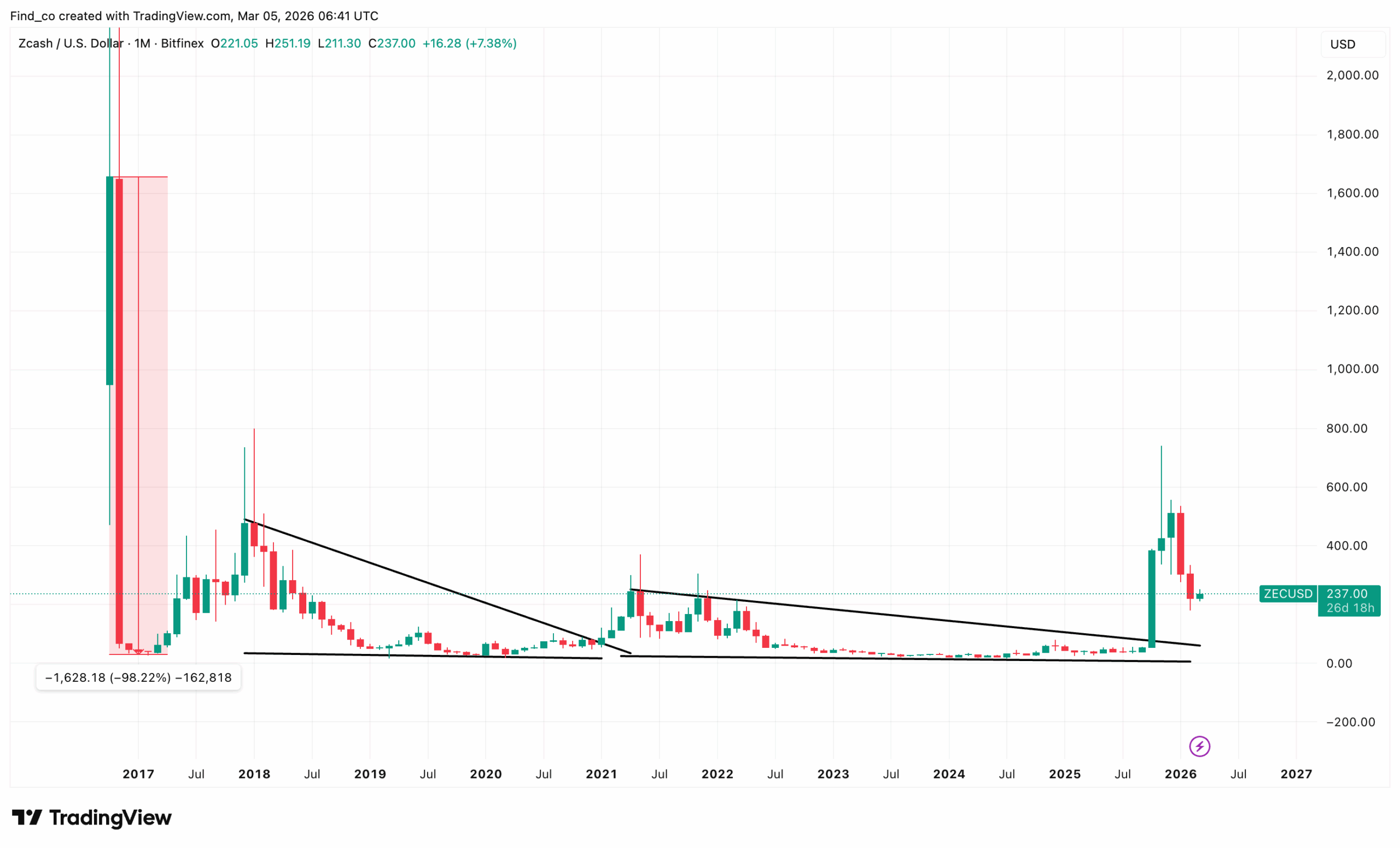
Looking at the image below, ZEC trades at $237.00, up 7.38% over the last 24 hours.
But zoom out, and the picture is stark. Since its 2016 launch, Zcash’s price has lost 98.22% of its peak value.
The monthly chart reveals a clear and repeating structure. Two massive descending triangles have already played out.
One formed from 2017 to 2020, and one from 2021 to 2024. Each followed the same pattern: a rally, a descending trendline of lower highs, a flat base near zero, and then a violent breakout.
As it stands, a third descending triangle is now breaking. The falling upper trendline connecting the 2018 and 2021 highs was pierced in late 2025, as Zcash’s price surged from near zero to a monthly high of $755 before pulling back.
Currently, the pullback to $237 is significant but not alarming on a monthly chart. The breakout level (roughly $100 to $150), where the descending trendline met the flat base, is now support.
If the pattern repeats a third time, the measured move projects a target well into the $800 range in the short term.
ZEC Price Outlook: Higher Values Soon
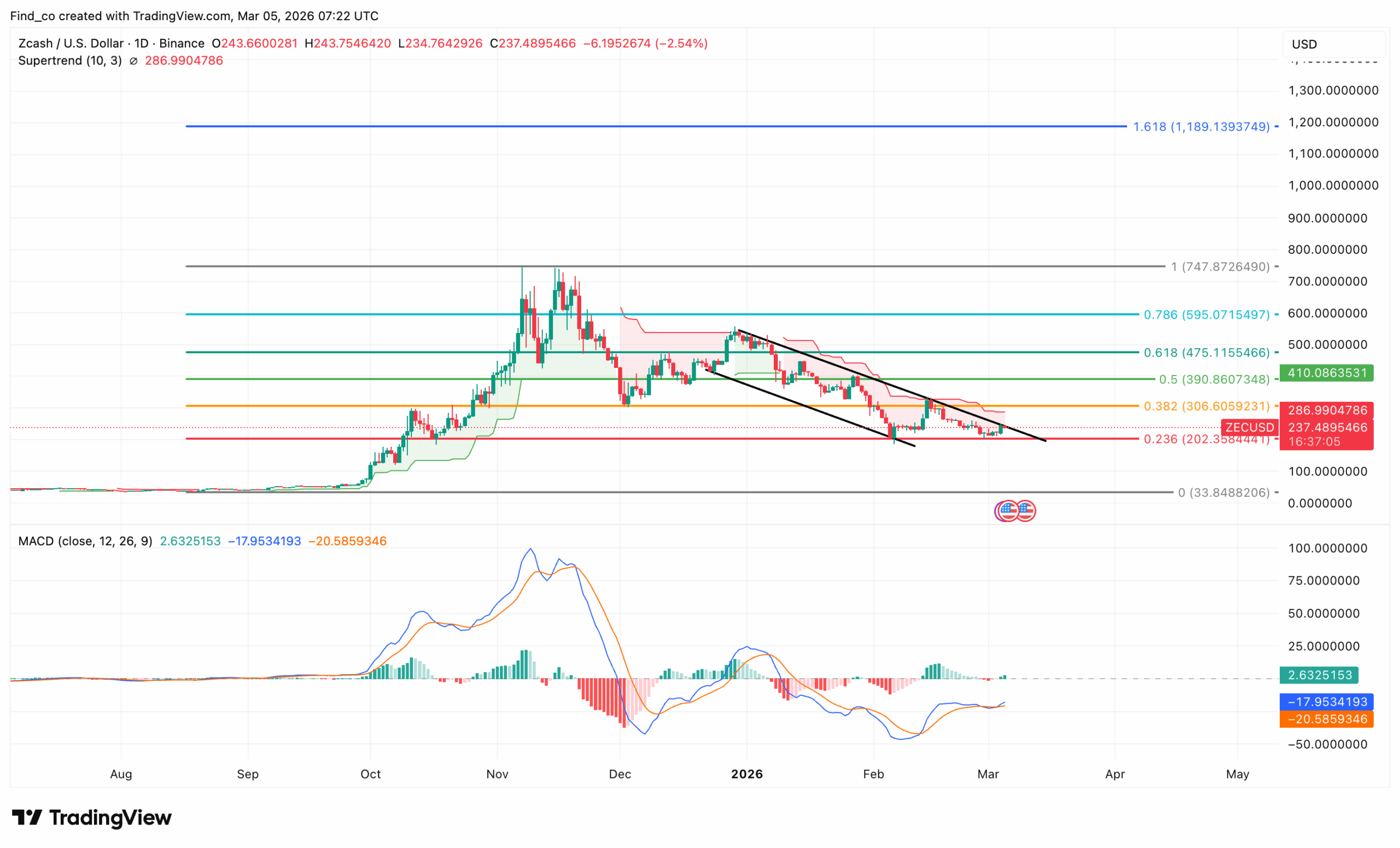
On the daily chart, ZEC is confined inside a descending channel that has erased the entire post-October rally from $747.
The pullback has been deep. Price has retraced through the 0.5 ($390) and 0.382 ($306) Fibonacci levels and is now testing the 0.236 ($202) Fibonacci level.
The Supertrend at $286.99 is overhead and serves as immediate resistance.
The Moving Average Convergence Divergence (MACD) is the first positive signal in months. The line (2.63) has just crossed above the signal (-17.95), and the histogram bars have turned green.
The crossover is early, and the signal line remains deeply negative. But the direction has shifted.
However, Zcash’s price needs to re-enter the descending channel and reclaim $286.99 (Supertrend) to confirm recovery. The 0.618 at $475 is the medium-term bull target.
In the long term, the coin’s market value could rise to $1,189. However, that will depend on a notable increase in buying pressure.
On the contrary, if demand for the privacy coin declines, this prediction might not come to pass. Instead, Zcash’s price might slide much lower.
Can Zcash Hit $10K?
The $10,000 long-term price target for Zcash is not arbitrary speculation.
It is grounded in supply economics, institutional demand for privacy, and the broader adoption curve for financial privacy infrastructure.
Zcash operates on a fixed supply schedule modeled closely after Bitcoin, with a hard cap of 21 million coins. As mining rewards continue to halve over time, the new ZEC supply entering the market decreases systematically.
With approximately 16 million ZEC currently in circulation, the long-term scarcity argument is straightforward and compelling for those with a patient investment horizon.
More critically, institutional demand for verified financial privacy is accelerating in ways that were not visible during Zcash’s previous bear cycle.
However, this does not guarantee that Zcash will hit $10,000. But at the same time, it is not impossible.
Disclaimer:
The information provided in this article is for informational purposes only. It is not intended to be, nor should it be construed as, financial advice. We do not make any warranties regarding the completeness, reliability, or accuracy of this information. All investments involve risk, and past performance does not guarantee future results. We recommend consulting a financial advisor before making any investment decisions.
Victor Olanrewaju is a crypto analyst and reporter at CCN with deep roots in on-chain research and technical analysis. His crypto journey began in 2017, but it was the 2020 Uniswap airdrop that sparked a full-time pivot into the space.
With a foundation in copywriting, Victor honed his craft creating high-converting content for leading crypto brokers — most notably an XRP price prediction that ranked #1 on Google during the 2021 bull run.
He later joined AMBCrypto in 2022, where he combined storytelling with technical and on-chain analysis to cover key market narratives.
In 2024, he expanded his expertise at BeInCrypto, collaborating with analysts and using tools like Glassnode, Santiment, and IntoTheBlock to break down Bitcoin and altcoin trends.
At CCN, Victor covers the top cryptocurrencies, memecoins, macro shifts, blending real-time insights with deep-dive metrics.
He holds a Bachelor’s degree in Physics from the University of Ibadan, equipping him to simplify complex data for a wide audience. Follow his work or connect on LinkedIn or X.