s the MANTRA rally sustainable? | Credit: Hameem Sarwar
Share
Key Takeaways
MANTRA surged 67% in 24 hours following its successful v7.0.0 Mainnet Upgrade.
The upgrade included a 1-to-4 non-dilutive token split, expanding the maximum supply.
MANTRA is currently consolidating above the 0.786 Fibonacci pivot at $0.025 — what next?
Over the last 24 hours, MANTRA’s price has seen a 67% surge that’s not roooted in speculation. But it has happened amid a convergence of major technical upgrades and structural changes to the token.
Here is everything traders need to understand about what just happened and where MANTRA’s price goes from here.
Notably, the team activated it at block height 13,000,000 yesterday. The upgrade officially transitioned the ecosystem’s ticker from $OM to $MANTRA — consolidating its identity as the leading Layer 1 blockchain for Real-World Asset (RWA) tokenization.
But this was far more than a name change. Three structural changes executed simultaneously made this upgrade genuinely market-moving.
First, a 1-to-4 non-dilutive token split automatically quadrupled holder balances.
Get These Top Crypto Casino Offers Now!
Sponsored
Disclosure
We sometimes use affiliate links in our content, when clicking on those we might receive a commission at no extra cost to you. By using this website you agree to our terms and conditions and privacy policy.
While technically value-neutral, the significantly lower unit price has triggered a retail buying frenzy.
Maximum supply expanded proportionally from 2.5 billion to 10 billion tokens, optimizing MANTRA’s liquidity profile for global secondary markets.
Second, the network migrated from 6 to 18 decimal places, aligning its technical infrastructure with Ethereum-standard protocols.
This is a critical detail for institutional adoption as it significantly simplifies integration for RWA partners building on the chain.
Third, and crucially, the upgrade was fully automatic for holders on MANTRA Chain. Interestingly, several exchanges, including Binance, Crypto.com, Bitget, Aster, and several others, listed the altcoin
The Binance Effect: Will It Help MANTRA’s Price?
If the v7.0.0 upgrade was the foundation, Binance’s aggressive same-day rollout was the accelerant.
On March 4, Binance launched spot trading pairs including MANTRA/USDT, MANTRA/USDC, and MANTRA/TRY at 08:00 UTC.
This instantly injected liquidity into the newly rebranded token. Within hours, Binance followed with USDⓈ-M Perpetual Contracts offering up to 50x leverage, inviting a massive wave of speculative volume.
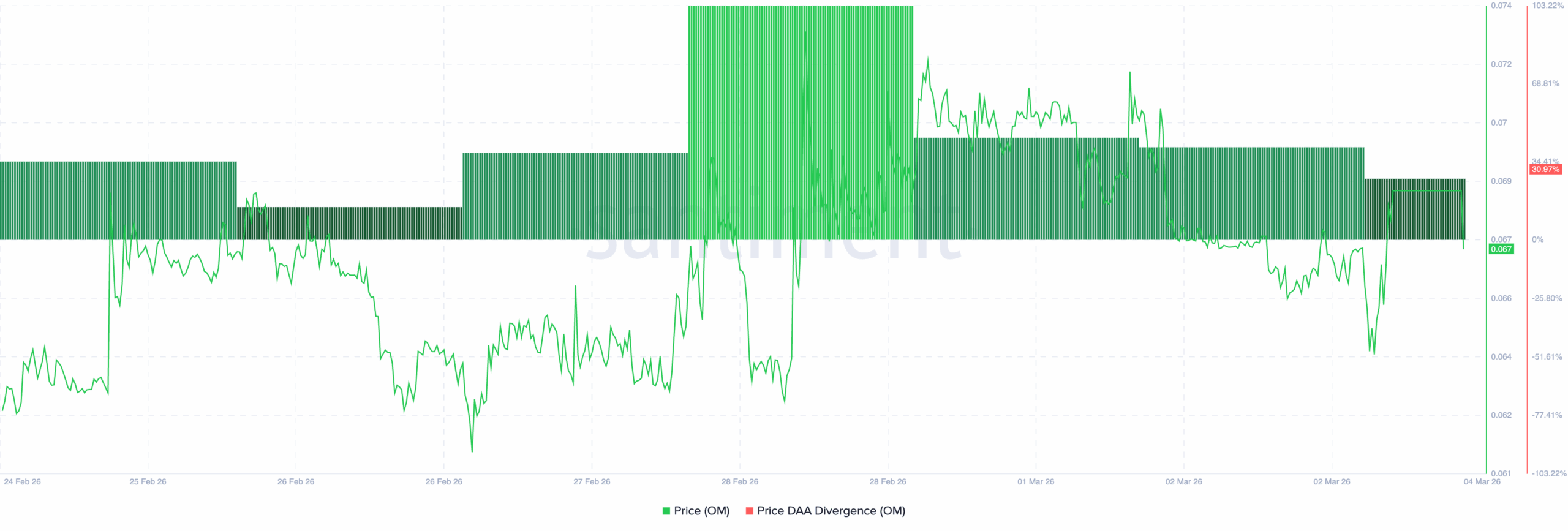
Amid the development, MANTRA’s on-chain activity is flashing a warning signal. At the time of writing, trades at $0.027, and the Price DAA Divergence metric has just turned red for the first time since late February.
The DAA Divergence indicator measures the relationship between Daily Active Addresses and price. When it’s green, addresses and price are moving in the same direction — healthy, aligned activity.
When it flips red, price is rising or holding while active addresses decline — a bearish divergence that historically precedes corrections.
The pattern over the past ten days tells a clear story. From Feb. 27 to 28, active addresses surged massively alongside price. That was genuine demand.
But since March 1, the divergence has quietly deteriorated. Price has held lower while active addresses have been declining steadily.
However, considering the current outlook, it appears that MANTRA’s price will continue to rise in the short term.
MANTRA Price Prediction
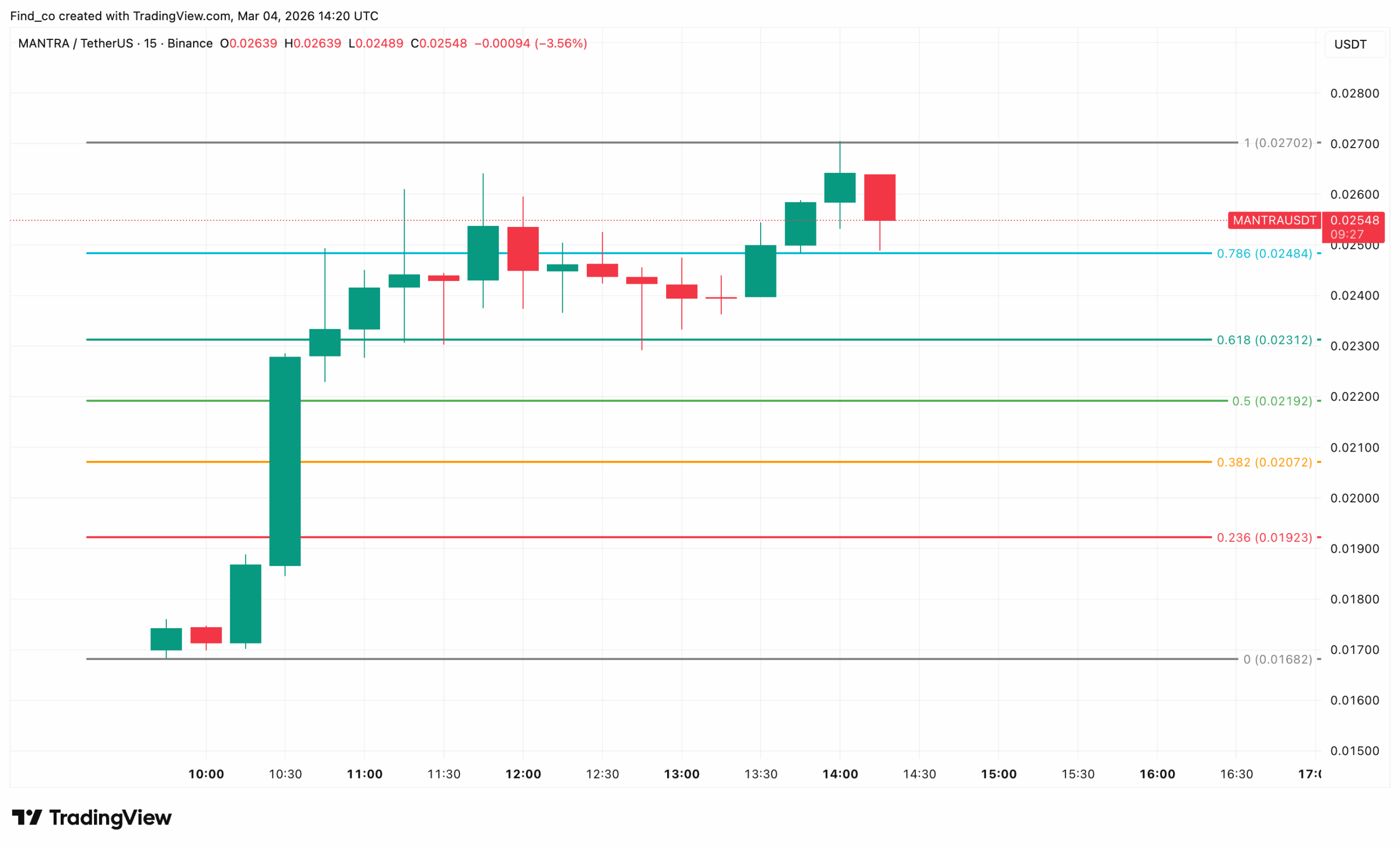
As it stands, this is MANTRA’s first hours of trading under its new ticker. The 15-minute chart captures the debut session, which is volatile.
MANTRA trades at $0.025, down 3.56%, after a sharp opening surge. Price launched from around $0.0168 at 10:00 UTC, spiked aggressively to the 1 Fibonacci level at $0.027 by 10:30, then pulled back into a choppy consolidation range.
The 0.786 Fib at $0.02484 is acting as the pivot. Price has tested it multiple times and is currently holding just above it at $0.02548.
That level is the immediate line in the sand — a close below it on the 15-minute chart opens the door to a retest of 0.618 ($0.02312).
The opening candle structure — a near-vertical move from $0.017 to $0.020. The Fibonacci retracements drawn from that initial move now define the intraday structure.
The fact that MANTRA’s price is consolidating above the 0.786 rather than collapsing back to the 0.5 ($0.022) or lower is modestly constructive.
For a rebrand debut following the OM crash history, holding above $0.025 into the close would signal that initial sellers have been absorbed.
What Happened to $OM: From 30,000% Rally to 90% Crash
Few tokens in recent crypto history have risen as fast or fallen as hard as OM, the former native token of MANTRA.
The Rise
Throughout 2024 and early 2025, OM’s price surged over 30,000% from its lows, peaking at approximately $8.99 on Feb. 22, 2025.
The rally wasn’t hype alone. MANTRA had reinvented itself as a purpose-built Layer 1 blockchain for Real-World Assets, securing a $1 billion real estate tokenization deal with Dubai developer DAMAC, a first-of-its-kind DeFi license from Dubai’s VARA regulator, and building anticipation around its mainnet launch.
The Crash
On April 13, 2025, it unravelled in under four hours. OM fell from $6.30 to $0.37.
It cascaded into $14 million in forced liquidations within a single minute. Despite its high market cap, OM had almost no buy-side depth to absorb the selling.
Supply dynamics compounded the panic. The team had recently doubled total supply from 888 million to 1.78 billion tokens to fund the new chain — a dilution that left holders primed to exit at the first sign of trouble.
The Rebirth
CEO John Patrick Mullin pledged to burn his personal token allocation. The project was restructured.
Recently, OM officially became history: the ticker was permanently changed to $MANTRA, and a 1:4 non-dilutive token split was executed — holders received four new MANTRA tokens for each OM held, with unit price adjusted proportionally.
But whether MANTRA’s price will replicate OM’s explosive move is something that is too early to predict
Disclaimer:
The information provided in this article is for informational purposes only. It is not intended to be, nor should it be construed as, financial advice. We do not make any warranties regarding the completeness, reliability, or accuracy of this information. All investments involve risk, and past performance does not guarantee future results. We recommend consulting a financial advisor before making any investment decisions.
Victor Olanrewaju is a crypto analyst and reporter at CCN with deep roots in on-chain research and technical analysis. His crypto journey began in 2017, but it was the 2020 Uniswap airdrop that sparked a full-time pivot into the space.
With a foundation in copywriting, Victor honed his craft creating high-converting content for leading crypto brokers — most notably an XRP price prediction that ranked #1 on Google during the 2021 bull run.
He later joined AMBCrypto in 2022, where he combined storytelling with technical and on-chain analysis to cover key market narratives.
In 2024, he expanded his expertise at BeInCrypto, collaborating with analysts and using tools like Glassnode, Santiment, and IntoTheBlock to break down Bitcoin and altcoin trends.
At CCN, Victor covers the top cryptocurrencies, memecoins, macro shifts, blending real-time insights with deep-dive metrics.
He holds a Bachelor’s degree in Physics from the University of Ibadan, equipping him to simplify complex data for a wide audience. Follow his work or connect on LinkedIn or X.