The Filecoin price has trended downward since its all-time high in 2021, losing 99% of its value.
The current market cycle has been disappointing. FIL barely reached double digits in March 2024 and nearly fell to a new all-time low in March 2025.
Let’s examine the price predictions for Filecoin made on April 4, 2025. We will also examine the Filecoin price history and discuss what FIL is and does.
We will add and remove 20% from the target price to provide a range of possible outcomes, resulting in minimum and maximum FIL price predictions.
Minimum FIL Price Prediction
Average FIL Price Prediction
Maximum FIL Price Prediction
2025
$0.37
$0.46
$0.55
2026
$0.31
$0.38
$0.46
2030
$0.14
$0.18
$0.22
The most likely wave count shows that Filecoin has completed an A-B-C structure (green) from its launch to 2021. Then, it started a five-wave downward movement (red) and is currently in the fifth and final wave.
The sub-wave count is black, showing the price in sub-wave three.
Finally, we will use the daily rate of decrease since launch to predict the Filecoin price at the end of 2030.
Filecoin has fallen 75% since launching. Projecting this rate of decline forward since our predicted target at the end of 2025 leads to predictions of $0.38 and $0.18 for the end of 2026 and 2030, respectively.
Filecoin Price Prediction for 2025
The wave count method predicts that Filecoin’s price will range between $0.37 and $0.55 by the end of 2025.
Filecoin Price Prediction for 2026
Using the daily rate of decrease in combination with the wave count leads to a Filecoin price prediction range between $0.31 and $0.46 for the end of 2026.
Filecoin Price Prediction for 2030
Using the daily rate of decrease in combination with the wave count leads to a Filecoin price prediction range between $0.14 and $0.22 for the end of 2030.
Filecoin Price Analysis
The weekly time frame FIL chart is bearish. It shows that FIL broke down from an ascending support trend line and the $3.20 horizontal support area.
After a bounce this week, the FIL price validated both as resistance, confirming its bearish trend.
Technical indicators are also bearish. The Relative Strength Index (RSI) and Moving Average Convergence/Divergence (MACD) are falling.
So, the Filecoin prediction is bearish, suggesting that new all-time lows are in store.
Short-term Filecoin Price Prediction
The FIL price prediction for the next 24 hours is bearish. FIL will likely continue falling until it reaches a new all-time low.
Filecoin Average True Range (ATR): FIL Volatility
The Average True Range (ATR) measures market volatility by averaging the largest of three values: The current high minus the current low, the absolute value of the current high minus the previous close, and the absolute value of the current low minus the previous close over a period, typically 14 days.
A rising ATR indicates increasing volatility, while a falling ATR indicates decreasing volatility. On April 4, 2025, the ATR for FIL was 0.95, a sign of average volatility. The ATR has fallen since 2024
Filecoin Relative Strength Index (RSI): Is FIL Overbought or Oversold?
The Relative Strength Index (RSI) is a momentum indicator traders use to determine whether an asset is overbought or oversold.
Movements above 70 and below 30 show over and undervaluation, respectively.
Movements above and below the 50 line also indicate if the trend is bullish or bearish. On April 4, 2025, Filecoin’s RSI was 40, signifying a gradual bearish trend.
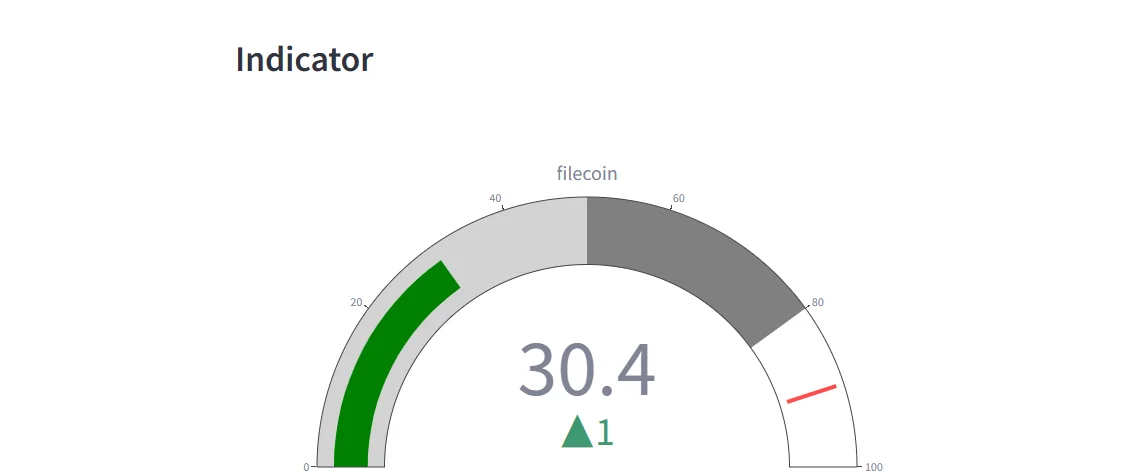
CCN Strength Index
The CCN Strength Index combines an array of advanced market signals to measure the strength of individual cryptocurrencies over the last 30 days.
Every day, it assigns a strength score, ranging from 0 to 100, to the top 500 assets by market capitalization on CoinMarketCap, focusing on both trend direction and the intensity of price movements.
0 to 24: Assets exhibit significant weakness, showing signs of sustained downtrend behavior.
25 to 35: The price tends to move within stable bounds with minimal volatility.
36 to 49: Assets begin a stable uptrend but without strong surges.
50 to 59: Consistent growth with moderate price advances, building momentum.
60+: Sharp price movements and high demand indicate more volatility and trend shifts.
On April 4, 2025, Filecoin scored 30.4 on the CCN Index, suggesting weak momentum.
Best Days and Months To Buy FIL
We examined the FIL price history and found the lowest prices on certain days, months, quarters, and weeks in the year, indicating the best times to buy FIL.
Let’s now examine the Filecoin price history. While past performance is not an indicator of future results, knowing what the token has done can give helpful context when making or interpreting a Filecoin price prediction.
Market capitalization, or market cap, is the sum of the total number of Filecoins in circulation multiplied by their price.
On April 4, 2025, the Filecoin market cap was $1.85 billion, making it the 59th-largest crypto by that metric.
Filecoin Supply and Distribution
Supply and distribution
Figures
Total supply
1,959,703,218
Circulating supply (as of April 4, 2025)
647,135,143 (33.0% of total supply)
From the Filecoin Whitepaper
Filecoin’s whitepaper, a technical document that explains the platform’s purpose and actual operations, says the network takes advantage of changes to the internet, with people looking for more control and privacy.
It says: “Filecoin is a decentralized storage network that turns cloud storage into an algorithmic market. The market runs on a blockchain with a native protocol token (also called “Filecoin”), which miners earn by providing storage to clients. Conversely, clients spend Filecoin hiring miners to store or distribute data.
“As with Bitcoin, Filecoin miners compete to mine blocks with sizable rewards, but Filecoin mining power is proportional to active storage, which directly provides a useful service to clients.”
Filecoin (FIL) Explained
Filecoin helps people use cloud storage on the blockchain. Since The Cloud is, in effect, a decentralized network where people can access their files from any device with an internet connection, it makes sense for the network’s organization to be decentralized.
Founded in 2014 by California-based crypto entrepreneur Juan Benet, Filecoin was originally an InterPlanetary File Network storage system sidechain. In 2017, though, it held an initial coin offering (ICO), and in 2020, its mainnet launched. Filecoin’s native token, FIL, supports it.
How Filecoin Works
Filecoin uses a consensus mechanism called Proof-of-Spacetime. According to the Filecoin whitepaper, Proof-of-Spacetime features blocks created by miners who store data in them, allowing the protocol to provide decentralized data storage and retrieval.
Clients pay to store and retrieve data, while storage miners can earn FIL by offering storage. Retrieval miners earn FIL by retrieving data.
Is FIL a Good Investment?
Filecoin has suffered over the last two years, losing more than 95% of its value since the Spring of 2021. While it initially looked like it would shrug off the SEC, which apparently classified it as an unregistered security, the regulator’s lawsuit against Binance and Coinbase threw it back into the spotlight.
Nevertheless, it is still comfortably in the top 50 cryptos by market cap and is not without its fans. We must see how the market reacts and if it recovers over time.
Will FIL Go Up or Down?
It is difficult to determine. While many price forecasts are pessimistic, at least in the longer term, price forecasts are often wrong. Remember, too, that prices can and do go down and up.
Should I Invest in FIL?
Before investing in Filecoin, you must research FIL and other similar cryptos, such as Storj Labs (STORJ). The most important thing is never to invest more money than you can afford to lose.
FAQs
How many Filecoin are there?
As of April 4, 2025, 647 million FIL were in circulation out of a total supply of 1.9 billion.
Will Filecoin reach $100?
Our price predictions suggest Filecoin will not reach $100 in the near future.
What is Filecoin used for?
The Filecoin blockchain is a decentralized remote storage network, and the FIL crypto coin is used to help support it.
Disclaimer:
The information provided in this article is for informational purposes only. It is not intended to be, nor should it be construed as, financial advice. We do not make any warranties regarding the completeness, reliability, or accuracy of this information. All investments involve risk, and past performance does not guarantee future results. We recommend consulting a financial advisor before making any investment decisions.
Valdrin Tahiri is a cryptocurrency analyst and reporter at CCN, specializing in technical analysis with a focus on Elliott Wave theory, on-chain metrics, and fundamental research. He brings over seven years of experience in the crypto space as both a trader and writer.
He discovered cryptocurrencies in 2017 while earning his MSc in Financial Markets at the Barcelona School of Economics, which sparked a deep interest in blockchain and market dynamics. Since then, he’s contributed to top crypto outlets like BeInCrypto and CoinGape.
Valdrin also served as Community Manager of BeInCrypto’s Telegram group for three years, helping grow it into one of the largest crypto communities worldwide. His expertise in market structure and price patterns allows him to break down complex trends into clear, actionable insights.
He’s published thousands of articles covering altcoins, Bitcoin cycles, and macro trends.