Home / Analysis / Crypto / Technical Analysis / Wallet Tied To Erik Voorhees Now Holds $292M in ETH — Will Ethereum Price Follow the Venice Token (VVV) Route?
ETH price could follow the VVV fractal — Here's why | Credit: Hameem Sarwar
Share
Key Takeaways
Erik Voorhees-linked wallets now hold over 121,000 ETH worth roughly $292 million.
Ethereum exchange balances keep falling as whales accumulate and more ETH moves into self-custody.
Ethereum’s price remains bullish above $2,221, with upside targets at $2,743, $3,164, and $3,586.
Not every large wallet move tells a story worth following. However, this one does.
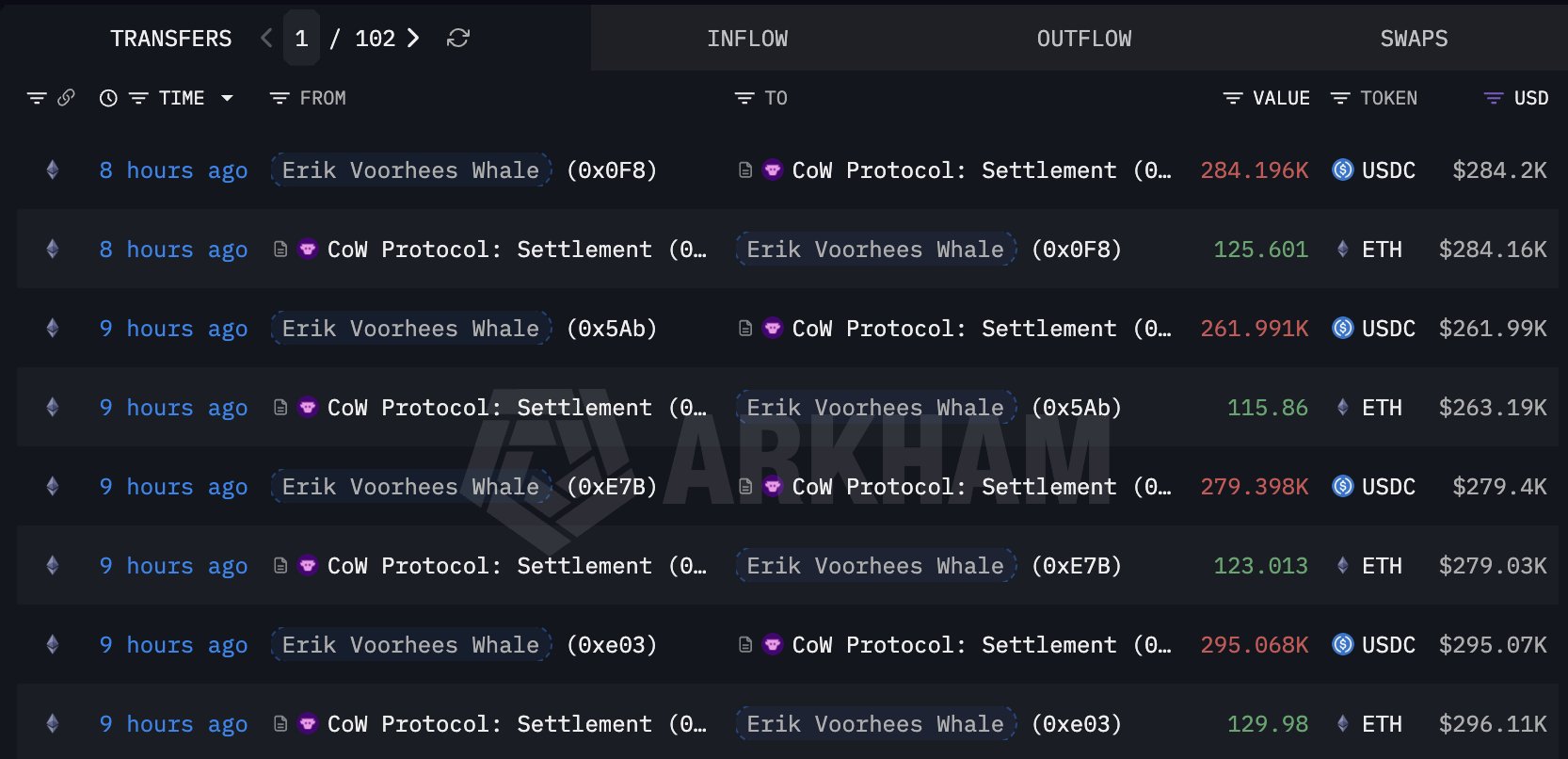
A wallet linked to Erik Voorhees, one of the earliest and most influential voices in crypto, now holds $292 million in Ethereum (ETH), and the timing of that accumulation is drawing comparisons that are difficult to dismiss.
The activity has sparked growing speculation that Ethereum’s price may be entering a structural setup similar to the supply squeeze recently seen with Venice Token (VVV), the AI-focused crypto project also founded by Voorhees.
But will Ethereum’s price follow Venice Token’s explosive rally?
Ethereum Sees Another Whale Accumulation
Recent on-chain tracking data revealed that a mysterious whale, which Lookonchain associated with Voorhees, has steadily accumulated tens of thousands of ETH.
Earlier today, the same wallet added 494 ETH to its holdings, bringing its total to 121,000 ETH.
Get These Top Crypto Casino Offers Now!
Sponsored
Disclosure
We sometimes use affiliate links in our content, when clicking on those we might receive a commission at no extra cost to you. By using this website you agree to our terms and conditions and privacy policy.
At current market prices, the position is estimated to be worth roughly $292 million.
Large whale accumulation alone is not unusual in crypto markets. For instance, Voorhees previously reduced ETH exposure last year.
So, the significance of this move might be worth watching, and could lie in the broader context of Ethereum’s current supply dynamics.
Ethereum’s liquid exchange balances have continued trending lower throughout 2026.
This is due to increased staking, rising institutional custody demand, and long-term self-custody trends, which remove more ETH from active circulation.
This combination is what many traders now compare to the “supply squeeze” conditions that fueled Venice Token’s explosive rally.
As CCN reported earlier, VVV recently became one of crypto’s top-performing AI assets. As a result, the price is only inches away from clinching a new all-time high.
Should this trend persist, there is a high likelihood that Ethereum’s price will rise soon.
What Else Is Happening?
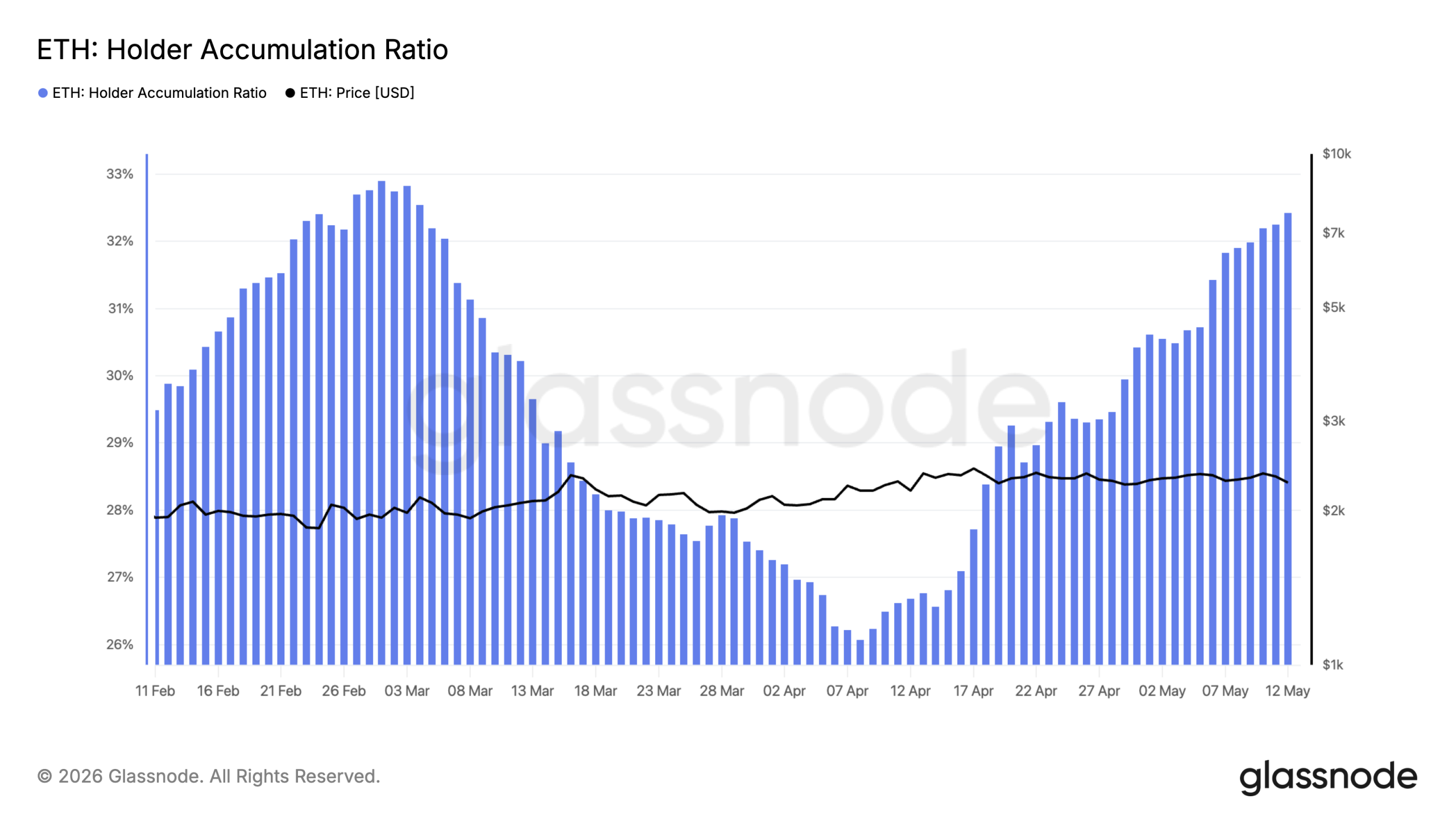
Outside that, on-chain data from Glassnode shows that the ETH holder accumulation ratio has been climbing since mid-April.
Roughly, it has moved from 26% to above 32%. During this period, Ethereum’s price remained relatively stable between $2,000 and $2,400.
This divergence is important because it suggests larger holders are accumulating aggressively despite ETH not yet breaking out in price.
So, the acceleration in accumulation over the past few weeks also suggests supply is gradually moving into stronger hands, potentially reducing sell pressure if demand increases.
If this trend continues alongside improving market sentiment, Ethereum’s price could be setting up for a delayed catch-up rally relative to BTC.
The main thing to watch is whether accumulation remains elevated during pullbacks.
If holders continue buying dips instead of distributing, it would reinforce the idea that this is still an accumulation phase.
ETH Price Forecast: Bullish
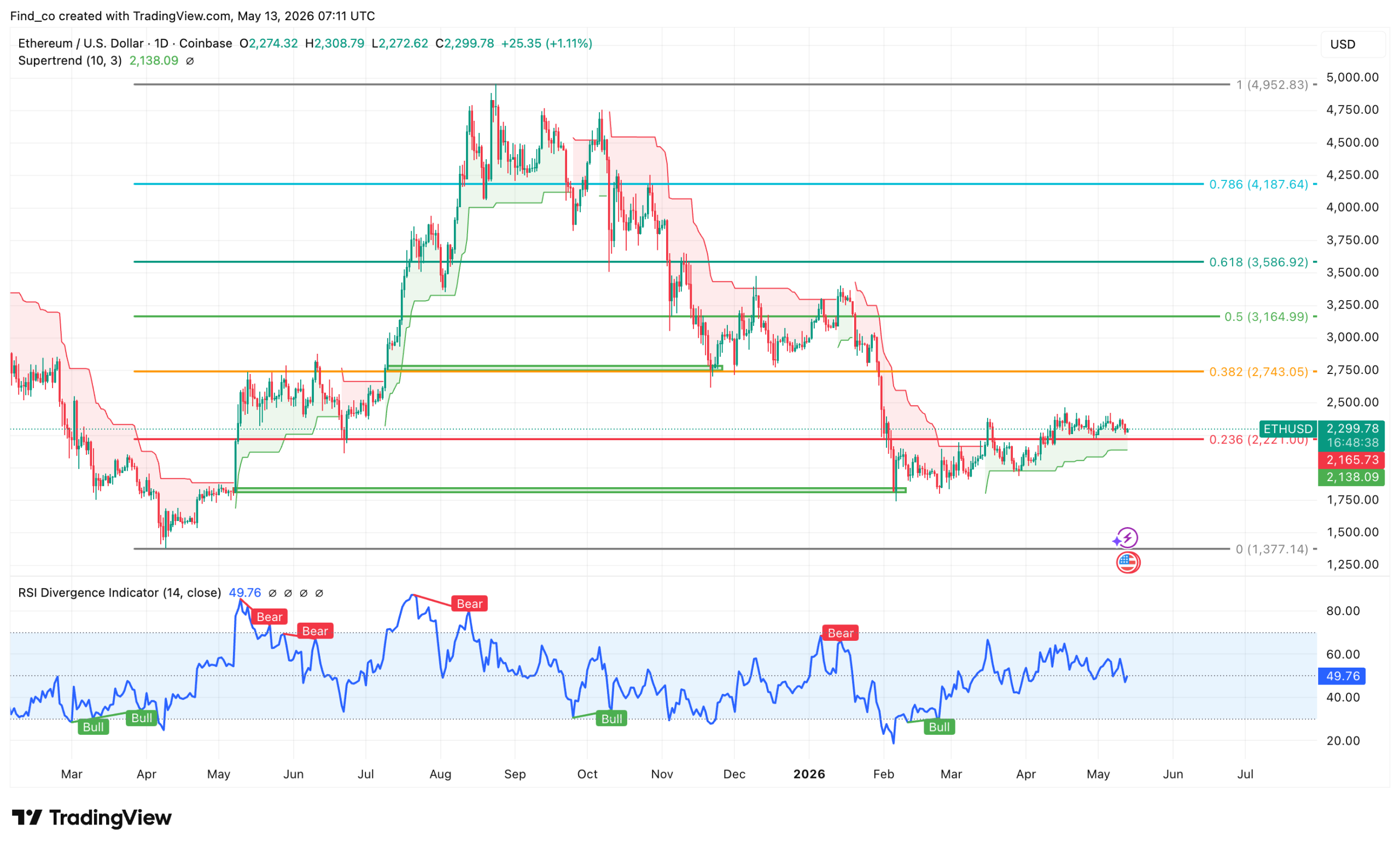
From a technical perspective, ETH is reclaiming bullish structure after holding the $1,800 support. Amid that, the Supertrend has flipped back upward around $2,140.
Notably, Ethereum’s price is now consolidating above the 0.236 Fibonacci level near $2,221, which is acting as an important support area.
The chart suggests ETH is building a base rather than showing exhaustion.
RSI near 50 shows momentum has cooled from previous overbought conditions, leaving room for another move higher if buying pressure returns.
As long as ETH’s price stays above the Supertrend and continues forming higher lows, the recovery trend remains intact.
If momentum continues, the next major upside targets are around $2,743, then $3,164, and potentially $3,586.
Disclaimer:
The information provided in this article is for informational purposes only. It is not intended to be, nor should it be construed as, financial advice. We do not make any warranties regarding the completeness, reliability, or accuracy of this information. All investments involve risk, and past performance does not guarantee future results. We recommend consulting a financial advisor before making any investment decisions.
Victor Olanrewaju is a crypto analyst and reporter at CCN with deep roots in on-chain research and technical analysis. His crypto journey began in 2017, but it was the 2020 Uniswap airdrop that sparked a full-time pivot into the space.
With a foundation in copywriting, Victor honed his craft creating high-converting content for leading crypto brokers — most notably an XRP price prediction that ranked #1 on Google during the 2021 bull run.
He later joined AMBCrypto in 2022, where he combined storytelling with technical and on-chain analysis to cover key market narratives.
In 2024, he expanded his expertise at BeInCrypto, collaborating with analysts and using tools like Glassnode, Santiment, and IntoTheBlock to break down Bitcoin and altcoin trends.
At CCN, Victor covers the top cryptocurrencies, memecoins, macro shifts, blending real-time insights with deep-dive metrics.
He holds a Bachelor’s degree in Physics from the University of Ibadan, equipping him to simplify complex data for a wide audience. Follow his work or connect on LinkedIn or X.