How DeSci, Blockchain and Brain Data Are Transforming Mental Health Research| Credit: Hameem Sarwar /CCN
Share
Blockchain is moving far beyond finance. It already supports global supply chains, digital identity systems, and healthcare data sharing, and now it is starting to change how science is done. Elata is part of this shift.
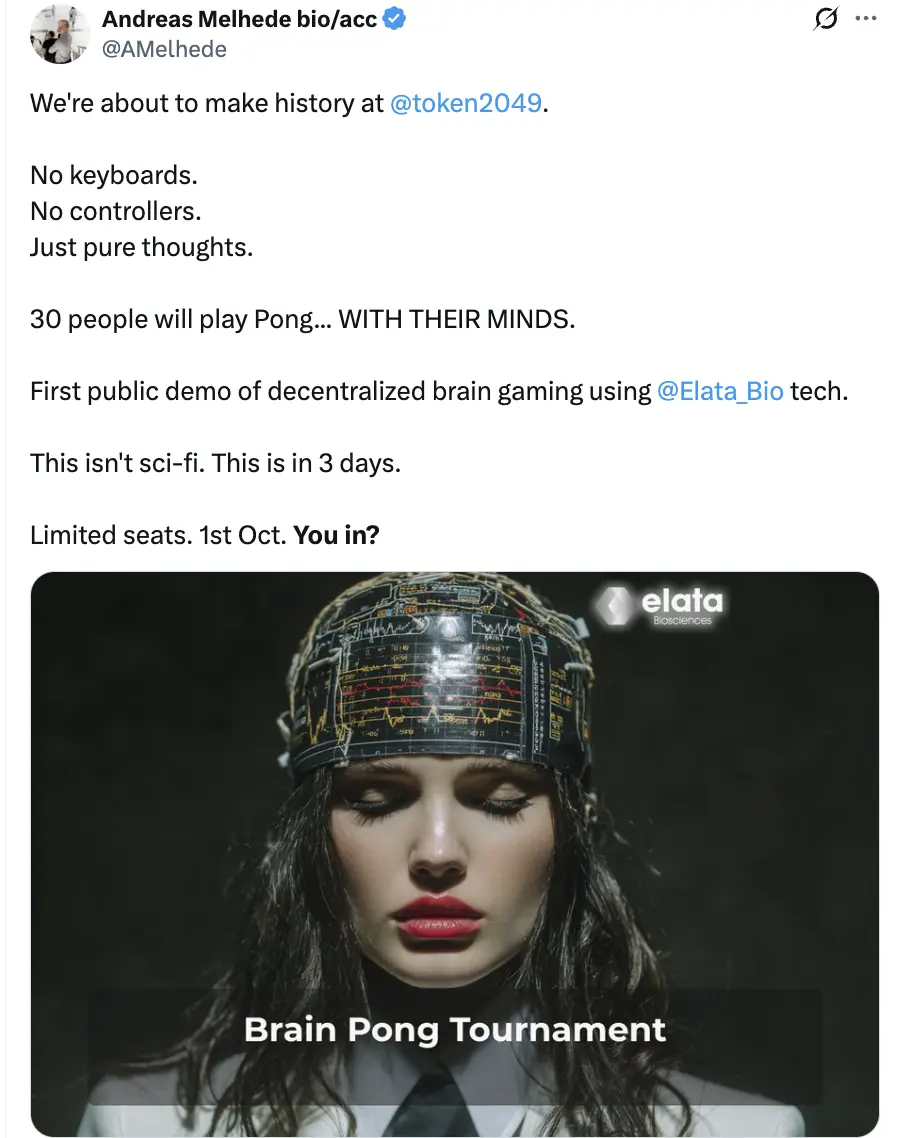
Ahead of Token2049, co-founder Andreas Melhede announced a live demonstration where 30 participants will play Pong using only their brain signals, with every interaction recorded on a decentralized network.
This demonstration highlights Elata’s goal of using brain-sensing technology and blockchain to generate neurodata in real time and make it available for research in a secure and transparent way.
In an exclusive interview with CCN, Andreas Melhede, co-founder of Elata, shared how Decentralized Science (DeSci) can transform mental health research.
He discussed how deeply personal experiences inspired him to build a decentralized neurotech ecosystem that links psychiatry, neuroscience, and blockchain.
Try Our Recommended Crypto Exchanges
Sponsored
Disclosure
We sometimes use affiliate links in our content, when clicking on those we might receive a commission at no extra cost to you. By using this website you agree to our terms and conditions and privacy policy.
The Inspiration Behind Elata’s DeSci DAO and ZORP Platform
When asked what inspired the creation of Elata and why a Decentralized Autonomous Organization (DAO) model was chosen, Melhede shared a very personal story:
“My inspiration for Elata comes from a deeply personal experience. My ex-girlfriend battled severe anxiety and depression that led to multiple suicide attempts. I found myself helpless in an unfamiliar country, navigating a fragmented mental health system, waiting long hours in emergency rooms not knowing if she’d make it.”
He explained that despite years of trial-and-error treatments, nothing brought meaningful improvement.
“This clearly revealed to me how fundamentally broken our mental healthcare paradigm is, particularly the lack of connection to biological markers.”
Elata’s response was to create ZORP, an open-source protocol for running experiments, paired with Elata EEG, a custom portable brain-sensing device, to generate high-quality neurodata.
“By building this infrastructure, we aim to enable personalized, biologically grounded treatments tailored to specific patient populations, moving beyond the trial-and-error approach that failed so many, including those close to me.”
The DAO model was a natural choice for its transparency and community-driven governance.
How Open Access and Tokens Can Reduce Peer Review Delays in Science
Peer review delays often slow scientific progress. While Elata is not directly building peer-review systems, Melhede emphasized their open approach:
“Our part is to ensure that all research and data produced via Elata are fully open access, open source, secure, and decentralized. This transparency naturally encourages broader participation and quicker dissemination, which indirectly accelerates verification and collaborative validation.”
Tokens also play a central role in rewarding contributions fairly. Researchers contributing Electroencephalogram (EEG) datasets or tools that improve data analysis receive tokens tied to the impact of their work.
“This collective governance helps minimize misuse or bias because no single entity controls incentives—checks and balances come from the token holder community actively shaping the open system.”
Balancing Privacy and Openness: How Elata Secures Psychiatric Research Data
Data accessibility remains one of psychiatry’s biggest hurdles. Elata prioritizes privacy while keeping research open:
“Patient data submissions are encrypted using public GPG/PGP keys,” meaning the data is locked with secure encryption so only the intended recipient can access it.
“The encrypted data is then stored in a decentralized manner on IPFS and Irys, with only encrypted content identifiers (CIDs) stored on-chain.”
He added that future plans include integrating zero-knowledge proofs (ZKP) to enhance privacy further.
Elata’s Approach to Transforming Psychiatry: Open Science, Incentives and Data-Driven Innovation
According to Melhede, Elata is tackling psychiatry’s most formidable challenges by combining neuroscience, data, and community input, using the following:
Open participation: Elata invites anyone motivated to contribute, including researchers, clinicians, and patients, ensuring that value creation comes from the whole community.
Incentivized collaboration: Rewards are distributed based on measurable contributions such as data, funding, or code, creating a fair and transparent system.
Data-driven innovation: Elata’s tools generate detailed biological data, enabling precise tracking of patient subpopulations and treatment outcomes.
Driving change: Work with partners like Spectruth DAO shows that biology-based treatments can outperform symptom-driven approaches. At the same time, interest in DeSci continues to grow despite the resistance of publishers and pharma.
Defining success: True success is measured by improved patient outcomes, global advancements in neuroscience, and the creation of reliable biological markers, rather than token price or DAO size.
Melhede sees DeSci playing an increasingly central role:
“When I entered the space in 2021, less than 10 projects existed; now there is a growing ecosystem recognized by top blockchain and traditional science organizations. I see a future where decentralized and traditional science co-exist, with DeSci driving open access, direct funding, community governance, and accelerated innovation.”
This future is already taking shape, with several projects showing how DeSci principles can solve long-standing challenges across multiple areas of science.
AminoChain: Decentralizing Biobanking
AminoChain, powered by Syndicate, applies DeSci principles using blockchain to store and share donated biological samples. It operates as a Layer 2 blockchain protocol tailored for enterprise healthcare apps.
Traditionally, biological samples like blood, tissue, or DNA are stored in different labs and hospitals, each with a private system. That makes it hard for researchers to know what samples exist, where they are, or how to request them.
AminoChain uses blockchain to connect over 20 biobanks (places that store these samples) into one searchable network. Instead of emailing multiple institutions or filling out separate forms, researchers can now search and request from a shared pool of 400,000 samples in one place.
The Specimen Center, launched in May 2025, is the actual platform where this happens. It is a kind of digital hub that lets scientists access samples more easily, with transparent tracking and permissions via blockchain. Because the data is stored on a blockchain, every action is recorded.
Samples remain traceable through privacy-preserving identifiers and can be reused across multiple studies, turning single donations into ongoing research assets.
This focus on access and patient involvement mirrors Elata’s mission to create richer neurodata and accelerate mental health breakthroughs.
VitaDAO: Community-Driven Longevity Research
VitaDAO is another example of how DeSci is reshaping science, this time focusing on aging and longevity. Instead of relying on traditional grant agencies or private investors, VitaDAO brings together a global community of token holders who pool resources to fund research projects.
Members vote on which proposals to support, deciding collectively which studies move forward.
This approach gives contributors a direct role in setting scientific priorities and turns early-stage biomedical research into a truly collaborative process.
These examples illustrate how DeSci is broadening its impact, moving beyond individual projects into a broader ecosystem where patients, researchers, and communities work together.
These initiatives demonstrate DeSci’s potential to reshape how research is funded, governed, and shared.
For Melhede and Elata, this future means a more connected, data-rich approach to mental health, one where reliable biological markers and open collaboration can finally move psychiatry beyond trial and error.
Disclaimer:
The information provided in this article is for informational purposes only. It is not intended to be, nor should it be construed as, financial advice. We do not make any warranties regarding the completeness, reliability, or accuracy of this information. All investments involve risk, and past performance does not guarantee future results. We recommend consulting a financial advisor before making any investment decisions.
Dr. Lorena Nessi is an award-winning journalist and media technology expert with 15 years of experience in digital culture and communication. Based in Oxfordshire, UK, she combines academic insight with hands-on media practice.
She holds a PhD in Communication, Sociology, and Digital Cultures, and an MA in Globalization, Identity, and Technology.
Lorena has taught at Fairleigh Dickinson University, Nottingham Trent University, and the University of Oxford. She is a former producer for the BBC in London, with additional experience creating television content in Mexico and Japan.
Her research focuses on digital cultures, social media, technology, capitalism, and the societal impact of blockchain innovation.
She has written extensively on digital media and emerging technologies, with her work featured in both academic and media platforms. Her Web3 expertise explores how blockchain technologies shape culture, economics, and decentralized systems.
Outside of work, Lorena enjoys reading science fiction, playing strategic board games, traveling, and chasing adventures that get her heart racing. A perfect day ends with a relaxing spa and a good family meal.


 Easy
Easy