X to Launch In-App Crypto & Stock Trading — Is This the Robinhood Killer?
Share
Key Takeaways
X will soon launch Smart Cashtags, allowing users to trade stocks and crypto straight in the app.
Musk envisions X as the central hub for all monetary transactions, which might disrupt existing brokers.
X, unlike Robinhood, has unique social connectivity but lacks advanced features like options trading or asset tokenization.
Regulatory barriers, such as compliance and potential SEC oversight, could influence the feature’s user adoption.
X (formerly known as Twitter) is currently transforming into an “everything app” by integrating financial services directly into its interface. On February 14, 2026, the Head of Product at X, Nikita Bier, confirmed that the social platform will launch cryptocurrency and stock trading within the next couple of weeks.
I genuinely want crypto to proliferate on X, but applications that create incentives to spam, raid, and harass random users is not the way.
It meaningfully degrades the experience for millions of people — only to enrich a few people.
Besides a 15% Dogecoin (DOGE) surge to $0.11, the news sparked discussions: Will established firms like Robinhood, which have made a name on user-friendly trading, be challenged by this integration?
This article delves into the launch details, comparisons, and broader ramifications, exploring what this can mean for investors and the industry.
What Is X’s New Trading Feature?
Convenience isn’t the only reason for the app update: Elon Musk wants to make X into an “everything app,” like WeChat, where users manage payments, investing, and chatting all in a single place. Musk has described X as potentially becoming “the place where all money is,” with around 600 million monthly users as a built-in audience. With no need for additional apps or brokers, newbies may find a stock or token mentioned in a post, tap and trade it right away.
This is wrong. X is not handling trade execution or acting as a brokerage. Just building the financial data tools and links.
Historically, traders have used X to track market sentiment before moving to third-party apps like Coinbase or Robinhood to execute trades. This friction often results in lost time and missed entries. By removing these barriers, X is positioning itself as a primary liquidity hub.
Why now?
Since Musk’s acquisition of X in 2022, the crypto market has matured, despite recent Bitcoin (BTC) turmoil. The retail trading environment is increasingly driven by social sentiment. Integrating trading tools directly where the conversation happens could fundamentally change market dynamics, making it a primary financial terminal for the average user. X’s move taps into this, making finance more democratized.
X’s Smart Cashtags Explained
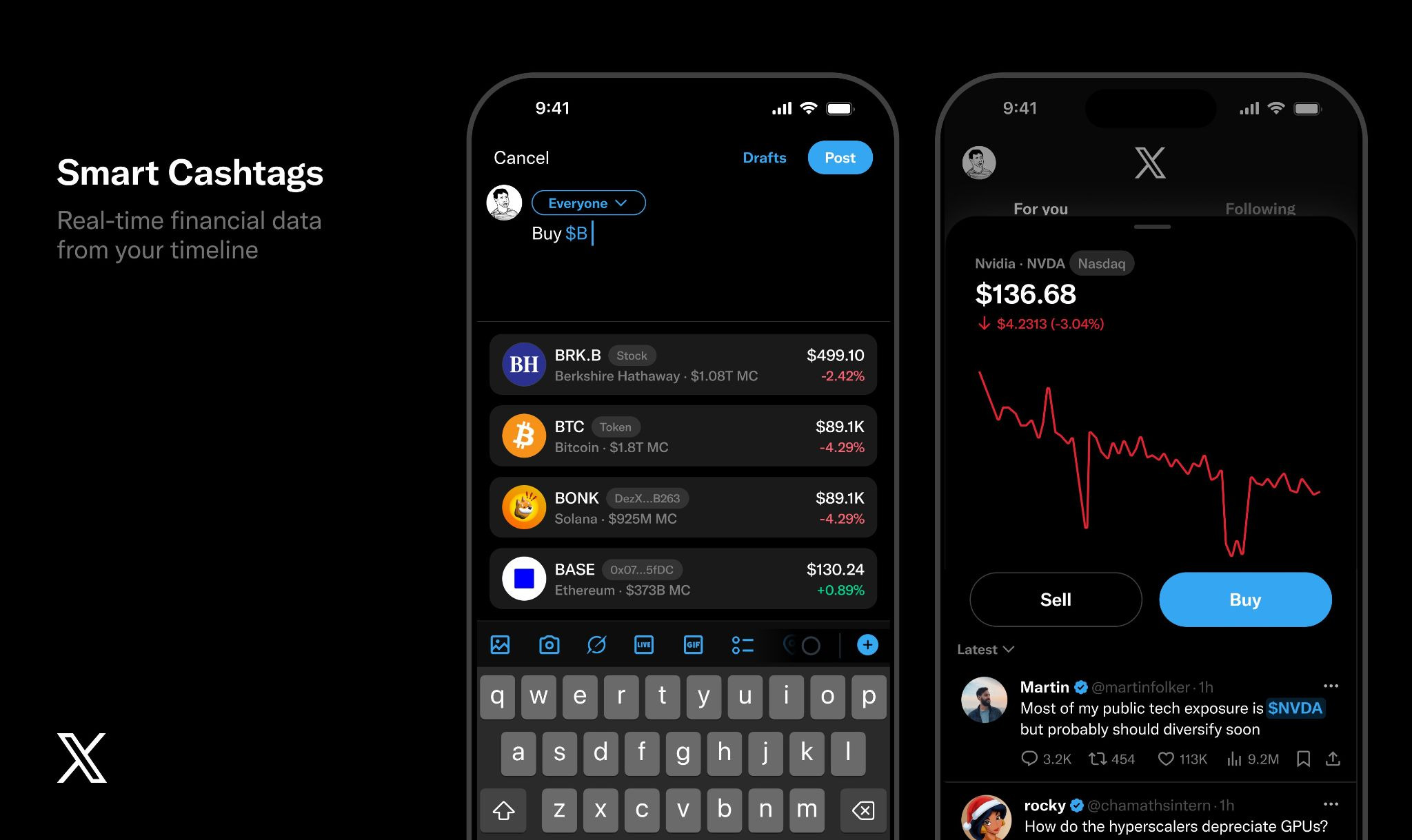
The technical backbone of X’s new trading suite revolves around “Smart Cashtags.” Currently, users can search for a ticker symbol like $BTC or $TSLA to see price charts. The upcoming update will transform these static charts into interactive trading portals. Tapping one reveals real-time prices, charts from sources like TradingView, aggregated posts, and trade options.
Reports from Bitcoin.com confirm that X is partnering with established fintech providers to handle the backend brokerage infrastructure. This allows X to offer trading without immediately becoming a licensed bank itself.
This integration is expected to include both spot trading for cryptocurrencies and traditional equities. By leveraging its existing user base, X can bypass the high customer acquisition costs that traditional firms face.
Display of X’s Smart Cashtags interface | Credit: Nikita Bier’s X
X vs. Robinhood: Trading Competition
Is X really a ‘Robinhood killer”? Both X and Robinhood offer trading to retail investors, but the extent and integration vary.
With 27M accounts, Robinhood, a trading app that was created in 2013, now offers stocks, options, crypto, futures, staking, and tokenized assets, including U.S. stocks on Arbitrum. Decentralized Finance (DeFi) composability and round-the-clock trading are supported by the Robinhood Chain testnet.
X emphasizes social discovery: trades are based on timelines, which combine news and action. While features like Smart Cashtags will offer real-time data and redirects, they will be unlikely to have Robinhood’s advanced features, such as prediction markets with 12B contracts in 2025, or credit cards.
X’s audience of 650M exceeds Robinhood’s, potentially pushing volume; yet, Robinhood’s $4.5B sales and $324B assets indicate maturity. X could “kill” Robinhood by leveraging social virality, but Robinhood’s ecosystem depth suggests coexistence.
Regulatory Considerations for X Trading
Launching trading features involves navigating complex regulations that vary by country. X holds U.S. money transmitter licenses but faces scrutiny under SEC rules for investment services and EU financial laws for crypto promotions.
Security is another major concern. Social media accounts are frequently targeted by hackers via SIM swapping. If a user’s X account is compromised, their financial portfolio could be at risk. X will likely need to implement mandatory two-factor authentication (2FA) and hardware key support for all trading-enabled accounts. By redirecting trades, X avoids broker status, but must also address spam-Bier noted restrictions on apps incentivizing raids. Let’s not forget market manipulation. Musk’s past tweets have moved markets, like DOGE surges, raising questions about fair trading. With the ability to trade directly on the platform, the line between a “hot take” and “financial advice” becomes blurred. How will X handle influential accounts that might “pump and dump” assets to their followers?
Why Investors Should Care About X’s Crypto Trading Launch
The trading feature of X is more than just another app, it’s a symbol of how finance and everyday digital life are merging. Although it makes the entry barrier lower for retail investors, it requires caution due to market and regulatory concerns. As X connects the social and financial territories, further solidifying “Crypto Twitter,” this development emphasizes the importance of understanding systems, from on-chain data to liquidity mechanics.
Whether it dethrones Robinhood remains probabilistic, but it expands choices.
Smart Cashtags are interactive tickers on X that display live prices, charts, and enable direct trading of stocks and crypto.
Is it safe to trade on a social media app?
Security depends on your account protection, such as 2FA and the platform’s underlying encryption.
How does X's trading differ from Robinhood?
X focuses on social integration and discovery, while Robinhood offers advanced tools like futures and staking.
Does Robinhood offer features that X will unlikely have?
Robinhood provides advanced financial tools like IRA matching, retirement accounts, and 24/7 dedicated customer support.
Will X trading impact crypto prices?
Yes, by amplifying social sentiment, but it could also increase volatility and speculation risks for users.
Disclaimer:
The information provided in this article is for informational purposes only. It is not intended to be, nor should it be construed as, financial advice. We do not make any warranties regarding the completeness, reliability, or accuracy of this information. All investments involve risk, and past performance does not guarantee future results. We recommend consulting a financial advisor before making any investment decisions.
Curious about how technology and crypto reshape global finance, Elizaveta Savenko explores blockchain, AI, decentralized systems, their applications, and regulatory requirements. She contributes to research, educational initiatives, and industry collaborations, examining trends in digital assets and fintech innovation, increasing awareness of the crypto space and its impact on financial systems.


 Easy
Easy