A 22% price surge follows the Brevis mainnet launch | Credit: Veronica Cestari
Share
Key Takeaways
Brevis is a ZK “coprocessor” that enables smart contracts to utilize cross-chain data by proving results off-chain.
The Jan. 5 TGE and mainnet launch triggered exchange listings and airdrops, causing a 22% price spike.
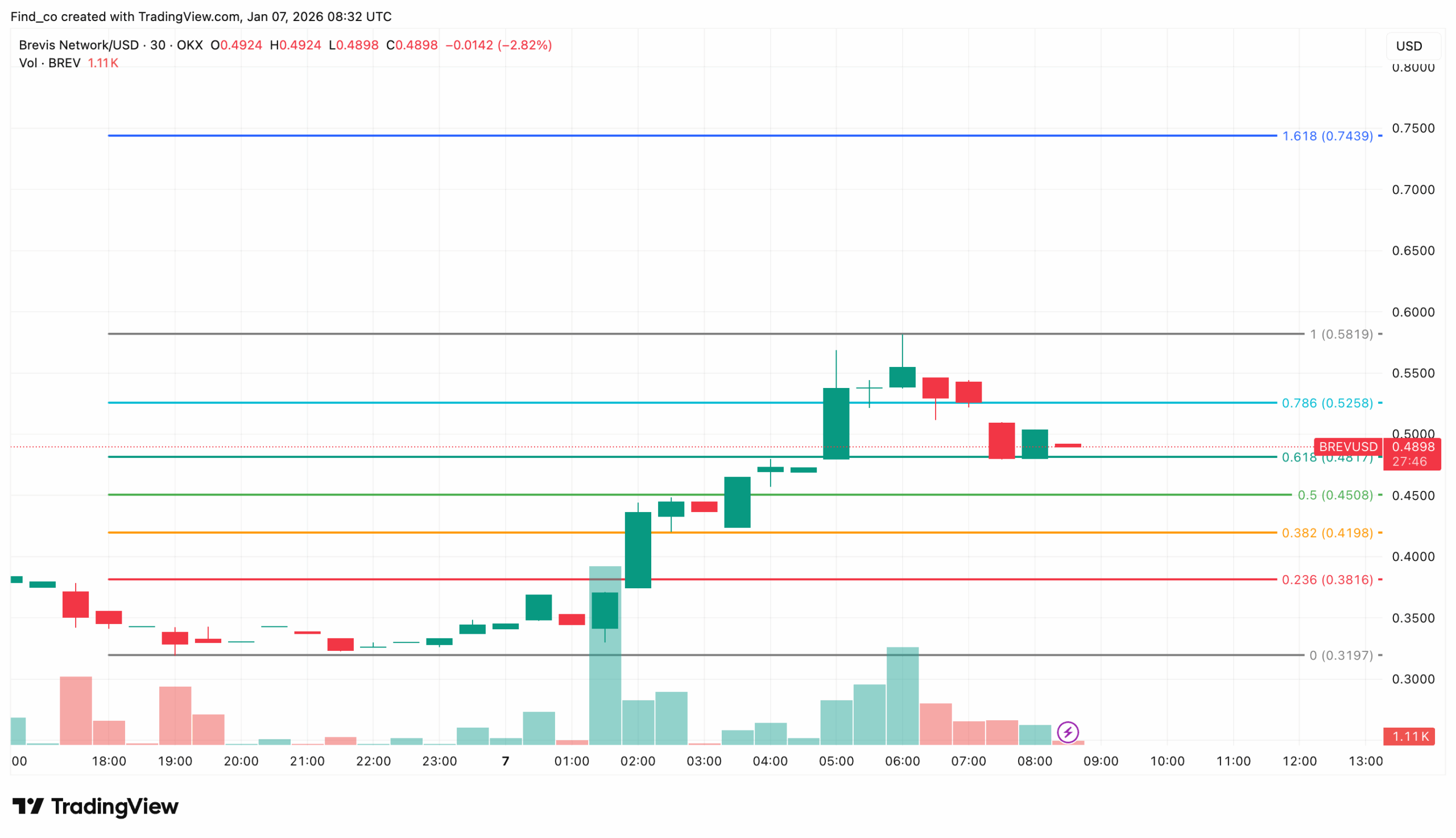
If demand holds, BREV could push toward $0.74, but if early sellers dominate, it could retrace toward $0.42
Brevis (BREV) has successfully cleared its first hurdle, riding a wave of exchange-driven momentum to a 22% price spike within 24 hours of its mainnet debut.
However, the path ahead is far from easy despite making a loud entrance.
As the initial hype of the Jan.5 Token Generation Event (TGE) begins to settle, the protocol enters its most critical phase.
Can the Brevis crypto convert its 20x faster proof generation into the sustained developer adoption required to justify its $450 million FDV?
It targets a core limitation in smart contracts: they cannot efficiently process large volumes of historical or cross-chain data without triggering heavy gas costs.
Brevis solves this by offloading the heavy computation off-chain. Then it sends the result back to the main chain with a concise ZK proof that verifies the output.
As a result, developers can build more data-rich decentralized Applications (dApps) without sacrificing security or decentralization.
How Does Brevis Work?
Think of Brevis like a GPU for blockchains. The chain itself acts like the CPU. It confirms transactions and updates the state. Meanwhile, Brevis handles the heavy math and deep data work in the background.
Then it returns a concise proof that the result is correct.
Usually, contracts can’t efficiently read old on-chain history or cross-chain data without high gas costs.
With the Brevis crypto project, a contract can ask questions like: “What was this wallet’s balance two years ago?” and still get a verifiable answer.
It also includes Pico zkVM, which is a high-performance virtual machine for writing advanced logic in Rust.
Pico runs the computation off-chain, then generates a zero-knowledge proof that confirms the program executed correctly. That way, the chain can verify the result without having to redo the work.
Finally, Brevis uses ProverNet to decentralize proof generation. It functions like a marketplace where specialized provers compete to produce ZK proofs.
This competition can reduce costs, improve speed, and maintain the system’s scalability as demand grows.
The BREV Airdrop and Tokenomics
Interestingly, Brevis finally launched on Mainnet on Jan. 5. On the same day, it introduced the BREV token, along with an airdrop for early adopters.
Furthermore, the project set aside 15,000,000 BREV (1.5%) for the Binance HODLer Airdrop.
It also allocated an additional 5,000,000 BREV (0.5%) for marketing purposes. That brings the Binance-linked allocation to 20,000,000 BREV.
Notably, those 20 million tokens come from a larger 35,000,000 BREV airdrop/incentive pool. In other words, Binance accounts for more than half of that distribution bucket.
In terms of tokenomics, the Brevios crypto has a maximum supply of 1 billion tokens. However, as of this writing, only 250 million are in circulation. But that’s not all.
Interestingly, the Mainnet launch also triggered several exchange listings. Many platforms listed Brevis almost immediately. Some of the exchanges involved include:
Upbit
Coinbase
Binance
Bithumb
Kraken
OKX
BREV Price Prediction
At the time of writing, the Brevis crypto is hovering around $0.50. However, it is still too early to make a firm call on where the price goes next.
Liquidity is still settling, early holders are still adjusting positions, and volatility can stay elevated. As a result, the token can swing sharply in either direction before a clearer trend forms.
If buying pressure increases, BREV’s price might rally to a new high of $0.74.
Disclaimer:
The information provided in this article is for informational purposes only. It is not intended to be, nor should it be construed as, financial advice. We do not make any warranties regarding the completeness, reliability, or accuracy of this information. All investments involve risk, and past performance does not guarantee future results. We recommend consulting a financial advisor before making any investment decisions.
Victor Olanrewaju is a crypto analyst and reporter at CCN with deep roots in on-chain research and technical analysis. His crypto journey began in 2017, but it was the 2020 Uniswap airdrop that sparked a full-time pivot into the space.
With a foundation in copywriting, Victor honed his craft creating high-converting content for leading crypto brokers — most notably an XRP price prediction that ranked #1 on Google during the 2021 bull run.
He later joined AMBCrypto in 2022, where he combined storytelling with technical and on-chain analysis to cover key market narratives.
In 2024, he expanded his expertise at BeInCrypto, collaborating with analysts and using tools like Glassnode, Santiment, and IntoTheBlock to break down Bitcoin and altcoin trends.
At CCN, Victor covers the top cryptocurrencies, memecoins, macro shifts, blending real-time insights with deep-dive metrics.
He holds a Bachelor’s degree in Physics from the University of Ibadan, equipping him to simplify complex data for a wide audience. Follow his work or connect on LinkedIn or X.