BTC forms a head-and-shoulders pattern as long-term holders stay firm | Credit: Veronica Cestari
Share
Key Takeaways
Despite optimism earlier in the month, BTC has fallen from near $120,000 to around $109,000.
A decline in CDD and low NUPL indicate holders are not selling, signaling strength this Halloween.
BTC faces resistance at $112,291 and support near $105,000, but what is next for the coin?
October’s final stretch has brought a different kind of tension to the crypto market.
At the beginning of the month, market participants were optimistic that the month would offer higher highs. During that period, Bitcoin’s (BTC) price was close to $120,000.
Unfortunately, that has not been the case as Bitcoin’s price has dropped below $110,000 on Halloween.
However, long-term holders, often the backbone of stability, are reportedly not offloading their positions.
If this remains the same, here is how BTC might perform this Halloween period.
In 2023, it stood at $34,479, indicating that BTC’s market value had climbed by over 50% year-over-year.
While this year’s gains aren’t as much as those seen in earlier cycles, it appears that Bitcoin may avoid a major correction.
Get These Top Crypto Casino Offers Now!
Sponsored
Disclosure
We sometimes use affiliate links in our content, when clicking on those we might receive a commission at no extra cost to you. By using this website you agree to our terms and conditions and privacy policy.
One metric supporting this outlook is the Bitcoin Coin Days Destroyed (CDD), which, according to Glassnode data, has declined notably in recent weeks.
A falling CDD suggests that long-term holders are less active, implying reduced selling pressure and lower volatility.
This trend suggests that older coins remain dormant, while newer coins dominate trading volume, indicating accumulation and growing confidence among holders.
Historically, such behavior reflects a healthy market structure, where participants hold BTC in anticipation of higher prices, preceding periods of rising prices.
If the current trend persists, long-term holders could help Bitcoin’s price maintain support near $105,000, acting as a stabilizing force amid short-term market fluctuations.
However, traders may need to stay cautious.
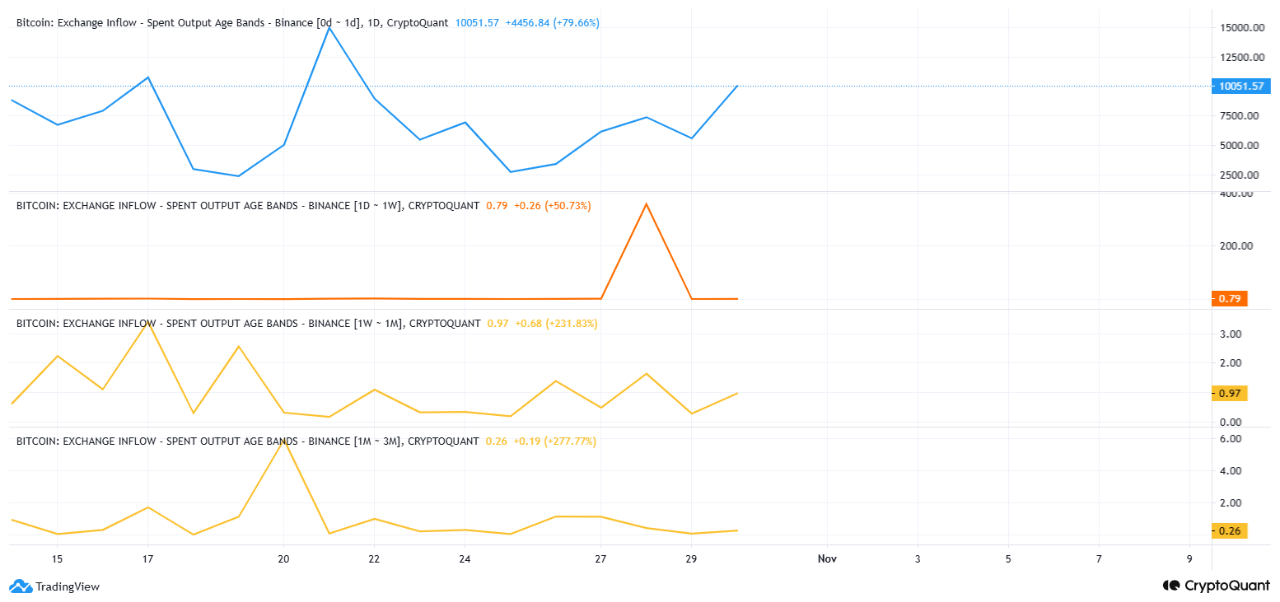
For example, many participants expected the recent Fed rate cut to spark an immediate price rally. Instead, volatility spiked.
During this period, over 10,000 BTC flowed into Binance, signaling selling pressure from retail investors.
In contrast, long-term holders (those who have held their coins for at least six months) refrained from sending BTC to exchanges.
This divergence between retail activity and long-term investor conviction highlights that, despite short-term uncertainty, Bitcoin’s price action remains fundamentally strong.
If history rhymes, the current pullback could represent the final shakeout for short-term traders, while long-term holders provide support for the next breakout.
BTC Price Analysis
From a technical standpoint, the daily chart reveals that Bitcoin’s price has formed a head-and-shoulders pattern.
This typically signals potential trend exhaustion or reversal.
However, in this case, bullish momentum appears to be offsetting the usual bearish implications.
The Money Flow Index (MFI) has risen, reflecting buying pressure, which helped BTC breach resistance at $108,982.
On the other hand, if selling pressure resurfaces, the pattern may fail to confirm, leading to a pullback toward $103,633, where bulls may once again attempt to defend the support level.
Disclaimer:
The information provided in this article is for informational purposes only. It is not intended to be, nor should it be construed as, financial advice. We do not make any warranties regarding the completeness, reliability, or accuracy of this information. All investments involve risk, and past performance does not guarantee future results. We recommend consulting a financial advisor before making any investment decisions.
Victor Olanrewaju is a crypto analyst and reporter at CCN with deep roots in on-chain research and technical analysis. His crypto journey began in 2017, but it was the 2020 Uniswap airdrop that sparked a full-time pivot into the space.
With a foundation in copywriting, Victor honed his craft creating high-converting content for leading crypto brokers — most notably an XRP price prediction that ranked #1 on Google during the 2021 bull run.
He later joined AMBCrypto in 2022, where he combined storytelling with technical and on-chain analysis to cover key market narratives.
In 2024, he expanded his expertise at BeInCrypto, collaborating with analysts and using tools like Glassnode, Santiment, and IntoTheBlock to break down Bitcoin and altcoin trends.
At CCN, Victor covers the top cryptocurrencies, memecoins, macro shifts, blending real-time insights with deep-dive metrics.
He holds a Bachelor’s degree in Physics from the University of Ibadan, equipping him to simplify complex data for a wide audience. Follow his work or connect on LinkedIn or X.