ASTER price targets $1 return — here is why | Credit: Veronica Cestari
Share
Key Takeaways
Aster officially launched the Aster Chain Mainnet, transitioning into a privacy-first L1 blockchain.
To coincide with the launch, the Aster project will initiate a Public Staking Program within a week.
ASTER is currently consolidating near $0.74, but analysis shows it has opened the path to $1.
Something significant happened on March 17 as Aster Chain went live.
And with that, ASTER’s entire thesis shifted from a multi-chain DEX token into something considerably more compelling.
Now the altcoin is the native asset of a sovereign, privacy-first Layer 1 blockchain engineered specifically to solve the problems that centralised exchanges have exploited for years.
As a result of the move, it appears that ASTER’s price could be ready to retest $1.
But the question is — will it?
What Is the Aster Chain?
For context, the Aster Chain is not a generic Layer 1 network. Instead, the project noted that it is built on a zero-knowledge architecture.
So by default, the chain hides order flow and liquidation levels.
Consequently, predatory traders cannot scan the chain for visible leverage positions and hunt liquidation levels — a practice that costs DeFi participants billions of dollars annually on transparent chains.
Additionally, performance is not a compromise. Aster Chain delivers 50-millisecond block times and 100,000 transactions per second.
Interestingly, the network also launched with a native bridge to BNB Chain from the start, alongside bridges to Arbitrum and Solana.
“Aster Chain is a purpose-built L1 for derivatives trading. 50ms block time. Up to 100,000 TPS. Zero gas. Cross-chain deposits live from BNB Chain, Arbitrum, Ethereum, and Solana,” The Aster official X handle revealed.
ASTER Price Extends Increase After Development
Following the launch, ASTER’s price surged. Before that, the altcoin spent six weeks quietly building one of the most orderly recovery structures in this series.
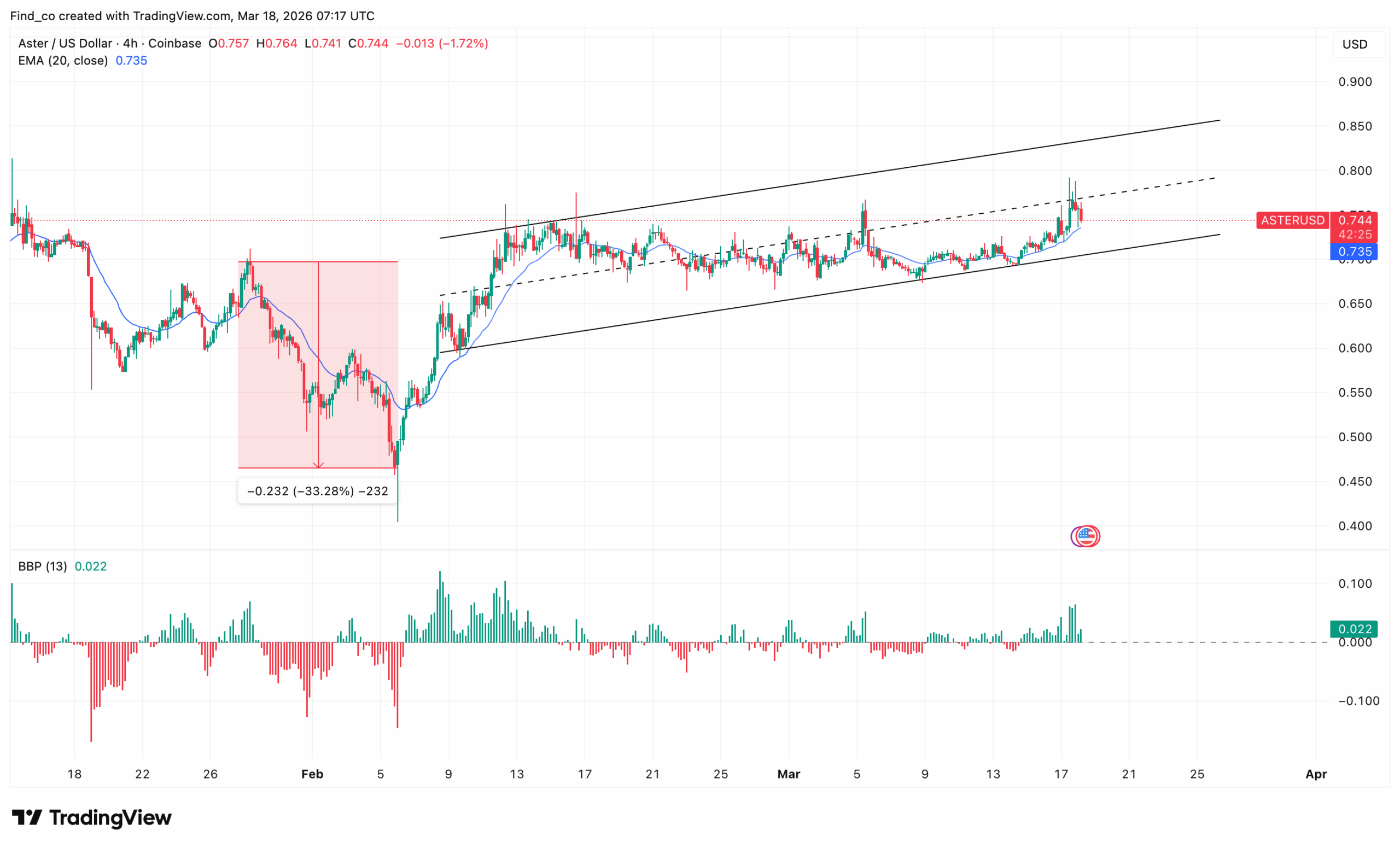
ASTER trades at $0.74 and is consolidating after yesterday’s push to $0.80.
Following the brutal 33.28% crash from $0.73 to $0.40 in late January and early February, the price has spent the entire period since constructing an ascending parallel channel
The 20-EMA at $0.74 is rising in lockstep with the channel’s lower boundary, acting as support on every pullback.
Each time ASTER’s price has dipped toward the EMA through February and March, buyers have stepped in.
Meanwhile, the Bull Bear Power (BBP) at 0.022 has been persistently positive since Feb. 9.
Crucially, it has not produced a single sustained negative reading throughout the channel. That’s a sign of underlying buyer dominance.
As it stands, the immediate test is the horizontal resistance near $0.76. If bulls break it, the channel’s upper boundary near $0.85 opens as the next target.
Other Catalysts to Watch
Beyond the technical outlook and chain deployment, Aster is also launching its public staking programme for ASTER holders later this week.
By the look of things, this could have a direct consequence for ASTER’s price. Once it goes live, every token staked is a token removed from available sell-side liquidity.
Hence, this could drive a supply squeeze in the crypto market. Another possible catalyst driving the ASTER price higher is the deflationary buyback.
Aster allocates up to 80% of platform fees to buy back the crypto from the open market. This buyback mechanism creates a persistent, protocol-level demand floor beneath the cryptocurrency’s market value.
In addition, if the Aster Chain captures between 10% and 20% of the perpetual DEX market share (which seems realistic), the resulting fee generation would create buyback pressure of sufficient scale to force a break above $1 on its own.
ASTER Price Outlook: No Breakdown Yet
Meanwhile, the daily chart adds the macro context to the 4-hour chart. And it reveals a setup with far more upside potential than the channel alone suggested.
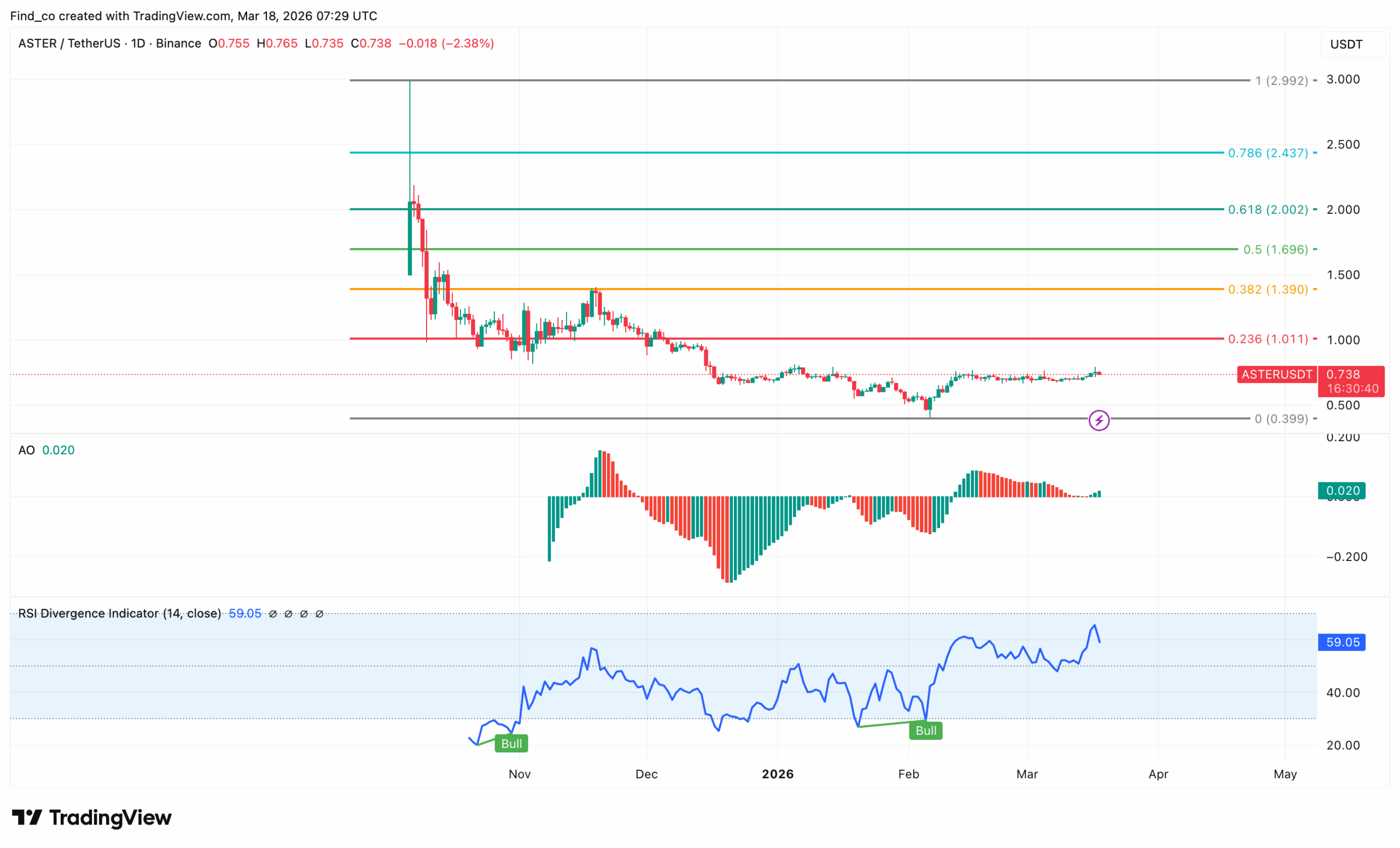
At the time of writing, ASTER is consolidating below the 0.236 Fib at $1.01. That level is the first major hurdle on the Fibonacci ladder, and clearing it would represent a significant structural milestone.
In addition, two RSI Bull divergence signals have printed on this chart. The first was fired in October 2025. The second confirmed at the February lows — exactly as ASTER’s price touched the $0.40 support.
Both prior Bull signals preceded sustained recoveries. The second signal, consequently, is the one that sets everything in motion now.
Meanwhile, the Awesome Oscillator (AO) has crossed above zero for the first time since November. For ASTER’s price, the AO zero-cross is happening quietly, without fanfare, while it remains well below its Fibonacci targets.
The full ladder above is the long-term roadmap. Should buying pressure increase, ASTER’s price might jump to $1.01 (0.236).
In the short term, it could also hit $1.39 (0.382) or reach $1.70 (0.5). However, in the long run, the altcoin could retest $2 (0.618), while intensified demand could push it to $2.437 (0.786).
On the contrary, if bears take over, this prediction might not happen. Instead, ASTER might decline to $0.40.
Disclaimer:
The information provided in this article is for informational purposes only. It is not intended to be, nor should it be construed as, financial advice. We do not make any warranties regarding the completeness, reliability, or accuracy of this information. All investments involve risk, and past performance does not guarantee future results. We recommend consulting a financial advisor before making any investment decisions.
Victor Olanrewaju is a crypto analyst and reporter at CCN with deep roots in on-chain research and technical analysis. His crypto journey began in 2017, but it was the 2020 Uniswap airdrop that sparked a full-time pivot into the space.
With a foundation in copywriting, Victor honed his craft creating high-converting content for leading crypto brokers — most notably an XRP price prediction that ranked #1 on Google during the 2021 bull run.
He later joined AMBCrypto in 2022, where he combined storytelling with technical and on-chain analysis to cover key market narratives.
In 2024, he expanded his expertise at BeInCrypto, collaborating with analysts and using tools like Glassnode, Santiment, and IntoTheBlock to break down Bitcoin and altcoin trends.
At CCN, Victor covers the top cryptocurrencies, memecoins, macro shifts, blending real-time insights with deep-dive metrics.
He holds a Bachelor’s degree in Physics from the University of Ibadan, equipping him to simplify complex data for a wide audience. Follow his work or connect on LinkedIn or X.