ASTER forms a rising wedge as momentum weakens near resistance.
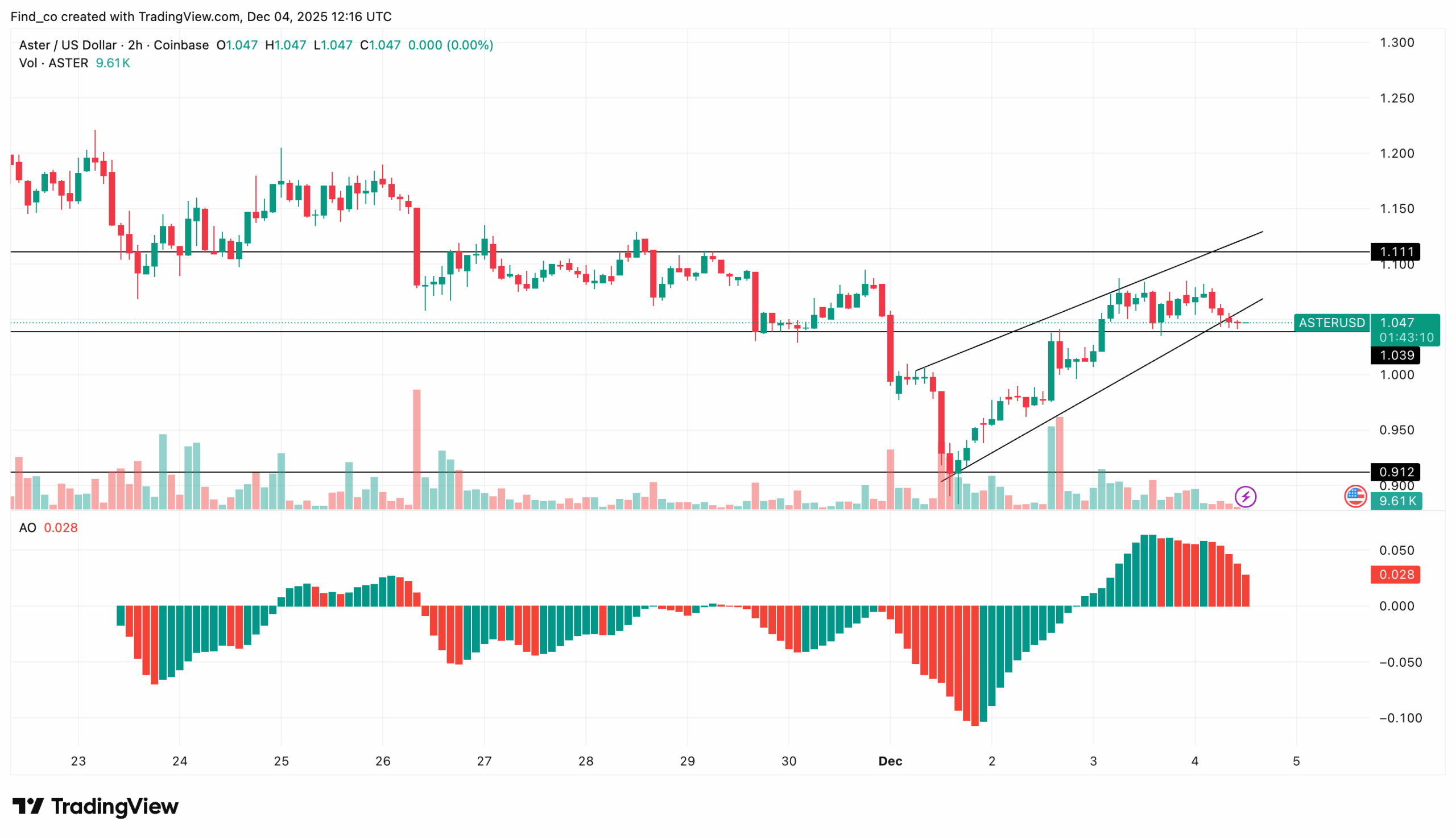
Failure to breach the resistance at $1.11 could result in a decline to $0.88.
Bullish divergence and MACD crossover support a potential rebound
ASTER, the native token of decentralized exchange Aster, saw its price jump in October.
However, over the past seven days, ASTER’s price has decreased by 3.15%, with indications that the altcoin may continue to decline.
Despite that, it does not seem that the cryptocurrency will undergo an extended correction.
Aster Keeps Losing Strength
Looking at the 2-hour chart, ASTER’s price has been forming a pattern of higher lows and higher highs. This reflected short-term bullish momentum.
However, this structure has also developed into a rising wedge, a pattern that typically signals a potential bearish reversal if support eventually breaks.
Get These Top Crypto Casino Offers Now!
Sponsored
Disclosure
We sometimes use affiliate links in our content, when clicking on those we might receive a commission at no extra cost to you. By using this website you agree to our terms and conditions and privacy policy.
If the market fails to generate enough bullish pressure to break above $1.11, the wedge is more likely to resolve downward.
If this rejection occurs, ASTER’s price risks dropping below the $1.04 support level.
Project Unveils 2026 Plans
Amid this move, Aster revealed that it will launch its layer-1 (L1) chain in the first quarter of 2026.
A native L1 chain signals a shift toward expanded utility and improved scalability for the ecosystem.
“2025 was about proving Aster can ship: we merged Astherus & ApolloX, launched multi-asset margin, released our mobile app, completed TGE, listed on major CEXs, and introduced features like Hedge Mode, Trade & Earn, and our buyback program, and more. Now we’re doubling down on three foundational engines—Infrastructure, Token Utility, and Ecosystem & Community—each reinforcing the others in continuous cycle,” The project disclosed.
However, despite the positive implications of the announcement, the market has not fully reacted with sustained bullish momentum.
The technical setup continues to show signs of strain, and buyers appear cautious as the rising wedge tightens.
While the L1 launch may strengthen Aster’s long-term outlook, its short-term price action still depends heavily on several key levels.
ASTER Price Analysis
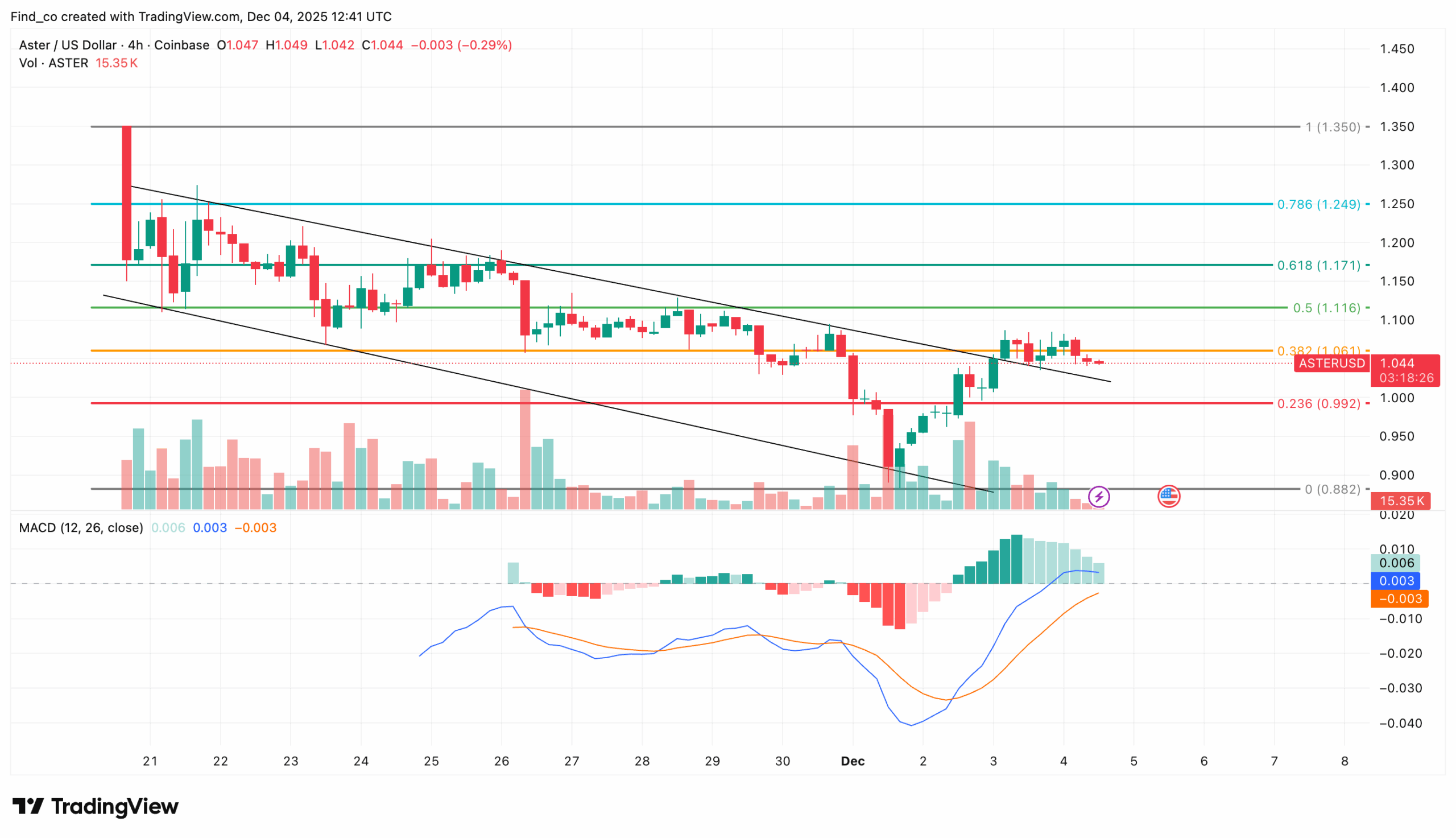
On the daily chart, ASTER’s price has developed a bullish divergence, despite its market value continuing to fall.
This signal appears when bearish momentum is weakening beneath the surface, hinting at a potential trend reversal. S
upporting this idea, the Moving Average Convergence Divergence (MACD) has produced a bullish crossover.
Still, for the reversal to fully take hold, buying pressure needs to increase and remain consistent.
If that strength emerges, ASTER could move toward $1.17, which represents the next significant upside target.
Along the way, the market will closely watch two key levels: $0.99, aligned with the 0.236 Fibonacci retracement, and $1.11, positioned at the 0.50 Fib level.
Disclaimer:
The information provided in this article is for informational purposes only. It is not intended to be, nor should it be construed as, financial advice. We do not make any warranties regarding the completeness, reliability, or accuracy of this information. All investments involve risk, and past performance does not guarantee future results. We recommend consulting a financial advisor before making any investment decisions.
Victor Olanrewaju is a crypto analyst and reporter at CCN with deep roots in on-chain research and technical analysis. His crypto journey began in 2017, but it was the 2020 Uniswap airdrop that sparked a full-time pivot into the space.
With a foundation in copywriting, Victor honed his craft creating high-converting content for leading crypto brokers — most notably an XRP price prediction that ranked #1 on Google during the 2021 bull run.
He later joined AMBCrypto in 2022, where he combined storytelling with technical and on-chain analysis to cover key market narratives.
In 2024, he expanded his expertise at BeInCrypto, collaborating with analysts and using tools like Glassnode, Santiment, and IntoTheBlock to break down Bitcoin and altcoin trends.
At CCN, Victor covers the top cryptocurrencies, memecoins, macro shifts, blending real-time insights with deep-dive metrics.
He holds a Bachelor’s degree in Physics from the University of Ibadan, equipping him to simplify complex data for a wide audience. Follow his work or connect on LinkedIn or X.