Analyzing Arthur Hayes' Hyperliquid Prediction | Credit: Veronica Cestari
Share
Key Takeaways
Arthus Hayes boldly predicted that Hyperliquid will surge 16x by 2028.
Hyperliquid has captured nearly two-thirds of the DEX market share.
Does the on-chain data back Arthur Hayes’ bullish Hyperliquid prediction?
Arthur Hayes has never been shy about bold predictions, and his latest target is Hyperliquid, the decentralized exchange (DEX) that has created a monopoly in DEX perpetuals trading.
In his view, Hyperliquid will grow 16x by 2028, potentially overtaking Binance as the largest cryptocurrency exchange.
With nearly two-thirds of the DEX market already under its belt, Hyperliquid has quickly outperformed its competition.
However, the question is whether the numbers support Hayes’ vision.
A closer look at Hyperliquid’s growth, tokenomics, and on-chain data sheds light on that bullish thesis.
Unlike many other decentralized platforms, it offers the speed, efficiency, and advanced tools usually reserved for centralized exchanges (CEXes)
Its trading interface is virtually identical to one from Binance, Bybit, Crypto.com, or any other CEX.
Get These Top Crypto Casino Offers Now!
Sponsored
Disclosure
We sometimes use affiliate links in our content, when clicking on those we might receive a commission at no extra cost to you. By using this website you agree to our terms and conditions and privacy policy.
In addition to standard order types like spot, market, and stop/loss orders, Hyperliquid offers orders such as scale and Time-Weighted Average Price (TWAP), which are not even present in Binance.
A scale order allows the user to place orders split between a range of your choosing, while a TWAP order does the same, though over a time range instead of a price range.
Hyperliquid Interface | Credit: Hyperliquid
The platform is built on its custom Layer-1 blockchain, utilizing a consensus mechanism called HyperBFT derived from the high-performance HotStuff protocol.
This combination empowers Hyperliquid with sub-second transaction finality, enabling lightning-fast trades.
At its core, Hyperliquid operates via a fully on‑chain order book, allowing users to place bids and asks in real time just like on a traditional centralized platform, even though everything is permissionless and recorded on-chain.
Importantly, Hyperliquid is self‑funded, rejecting venture capital in favor of community alignment.
It was founded by Jeff Yan and Iliensinc, former Harvard classmates, alongside a team with expertise from institutions like Caltech, MIT, and Citadel.
The team aims to build a platform that evolves based on community feedback and needs, rather than external investor pressure.
Hyperliquid Tokenomics
The ecosystem’s native token is HYPE, which provides governance and staking purposes while offering fee incentives.
So, users can stake the token for profit, hold it to pay lower fees, or even participate in governance by influencing future protocol upgrades, adding new trading pairs, or adjusting fees.
HYPE debuted on Nov. 29 at $3.90, with a total airdrop value of $1.2 billion, one of the largest and most successful airdrops ever.
A key aspect of the token’s design is its deflationary mechanism. Hyperliquid allocates a portion of its trading fees to automated buybacks and burns.
As of the time of writing, nearly 385,000 tokens have been burned, amounting to 0.04% of the supply.
Such a burn mechanism supports price stability and incentivizes long-term holders by reducing the supply over time.
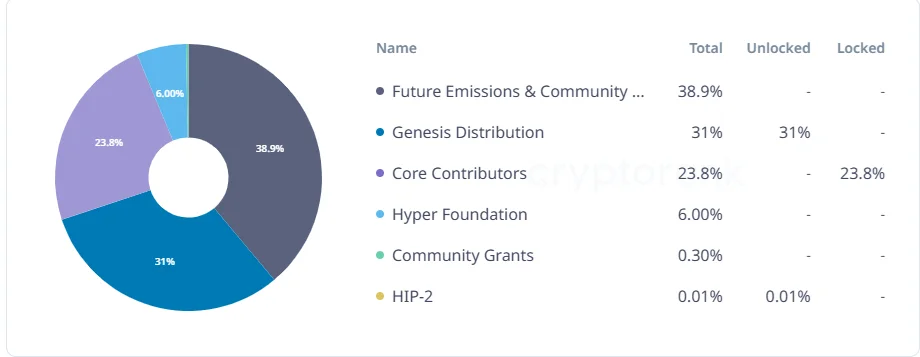
The token distribution includes allocations for the genesis airdrop, core contributors, community grants, and a foundation budget.
No further tokens have entered circulation since its Token Generation Event (TGE) in November, which released 31% of the total supply.
So, only 31% of the total supply is circulating, while the rest is locked. The circulating supply becomes even smaller when considering the amount of HYPE burned.
This supply freeze will continue until November 29, 2025, when daily emissions of 216,580 tokens will begin and continue through November 2028.
Overall, Hyperliquid proposes a compelling blend of features, speed, advanced tools, transparency, and community-centric governance, which have redefined decentralized perp trading.
Arthur Hayes’ Prediction
Arthur Hayes’ bullish thesis on Hyperliquid rests on two main forces: fiat debasement and market dominance.
Hayes argues that governments’ relentless money printing has forced ordinary people to speculate to maintain their standard of living.
With a growing number of people holding savings on-chain in stablecoins, crypto becomes the natural asset class for speculation.
Hayes sees Hyperliquid as the primary beneficiary of this shift.
The DEX already commands roughly two-thirds of its market share, growing fast enough to challenge centralized giants like Binance.
By the end of the bullish cycle, Hayes believes that Hyperliquid will become even bigger than Binance while remaining fully decentralized.
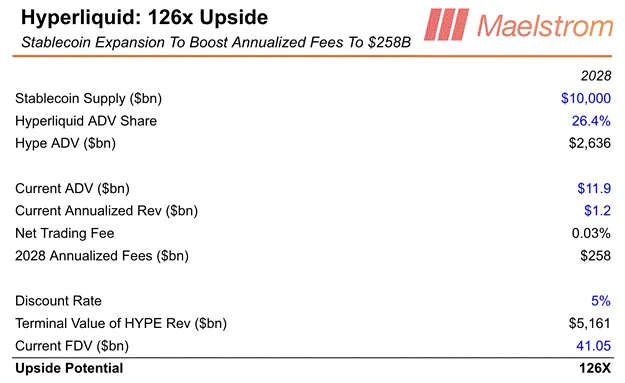
Hence, he uses the Binance perpetuals share relative to the stablecoin supply to predict the HYPE price at the end of 2028.
By 2028, he projects the stablecoin supply to reach $10 trillion.
Applying Binance’s peak share of 26.4% to that supply, Hayes estimates Hyperliquid’s Average Daily Volume (ADV) could reach $2.63 trillion, up from the current $11.9 billion.
With trading fees of 0.03%, that ADV translates to $258 billion in annualized revenue.
Using a conservative 5% discount rate, Hayes calculates Hyperliquid’s terminal value at $5.16 trillion.
This is 126 times higher than its current fully diluted valuation, leading to his 16x price prediction for HYPE.
While Hayes’ math is sound, he makes two main assumptions that could ruin it in the future.
Firstly, the stablecoin market cap must expand more than 36 times from today’s $277 billion to $10 trillion by 2028.
Secondly, Hyperliquid must capture and hold a dominance level that matches or exceeds Binance’s peak.
Another minor assumption is that fee structures will remain intact, but regulatory changes, fee wars, or user pressure could force them lower, reducing revenue projections.
Hyperliquid’s Market Share
When Hyperliquid entered the scene, few expected it to dominate the decentralized exchange (DEX) market so quickly.
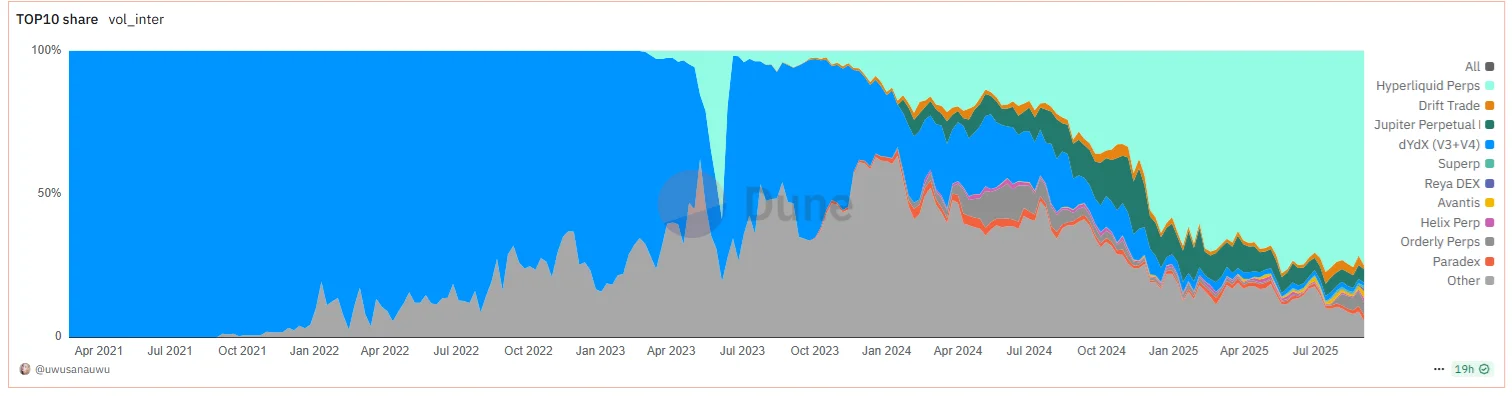
At its launch in March 2020, DYDX dominated the DEX landscape, holding more than 50% of the total share ranked by volume.
Shortly after its launch, Hyperliquid (teal) started eating into the DYDX (blue) dominance.
Hyperliquid is a direct competitor to DYDX, since its rise was nearly proportional to the latter’s decline.
By late 2024, the tables had turned. Hyperliquid not only matched DYDX’s market share decline almost one-for-one, but it also secured an overwhelming lead.
The turning point came with the launch of the HYPE token in November 2024, which turbocharged adoption and cemented Hyperliquid’s place at the top.
This is an example of a well-executed airdrop of a native token, whose benefits encourage users to move from their competitors to Hyperliquid.
As of the time of writing, Hyperliquid has 75% of the DEX market share.
This is even better illustrated when considering the volume of the top main perp protocols since the start of 2024.
While Hyperliquid took the lead in September 2024, it wasn’t until November, when the HYPE token launched, that it completely exploded.
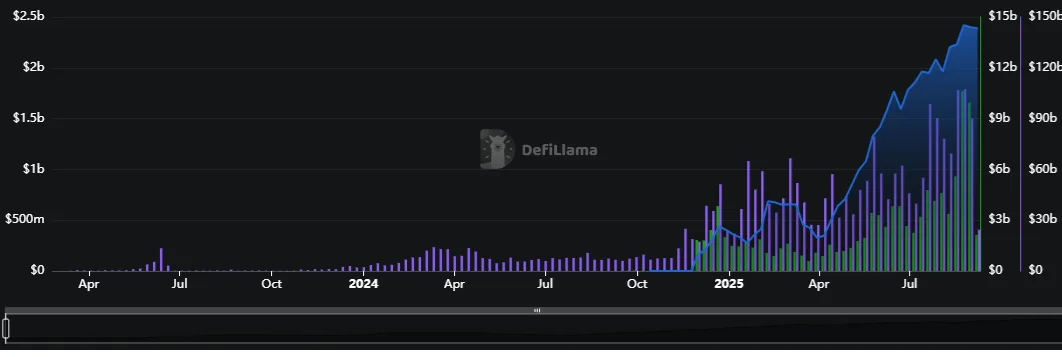
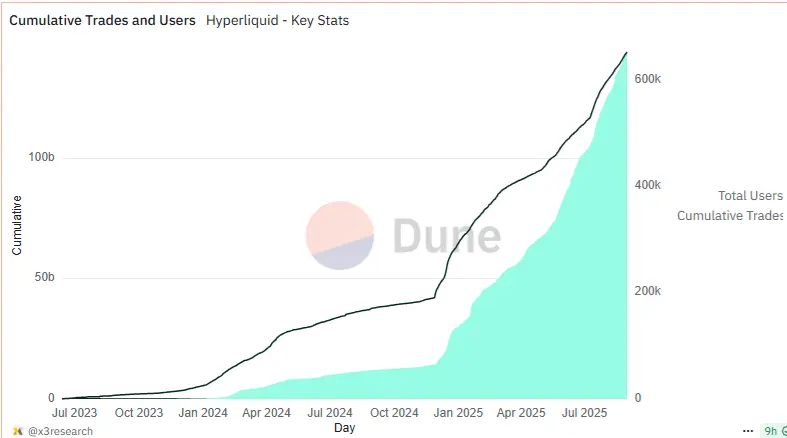
Hyperliquid has also reached new all-time highs in various metrics, such as TVL, DEX volume, and perp volume, which have all steadily risen since the beginning of the year.
Most of the TVL comes from USDC bridged on Hyperliquid through Arbitrum.
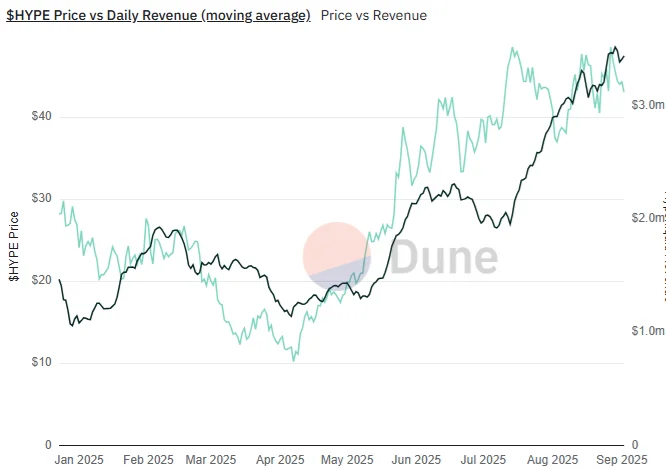
The increase in revenue is directly reflected in the HYPE price. When using a moving average, the Hyperliquid revenue and HYPE price graphs nearly mirror one another, confirming their close correlation.
This alignment is logical since a share of the revenue is allocated to token buybacks. In turn, the buybacks drive the HYPE price upward.
Thus, the on-chain data confirms that Hyperliquid keeps breaking records each month and ties its rapid increase to the release of the HYPE token.
Hyperliquid Price
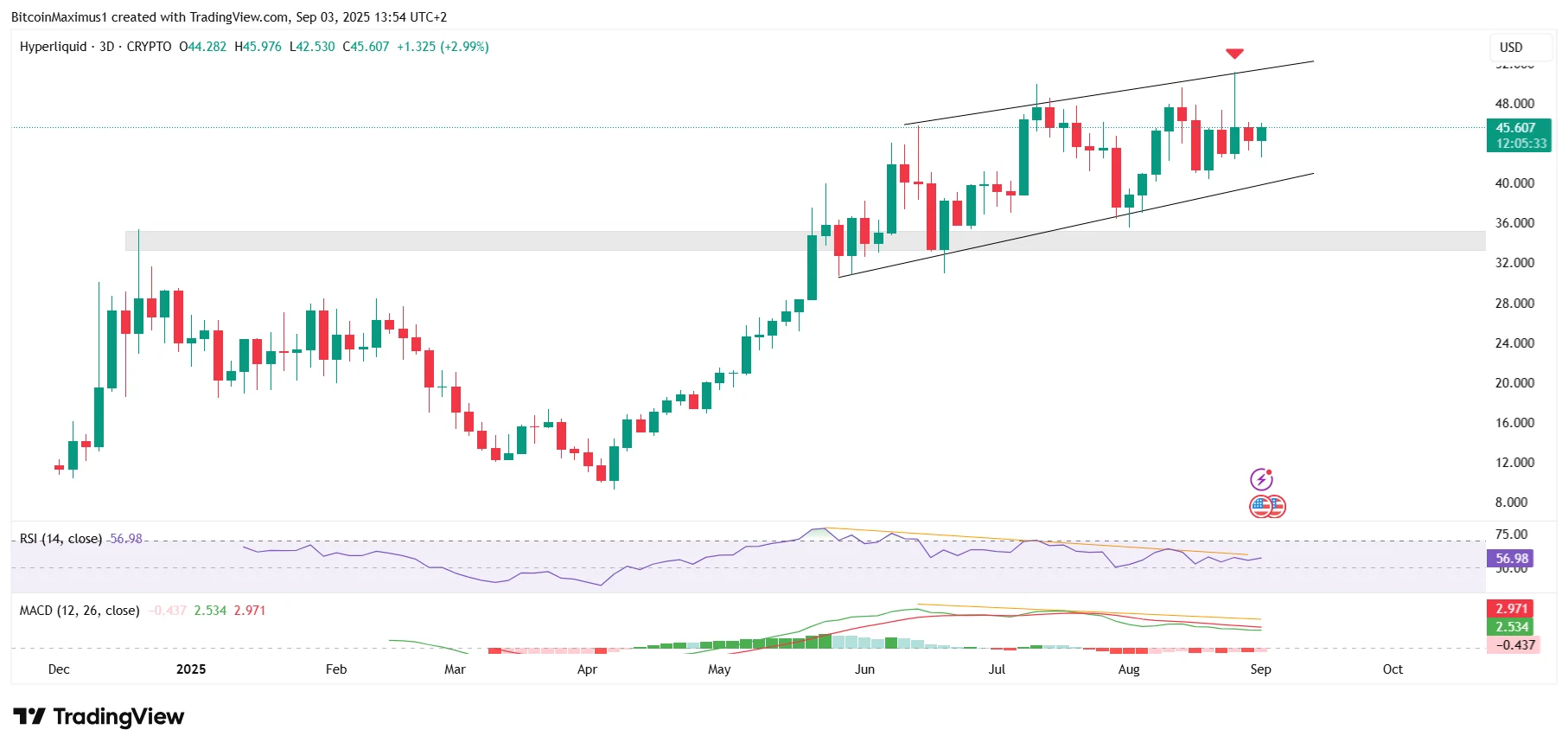
The HYPE price shows bearish signs despite reaching a new all-time high of $51.12 in August.
The first sign comes from the shooting star candlestick right after the high (red icon), illustrating that the bulls could not sustain the rally.
Momentum indicators also provide some bearish signs, since the Relative Strength Index (RSI) and Moving Average Convergence/Divergence (MACD) have generated bearish divergences (orange).
Finally, the HYPE price has created an ascending wedge, considered a bearish pattern, further supporting the possibility of a breakdown.
Despite all these warning signs, the HYPE trend is still bullish. Since April, the price has created higher highs and higher lows, confirming that bulls still have the upper hand.
Nevertheless, the signs of weakening momentum are worrying since they could soon catalyze a bearish trend reversal.
If the HYPE price breaks down from its wedge, it could find support near $35. Alternatively, the wedge’s resistance at $52 will likely provide resistance in case of an upward movement.
Community Sentiment
Even though the HYPE price is at an all-time high, the community could not be more bullish. They believe that the token is still undervalued.
Yesterday, GLC_Research posted a long thread comparing its cash generation to Robinhood and Coinbase.
Even though Hyperliquid operates at a similar scale with an even more structurally profitable model, its valuation pales compared to the other two when looking at metrics such as EBITDA.
GLC echoes Arthur Hayes’ view, suggesting that Hyperliquid is gradually taking the market share of other CEXes.
We have long been accustomed to seeing Hyperliquid dominate the perp DEX market, but what stood out most in the first half of 2025 was its growth relative to centralized exchanges, which are currently losing ground. Hyperliquid holds a set of competitive advantages that make it the most compelling venue to trade. First, it is one of the cheapest places to trade both spot and perpetual futures. It also offers the deepest onchain liquidity, with order book depth on certain assets now rivaling that of leading CEXs.
GLC also notes the massive increase in Total Value Locked (TVL) and buybacks to confirm the interest in the DEX and its alignment for providing value to its token holders.
While not an apples-to-apples comparison, others have noted its massive revenue-to-market-cap discrepancy relative to Ethereum and Solana to come to the same conclusion.
Conclusion
Regarding crypto predictions, Hayes’ forecast for Hyperliquid might sound extreme, but the fundamentals are hard to ignore.
The platform has already pulled off one of the most successful token launches in recent memory, turbocharging user adoption and trading volumes.
Its fully on-chain order book, fast execution, and advanced tools make it feel like a centralized exchange.
At the same time, its community-first approach has resonated with traders, especially regarding the buybacks of its native token, HYPE, aligning its goals with those of long-term holders.
On-chain metrics show climbing revenue, buybacks support price growth, and the user base has tripled since the end of 2024.
Still, the prediction faces major hurdles. For Hayes’ 16x call to hold, stablecoin supply needs to balloon to $10 trillion, and Hyperliquid must sustain dominance levels rivaling Binance’s peak.
Yet, if any DEX has a shot at closing the gap with centralized giants, Hyperliquid seems best positioned.
Whether Hayes proves exactly right or not, Hyperliquid has already secured its place as one of the defining crypto stories of this cycle.
Is Arthur Hayes’ Hyperliquid prediction realistic?
Arthur Hayes’ 16x prediction for Hyperliquid by 2028 is based on two big assumptions: that stablecoin supply will grow to $10 trillion and that Hyperliquid will capture Binance-level dominance. While the math is sound, the outcome depends heavily on market growth and competition.
How does Hyperliquid compare to Binance and DYDX?
Hyperliquid has already overtaken DYDX, commanding about 75% of the DEX perpetuals market share. However, compared to Binance, it’s still smaller. Binance leads by a wide margin in both spot and perp volumes.
What drives the value of the HYPE token?
The HYPE token gains value from governance rights, staking rewards, and reduced trading fees. A key driver is its deflationary buyback-and-burn mechanism, where trading fees are used to repurchase tokens from the market. This direct link between platform revenue and token supply helps support long-term price growth.
Disclaimer:
The information provided in this article is for informational purposes only. It is not intended to be, nor should it be construed as, financial advice. We do not make any warranties regarding the completeness, reliability, or accuracy of this information. All investments involve risk, and past performance does not guarantee future results. We recommend consulting a financial advisor before making any investment decisions.
Valdrin Tahiri is a cryptocurrency analyst and reporter at CCN, specializing in technical analysis with a focus on Elliott Wave theory, on-chain metrics, and fundamental research. He brings over seven years of experience in the crypto space as both a trader and writer.
He discovered cryptocurrencies in 2017 while earning his MSc in Financial Markets at the Barcelona School of Economics, which sparked a deep interest in blockchain and market dynamics. Since then, he’s contributed to top crypto outlets like BeInCrypto and CoinGape.
Valdrin also served as Community Manager of BeInCrypto’s Telegram group for three years, helping grow it into one of the largest crypto communities worldwide. His expertise in market structure and price patterns allows him to break down complex trends into clear, actionable insights.
He’s published thousands of articles covering altcoins, Bitcoin cycles, and macro trends.