Home / Analysis / Crypto / Technical Analysis / Aave Founder Promises Full Refunds After Two Crises in 72 Hours Raise Red Flags, but What Does It Mean for Price?
$AAVE survives a $26M oracle glitch and a $50M slippage event | Credit: Hameem Sarwar
Share
Key Takeaways
On March 10, 2026, a misconfiguration in Aave’s CAPO oracle caused $26 million in unfair wstETH liquidations.
Despite extreme slippage warnings, a trader incinerated $50.4 million in a single swap from aETH USDT to aETH AAVE.
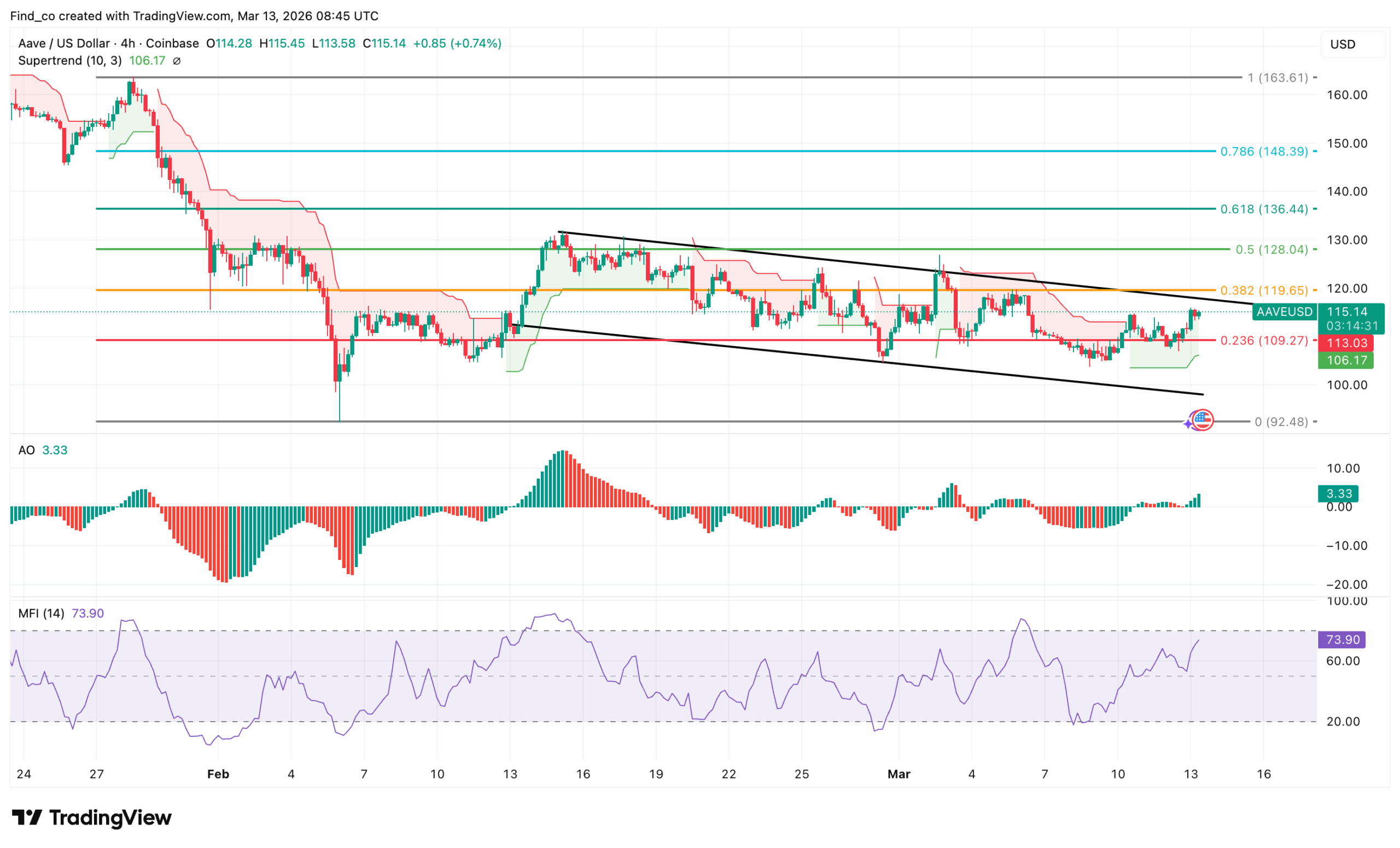
AAVE is currently testing the upper boundary of a descending channel near $115, suggesting it is ready to trade higher.
Aave, the largest decentralized lending protocol in DeFi, has faced two crises within days of each other.
Despite these unfortunate incidents, the AAVE price did not drop below $100.
However, these events may have raised red flags for DeFi’s biggest lender. In this analysis, CCN reveals what happened and what lies ahead for AAVE’s price.
Incident 1:The Oracle Glitch (March 10)
The first incident happened on March 10.
During that period, Aave experienced a temporary oracle malfunction across its Ethereum Core and Prime, resulting in approximately $26 million in wstETH positions being unfairly liquidated.
The issue stemmed from a misconfiguration in the Correlated Asset Price Oracle (CAPO), Aave’s primary risk management tool.
Roughly $27 million worth of borrower positions were liquidated. Some observers say the liquidations may have been triggered by a temporary discrepancy in the price of wstETH relative to ETH, which appeared lower than the actual market ratio.
However, Aave’s founder, Stani Kulechov, posted a public explanation on X.
According to him, CAPO is an external tool that has historically processed over 1,200 payloads and 3,000 parameters without issues, and it is a separate defense mechanism designed to protect against inflation attacks.
Kulechov confirmed all affected users would receive full refunds, totalling 345 ETH ($700,000). Importantly, Aave incurred no bad debt as a result of the incident.
“A reimbursement plan is currently being coordinated by Service Providers (SPs) to compensate affected borrowers using fees previously earned from liquidations,” Kulechov stated.
Incident 2: The $50M Slippage Catastrophe (March 12)
Just two days later, a second dramatic event unfolded. A crypto trader lost about $50 million in a single transaction after swapping interest-bearing aETH USDT for aETH AAVE via CoW Protocol.
However, he received only 324 AAVE tokens, worth roughly $36,100.
After Kulechov got wind of the situation, he said the trade went through despite multiple warnings presented to the user before the transaction was confirmed.
According to Kulechov, the user accepted the warning on their mobile device and proceeded with the trade.
“The CoW Swap routers functioned as intended, and the integration followed standard industry practices. However, while the user was able to proceed with the swap, the final outcome was clearly far from optimal,” He disclosed.
Kulechov said the Aave team will attempt to contact the trader and return approximately $600,000 in fees generated by the transaction.
He also pointed to the need for structural improvements across the DeFi ecosystem, saying the industry needs to build additional safety mechanisms to protect users while preserving permissionlessness.
On-Chain Data Support AAVE Price Bounce
Despite the incidents, smart money is accumulating AAVE.
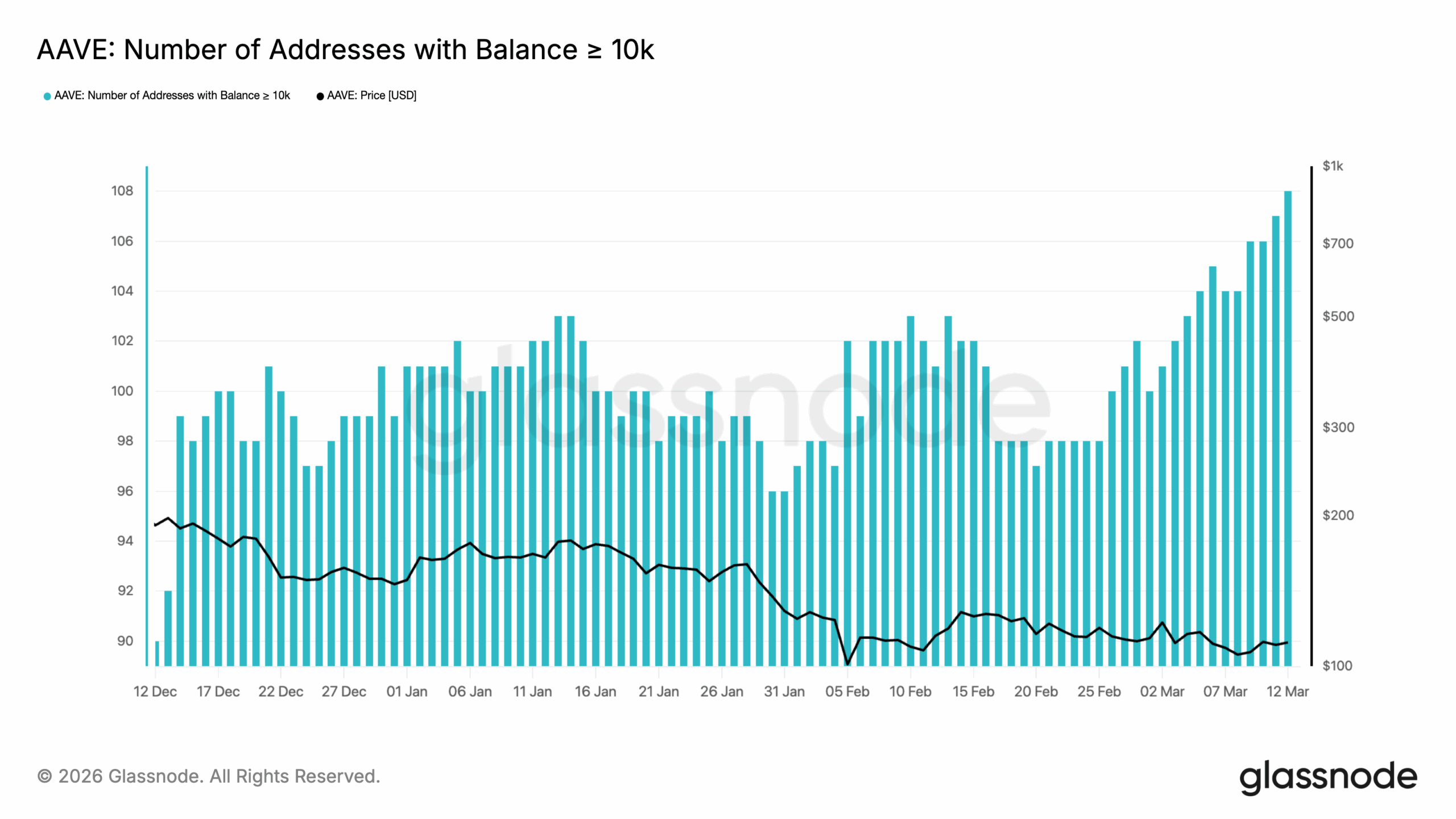
According to Glassnode, the number of addresses holding ≥ 10,000 AAVE has climbed to 108 today. For context, this is the highest level on the three-month chart.
That count has been rising steadily since early March, accelerating through this week.
The divergence with price is the key signal. AAVE’s price (black line) has been declining since December, while large holder addresses have held steady between 97–103 throughout that entire drawdown, and are now breaking to new highs.
AAVE Number of Addresses with Balance ≥ 10k | Credit: Glassnode
So, it means whales did not sell the dip. Instead, they bought more.
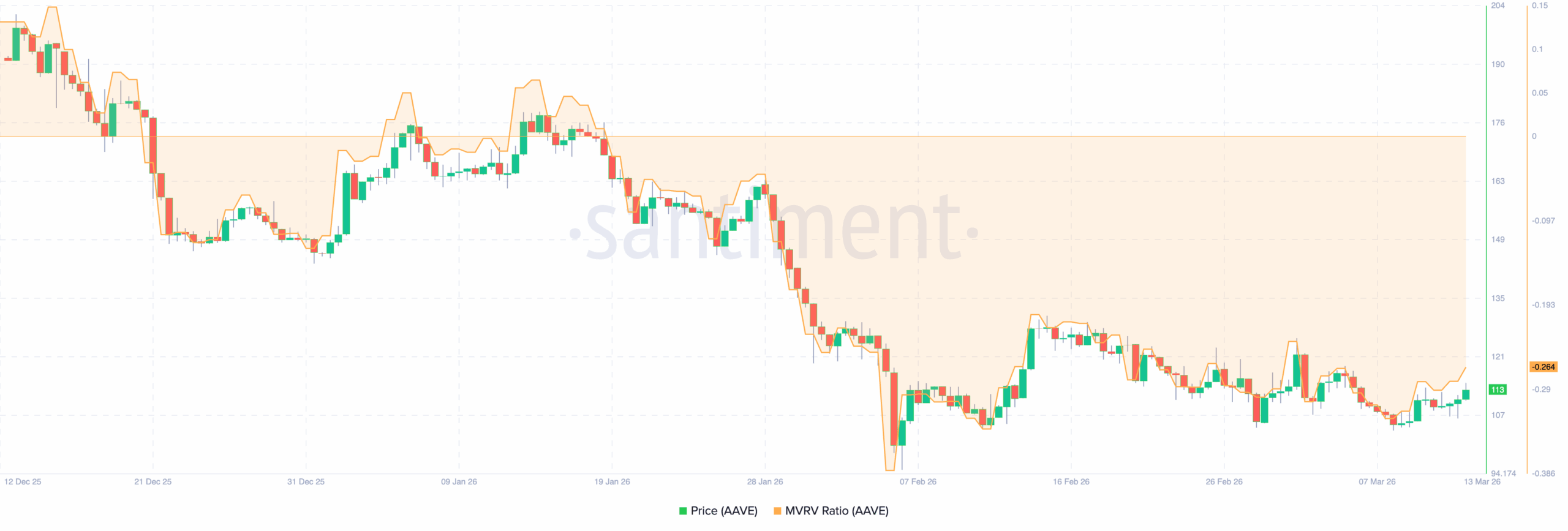
Additionally, on-chain data from Santiment shows that the Market Value to Realized Value (MVRV) ratio is 0.26.
This means the average holder is currently sitting at a 26.4% unrealised loss. The ratio has been negative since late January and has remained in negative territory through six weeks of sideways price action between $107 and $135.
But this outlook could be bullish. For context, a deeply negative MVRV is historically one of the strongest mean-reversion signals in crypto on-chain analysis.
In this instance, the average holder is underwater, and selling pressure diminishes.
As it stands, AAVE’s price will need the MVRV ratio to return to breakeven for the average holder, which would require it to recover to approximately $150.
Once that happens, the altcoin’s value might rise toward $200.
Short-Term Bearish Pressure for AAVE Price
Meanwhile, the technical chart completes the AAVE thesis.
AAVE trades at $115.14, pressing against the upper trendline of a descending channel that has compressed the price since the February 13 high near $132.
The Supertrend at $106.17 has flipped green — the first bullish Supertrend signal in over a month.
The Awesome Oscillator (AO) at 3.33 has just crossed above zero for the first time since mid-February, with building green bars confirming the shift in short-term momentum.
Furthermore, the Money Flow Index (MFI) at 73.90 is rising toward overbought.
Price is testing the channel’s upper boundary right now. As it stands, a 4-hour close above it targets $119.65 (0.382 Fib) immediately, then $128.04 (0.5 Fib).
Disclaimer:
The information provided in this article is for informational purposes only. It is not intended to be, nor should it be construed as, financial advice. We do not make any warranties regarding the completeness, reliability, or accuracy of this information. All investments involve risk, and past performance does not guarantee future results. We recommend consulting a financial advisor before making any investment decisions.
Victor Olanrewaju is a crypto analyst and reporter at CCN with deep roots in on-chain research and technical analysis. His crypto journey began in 2017, but it was the 2020 Uniswap airdrop that sparked a full-time pivot into the space.
With a foundation in copywriting, Victor honed his craft creating high-converting content for leading crypto brokers — most notably an XRP price prediction that ranked #1 on Google during the 2021 bull run.
He later joined AMBCrypto in 2022, where he combined storytelling with technical and on-chain analysis to cover key market narratives.
In 2024, he expanded his expertise at BeInCrypto, collaborating with analysts and using tools like Glassnode, Santiment, and IntoTheBlock to break down Bitcoin and altcoin trends.
At CCN, Victor covers the top cryptocurrencies, memecoins, macro shifts, blending real-time insights with deep-dive metrics.
He holds a Bachelor’s degree in Physics from the University of Ibadan, equipping him to simplify complex data for a wide audience. Follow his work or connect on LinkedIn or X.