Governance dispute triggered a sharp AAVE sell-off.
Mid-sized holders are reducing exposure amid uncertainty.
Price risks further decline without conflict resolution.
AAVE, the native token of the decentralized finance protocol, has extended its seven-day decline. This price crash occurred due to a governance battle that has remained unresolved.
At the time of writing, AAVE’s price wobbles around $154.24, with indicators showing no sign of recovery.
In this analysis, CCN breaks down the reasons behind the decline and what the short-term holds for the cryptocurrency.
Aave–CoWSwap Controversy Escalates Into Governance Crisis
According to CCN’s findings, AAVE’s price crashed due to a dispute involving some contributors’ proposal. Here is how it all started:
Dec. 4, 2025 Aave Labs announces a partnership with CoWSwap. The goal is clear. Improve swap pricing. Add MEV protection on the Aave interface.
Dec. 11, 2025 A prominent delegate, @DeFi_EzR3aL, releases on-chain analysis. The findings raise alarms.
Swap fees from the new CoWSwap contract route to a private wallet
The wallet appears to be controlled by Aave Labs
The DAO receives nothing
In short, DAO revenue is quietly cut off.
Dec. 12, 2025 Marc Zeller, Aave’s largest delegate and lead of the Aave Chan Initiative, responds. He calls the move “stealth privatization.”
Estimated impact: $10 million per year
Funds that should flow to the DAO now disappear
As a result, tensions explode.
Dec. 16, 2025 The situation remains unresolved with counterproposals.
Proposal A: “Poison Pill” (Tulip King)
A hardline proposal enters governance. Its demands are sweeping.
Seize all Aave IP, code, and brand
Convert Aave Labs into a DAO-owned subsidiary
Claw back all past revenue earned using the Aave brand
Proposal B: “Brand Seizure” (by former Aave Labs CTO)
Despite the controversy, founder Stani Kulechov maintained his ground, saying that it was subject to a vote.
“People are tired of this discussion, and getting into a vote is the best way to resolve this. This is governance, end of the day. The way to resolve this issue is simply to vote. See you at the polls, whatever the outcome will be,” He added.
The disagreement is not over a marginal sum. Estimates suggest the arrangement could generate roughly $10 million annually for Aave Labs.
Delegates and AAVE token holders argue that these funds should instead be allocated to the DAO, thereby strengthening the protocol’s treasury and aligning incentives with decentralized governance principles.
In response, multiple proposals have surfaced on Aave’s decentralized governance forum.
Among them is a hardline option that would seek legal action against Aave Labs over the alleged misappropriation of funds that delegates argue should belong to the DAO.
Holders Leave the Show
Meanwhile, early voting data suggests the proposal is facing significant resistance.
As of this writing, Snapshot results show that 63.64% of voters have voted against the measure, while 33.21% have chosen to abstain. Only 3.16% have voted in favor.
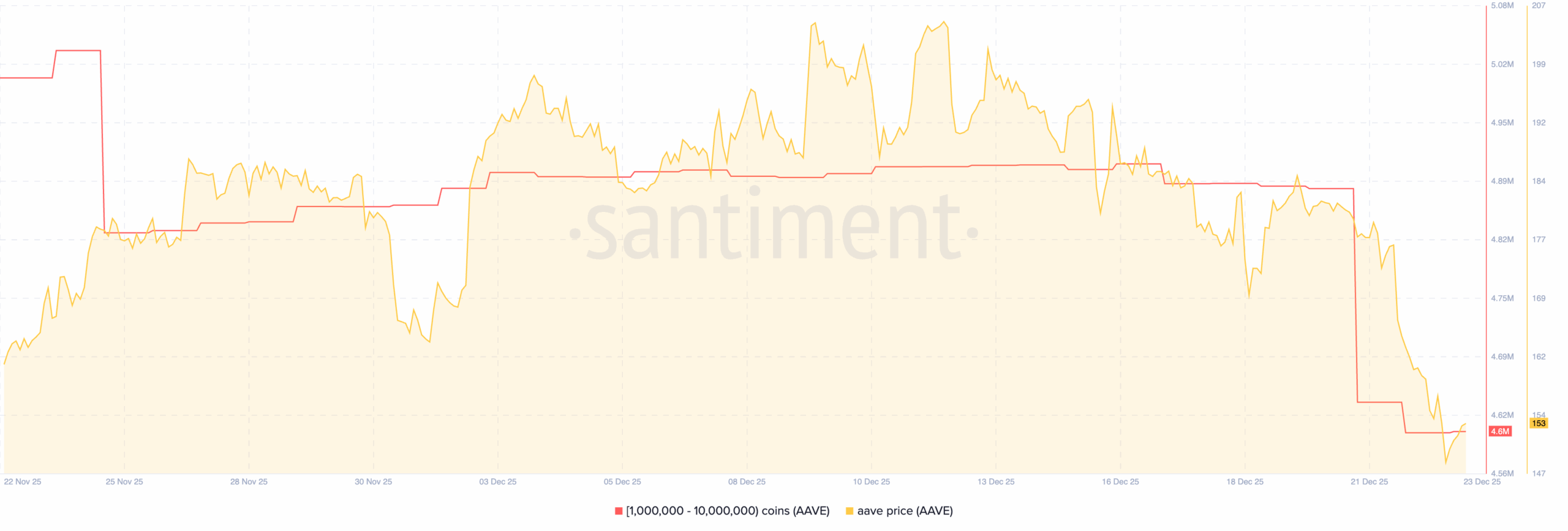
Following the governance developments, on-chain data from Santiment points to a notable shift in positioning among mid-sized AAVE holders.
Wallets holding between 1 million and 10 million AAVE tokens have reduced their exposure over the past several days.
On Dec. 20, this cohort collectively held approximately 4.88 million AAVE, with the token trading near $183 at the time.
As of this writing, holdings have declined to around 4.6 million, coinciding with AAVE’s price sliding below the $155 level.
Should this trend fail to reverse, then AAVE’s price will likely experience an extended decline.
AAVE Price Prediction: Bounce Not Here
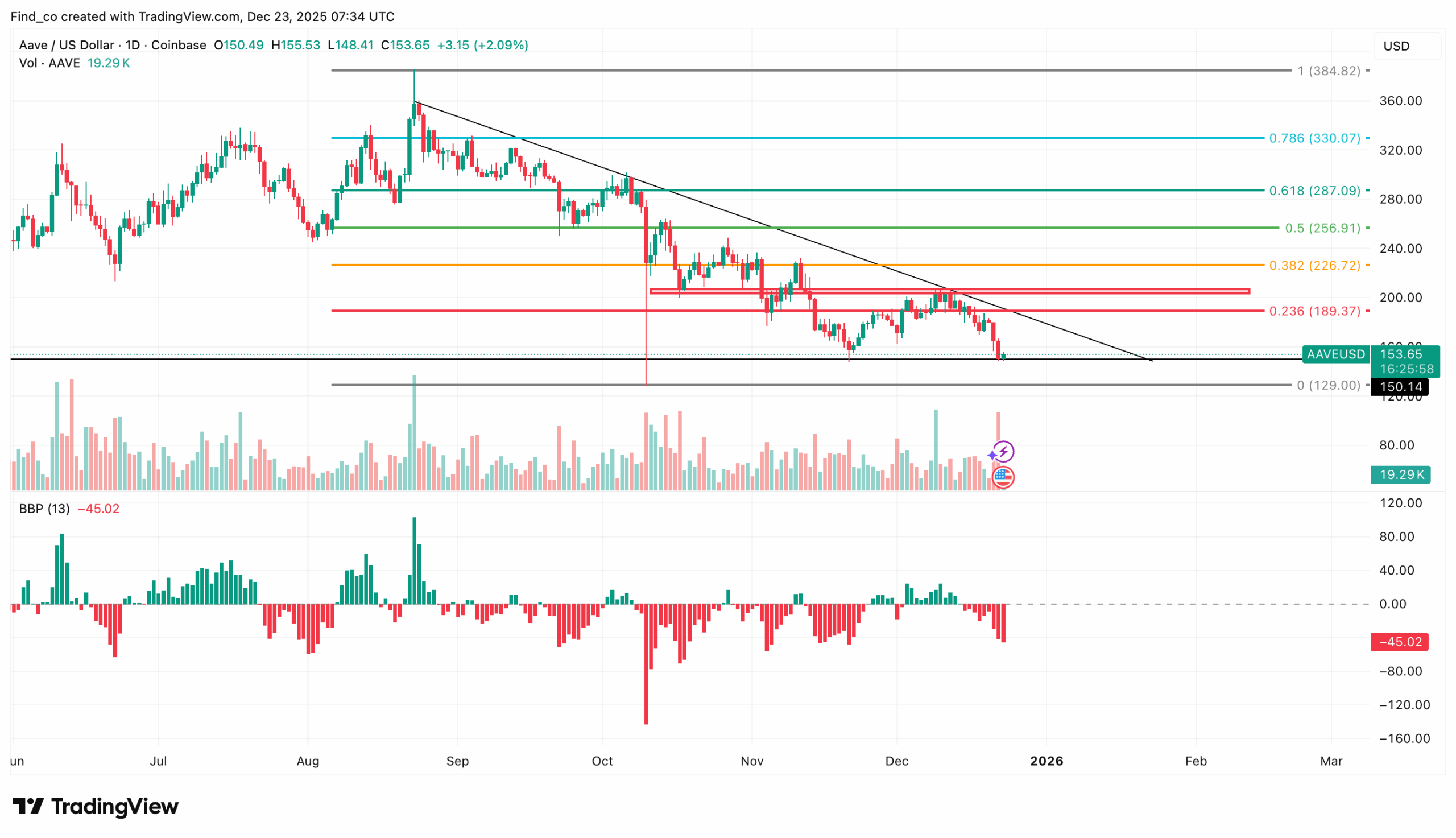
From a technical standpoint, the daily chart shows AAVE has fallen to its lowest level since April.
In addition, the price action remains confined within a descending triangle, with horizontal support near the $150 level now under increasing pressure.
A breakdown below this zone would reinforce the bearish structure and expose deeper downside.
Momentum indicators add to the caution. Bull Bear Power (BBP) has turned sharply negative, signaling accelerating seller dominance.
On the upside, a key resistance zone near $206 continues to restrict recovery attempts, limiting the probability of a near-term breakout under current conditions.
However, the outlook is not set in stone. A resolution between Aave Labs and the DAO, whether through the proposal or subsequent counterproposals, could materially shift sentiment.
In that scenario, a recovery above resistance near $226.72 is possible.
Disclaimer:
The information provided in this article is for informational purposes only. It is not intended to be, nor should it be construed as, financial advice. We do not make any warranties regarding the completeness, reliability, or accuracy of this information. All investments involve risk, and past performance does not guarantee future results. We recommend consulting a financial advisor before making any investment decisions.
Victor Olanrewaju is a crypto analyst and reporter at CCN with deep roots in on-chain research and technical analysis. His crypto journey began in 2017, but it was the 2020 Uniswap airdrop that sparked a full-time pivot into the space.
With a foundation in copywriting, Victor honed his craft creating high-converting content for leading crypto brokers — most notably an XRP price prediction that ranked #1 on Google during the 2021 bull run.
He later joined AMBCrypto in 2022, where he combined storytelling with technical and on-chain analysis to cover key market narratives.
In 2024, he expanded his expertise at BeInCrypto, collaborating with analysts and using tools like Glassnode, Santiment, and IntoTheBlock to break down Bitcoin and altcoin trends.
At CCN, Victor covers the top cryptocurrencies, memecoins, macro shifts, blending real-time insights with deep-dive metrics.
He holds a Bachelor’s degree in Physics from the University of Ibadan, equipping him to simplify complex data for a wide audience. Follow his work or connect on LinkedIn or X.