Covalent (CQT), a pioneering Web3 data indexer and provider, announced a landmark partnership with the University of Calgary, Alberta, Canada marking a significant leap forward in the realm of blockchain data research and accessibility.
As the inaugural academic collaborator to join Covalent as a validator, this alliance not only signifies an expansion of Covalent’s network but also underscores a shared dedication to advancing education and innovation within the Web3 ecosystem.
In its capacity as a validator, the University of Calgary stands poised to receive staking rewards in CQT, which will be channeled towards driving impactful research endeavors. Covalent inaugurates this collaboration by bestowing upon the university a grant of 175,000 CQT, valued at approximately CAD $44,000, reaffirming its commitment to nurturing scholarly pursuits and fostering a culture of innovation.
After the news, Covalent’s CQT token reached the highest level in two years of $0.30 on February 20, 2024.
But what is Covalent (CQT)? How does Covalent work? Let’s see what we can find out, and also take a look at some of the Covalent Price Predictions that were being made as of February 20, 2024.
Covalent Price Prediction
With that all out of the way, let’s take a look at some of the Covalent price predictions that were being made as of February 20, 2024. It is important to remember that price forecasts, especially for something as potentially volatile as crypto, very often end up being wrong. Also, keep in mind that many longer-term crypto price predictions are made using an algorithm, which means that they can change at a moment’s notice.
2024
2025
2030
Prediction #1
$0.66
$0.75
$2.25
Prediction #2
$0.82915
$1.13
$2.61
Prediction #3
$0.3254
$0.4674
$3.03
First, CoinCodex had a short-term Covalent price prediction which said that the token would be somewhat volatile in the coming weeks, with it dropping to $ 0.797759 by February 25 and reaching $ 0.880553 by March 19. The site’s technical analysis was bullish, with 25 indicators sending encouraging signals and just three making bearish ones.
Covalent Forecast for 2024
When it came to other sites making their Covalent price predictions for 2024, DigitalCoinPrice said it would thrive in the coming months, reaching $0.66, while Bitnation said CQT would get to $0.82915. PricePrediction.net, on the other hand, was more cautious, forecasting Covalent to stand at $0.3254 this year.
Covalent Forecast for 2025
In terms of a Covalent price prediction for 2025, Bitnation thought the token would reach $1.13, while DigitalCoinPrice went a bit higher at $0.75. PricePrediction.net, meanwhile, said that CQT would trade at $0.4674 next year.
Covalent Forecast for 2030
Moving forward to a more long-term Covalent price prediction for 2030, PricePrediction.net said that the token would soar to $3.03 that year, with DigitalCoinPrice saying it would hit $2.25. Bitnation had a CQT price prediction that said the crypto would trade at $2.61 at the start of the next decade.
Google Gemini AI Price Prediction for Covalent (as of February 20)
Google’s Gemini AI platform gave the following price prediction for Covalent on February 20. Please remember that the exact price prediction of an asset or cryptocurrency in the future is nearly impossible to achieve. Additionally, artificial intelligent price predictions are predicated on past performances and are in no way entirely accurate.
Short Term (Next 3 months)
Expected price: $0.88
Factors to Consider:
Market Sentiment: The overall sentiment of the cryptocurrency market can significantly impact the price of CQT.
Adoption and Development: The adoption of Covalent’s technology and the development of its platform could drive the price up.
Regulations: Regulatory changes in the cryptocurrency space could impact the price of CQT.
Medium Term (Next 6 months)
Expected price: $1.13
Factors to Consider:
Overall market sentiment: The cryptocurrency market is volatile and can be influenced by many factors, including news, regulations, and investor confidence.
Covalent’s development and adoption: The success of the Covalent platform and its token will depend on its ability to attract developers and users.
Competition: There are other blockchain data platforms competing for market share.
Long Term (Next 5 years)
Expected price: $1.302
Factors to Consider:
Overall Cryptocurrency Market: The success of Covalent is tied to the overall health of the cryptocurrency market. If the market experiences a bull run, Covalent could see significant price increases. Conversely, a bear market could lead to price drops.
Adoption and Use: The more developers and projects adopt Covalent’s data solutions, the higher the demand for CQT tokens, potentially driving the price up.
Competition: Other blockchain analytics platforms compete with Covalent, and their success could impact Covalent’s price.
Regulations: Government regulations related to cryptocurrencies could significantly impact the market and Covalent’s price.
CQT Price History
Let’s now take a look at some of the Covalent price history. While past performance should never be taken as an indicator of future results, knowing what the token has done can help give us some very useful context when it comes to either making or interpreting a Covalent price prediction.
When CQT first came onto the open market in the summer of 2021, it was worth about $0.80. Although the price dipped, it shot up again and reached an all-time high of $2.09 on 14 August. After that, it fell down somewhat and it closed the year at $0.5758.
In 2022, things got worse for crypto and CQT suffered, with a series of market crashes seeing it sink to an all-time low of $0.05081 on 1 August. There was some recovery after this, but not as much as investors may have wanted, and it closed 2022 at $0.1063, representing an annual loss of more than 80%.
Covalent in 2023 and 2024
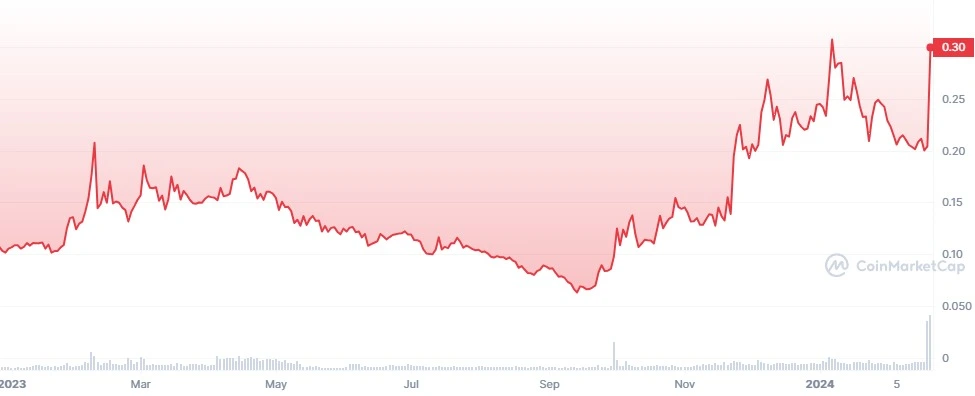
2023 has been a rather mixed year for Covalent. A bullish market saw it surge to $0.2337 on 7 February, but it has largely been downhill since then. In early July, it fell below 10 cents, with a low of $0.09739 on 10 July but has since made a small recovery. On 19 July 2023, Covalent was worth about $0.11.
Covalent in 2023 and 2024 | Credit: CoinMarketCap
It then moved up in the second half of the year, closing it a $0.248, before starting a sideway movement in January. CQT had a mixed February as well, reaching $0.3156 on February 20, 2024.
At that time, there were about 634.1 million CQT in circulation, out of a total supply of 1 billion. This gave it a market cap of $191.1 million, making it the 265th largest crypto by that measurement.
Is Covalent a Good Investment?
It is hard to say. The CQT token has made a recovery recently, admittedly from a very low point, but we don’t know how long things will last, or where they will get to.
Although Covalent provides a useful service, it has still yet to truly catch on with the wider crypto public, and it will be interesting to see what the platform can do to really grab people’s attention.
As ever with crypto, you will need to make sure you do your own research before deciding whether or not to invest in CQT.
Will Covalent go up or down?
No one can really tell right now. While the Covalent crypto price predictions are largely positive, price predictions have a well-earned reputation for being wrong. Keep in mind, too, that prices can, and do, go down as well as up.
Should I invest in Covalent?
Before you decide whether or not to invest in Covalent, you will have to do your own research, not only on CQT, but on other, related, coins and tokens such as Ocean Protocol (OCEAN) and The Graph (GRT). Either way, you will also need to make sure that you never invest more money than you can afford to lose.
Covalent (CQT) Explained
If the internet is all about data, then it follows that blockchain technology is also all about data. Put simply, people who work on the blockchain need to be able to access accurate information, quickly, in order to do what they need to do.
Covalent is a platform which is designed to help blockchain users do just that. Founded by physicist Ganesh Swami and tech expert Levi Aul, the system is an application programming interface (API). It basically means that it is a program designed to help other programs communicate with each other.
Covalent, which is based on the Ethereum (ETH) blockchain, is supported by its native token, which goes by the ticker handle CQT.
How Covalent Works
Covalent puts information together from a range of blockchain-based sources, finds people who want to use the data, and puts them together. Its API is designed to be simple and easy to use. And it promises to return information in a timely and consistent manner.
In terms of CQT, the token gives people access to data queries. It can also be set aside, or staked, in return for rewards, with people who validate transactions on the platform able to earn it for answering queries. Holders can also vote on changes to the network, and it can also be bought, sold, and traded on exchanges.
It is important to point out that, because Covalent is based on Ethereum, it is a token, not a coin. You might see references to such things as a Covalent coin price prediction, but these are not entirely accurate.
Covalent Attention Tracker
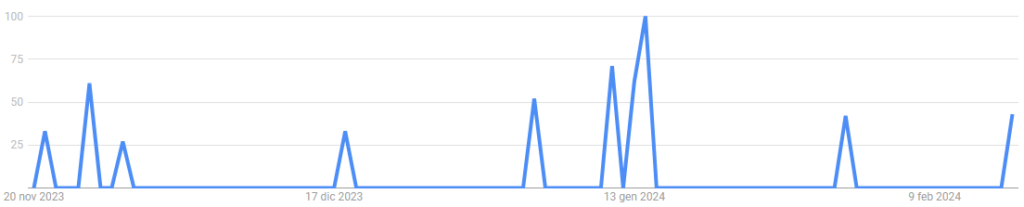
Covalent Google search volume | Credit: Google
Here is a chart for the Covalent Google search volume for the past 90 days. This represents how many times the term “Covalent CQT” has been Googled over the previous 90 days.
FAQs
How many Covalent are there?
AS of February 20, 2024, there were about 634.1 million CQT in circulation, out of a total supply of 1 billion.
Will Covalent reach $1?
It might do, but not for a little while yet. PricePrediction.net says it will get there in 2029, while DigitalCoinPrice thinks that 2030 is the year it will happen and Bitnation predicts it will reach that target in 2031.
Keep in mind that Covalent has traded above the dollar before, most recently in December 2021.
What is Covalent used for?
The CQT token is used to support the Covalent crypto data platform. Holders can vote on changes to the network, it can be staked in return for rewards and it is used to pay for queries on the system. It can also be bought, sold and traded on exchanges.
Disclaimer:
The information provided in this article is for informational purposes only. It is not intended to be, nor should it be construed as, financial advice. We do not make any warranties regarding the completeness, reliability, or accuracy of this information. All investments involve risk, and past performance does not guarantee future results. We recommend consulting a financial advisor before making any investment decisions.
Peter Henn has been a journalist since 2005. In that time, he has written for a variety of publishers including the Mail on Sunday and the Daily Express. He has previously covered the world of cryptocurrency for Currency.com and Capital.com, and has also written for ECigIntelligence.com and CBD-Intel.com. A graduate of the University of Liverpool, he is based in the United Kingdom. His hobbies include music, horse racing and performance art.