“While the world watches the price, I watch the people.” | Credit: Veronica Cestari /CCN
Share
Key Takeaways
Bitcoin’s value lies in its design, not short-term price movements, as it operates as a decentralized network with a fixed supply and code-based rules.
Many still view Bitcoin as speculation, which discourages women seeking long-term financial independence from engaging with the technology.
Education changes how women approach Bitcoin by helping them understand money, financial systems, and Bitcoin’s role as an alternative framework.
Financial empowerment begins with knowledge, and understanding Bitcoin can help people navigate future economic change.
The headlines are loud again. Bitcoin is up. Bitcoin is down. Politicians are weighing in. Macro forces are shifting. And once again, the noise is drowning out the signal.
I have been teaching Bitcoin in Switzerland for years: to women in live cohort programs, to employees at banks and tech companies, to anyone curious enough to sit down and actually learn.
And I will tell you what I tell every single one of my students: the price is not the point.
This matters especially now, and especially for women.
Bitcoin’s Financial Sovereignty Model Remains Unchanged
Bitcoin’s underlying use case has not changed.
It is a decentralized, open monetary network with a fixed supply, rules enforced by code rather than institutions, and no central authority that can debase it or freeze your account.
Bitcoin is a tool for financial sovereignty that does not require permission, a bank account, or anyone else’s approval.
That was true when Bitcoin was at $3,000.
It is true today.
It will be true tomorrow regardless of what any chart says.
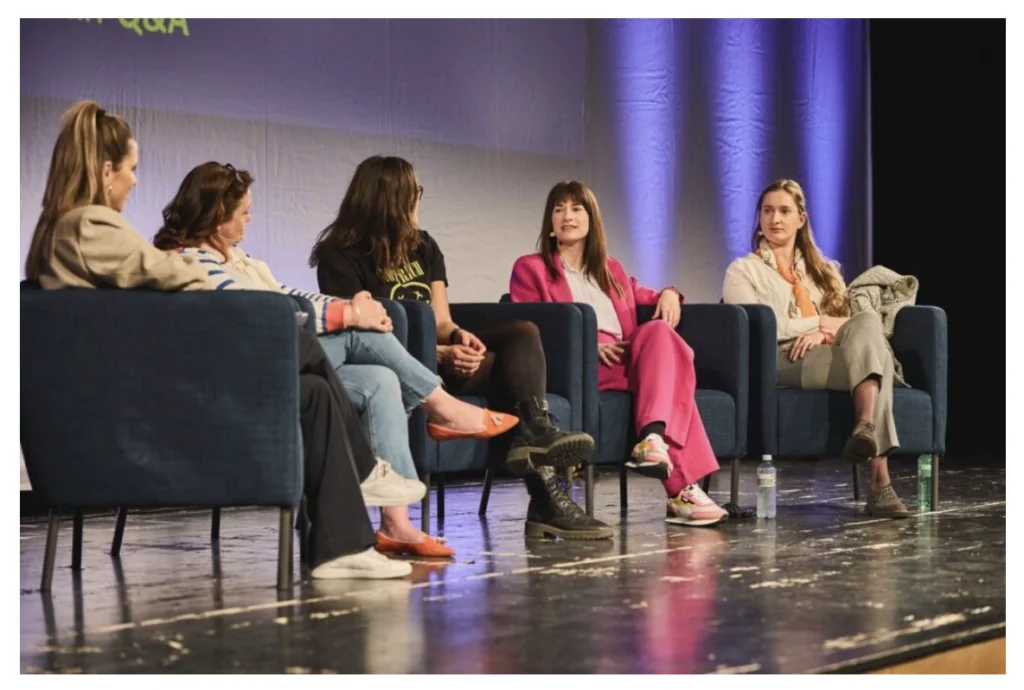
Lisa Tscherry speaking at a Bitcoin, finance, and innovation event. | Source: SatoShe Space
In Switzerland, Bitcoin is persistently misunderstood as a speculative vehicle, something for traders, for people willing to gamble.
This framing does enormous damage.
It keeps the very people who would benefit most, women building long-term financial independence, on the sidelines, waiting for the “right moment” or dismissing it entirely as too risky, too complicated, too male.
Today, the numbers reflect this gap. Women represent only about 25% of crypto holders globally, according to several industry surveys.
Education plays a key role in closing that gap and helping more women understand the technology behind the headlines.
Bitcoin’s Long-Term Development and the Role of Education
Meanwhile, the technology is maturing. Developers are actively working to make Bitcoin quantum-resistant, building the cryptographic foundations that will protect the network for decades to come.
These are not the moves of a speculative bubble. They are the slow, deliberate work of people who believe in something built to last.
Slow and steady wins the race. That is not a consolation for impatience. It is the entire thesis.
What I have learned from running my online course and monthly membership sessions, with students and members joining from around the world, is that women learn Bitcoin differently when the space is designed for them. Not dumbed down. Not dressed up in pink.
But taught with rigor, context, and the explicit acknowledgment that financial knowledge is power, and that power belongs to everyone.
“Financial knowledge is power, and that power belongs to everyone.” | Image source: Lisa Tscherry
The women who complete my program do not leave talking about price targets. They leave with a framework. They understand what money is, why it has historically failed the people with the least structural protection, and why a fixed-supply, censorship-resistant network is not a fringe idea. It is a rational response to a system that was never designed with them in mind.
Financial Empowerment Begins With Understanding
For most of modern history, women were excluded from financial decision-making. In many countries, women could not open a bank account, access credit, or control assets without a male relative until only a few decades ago. Finance was not built with women in mind.
That legacy still shapes participation today.
Yet the shift is already underway. By 2030, women are expected to manage around $34 trillion in assets in the United States alone.
Access to financial knowledge will determine how that wealth is understood, managed, and protected.
On Women’s Day, I am not asking anyone to buy Bitcoin.
I am asking for something harder:
Genuine curiosity.
The willingness to learn before forming an opinion.
The discipline to separate signal from noise in a media environment that profits from fear and excitement in equal measure.
I live this discipline daily. When the market panics, I open my laptop and teach. When the headlines scream, I ask my students: What do you actually understand about what you are seeing?
The answer, almost always, is: not enough yet.
And that is fine. That is where we start.
Education does not have an entry price. Empowerment does not require a bull market.
Regardless of what Bitcoin trades at today, I will keep teaching. Because the people who understand it will be far better positioned for whatever comes next.
That is true for investors.
It is especially true for women who have spent too long being told that finance is not for them.
The signal is not in the price. It is in the learning. And it is available to everyone willing to look.
Disclaimer:
The information provided in this article is for informational purposes only. It is not intended to be, nor should it be construed as, financial advice. We do not make any warranties regarding the completeness, reliability, or accuracy of this information. All investments involve risk, and past performance does not guarantee future results. We recommend consulting a financial advisor before making any investment decisions.
About the Author
Lisa Tscherry
Lisa Tscherry is the founder of SatoShe, a Bitcoin education company based in Switzerland, focused on empowering women with financial and monetary knowledge. She runs an eight-week online course, a global membership community with monthly live sessions, and corporate workshops. She serves on the board of the Bitcoin Association Switzerland.