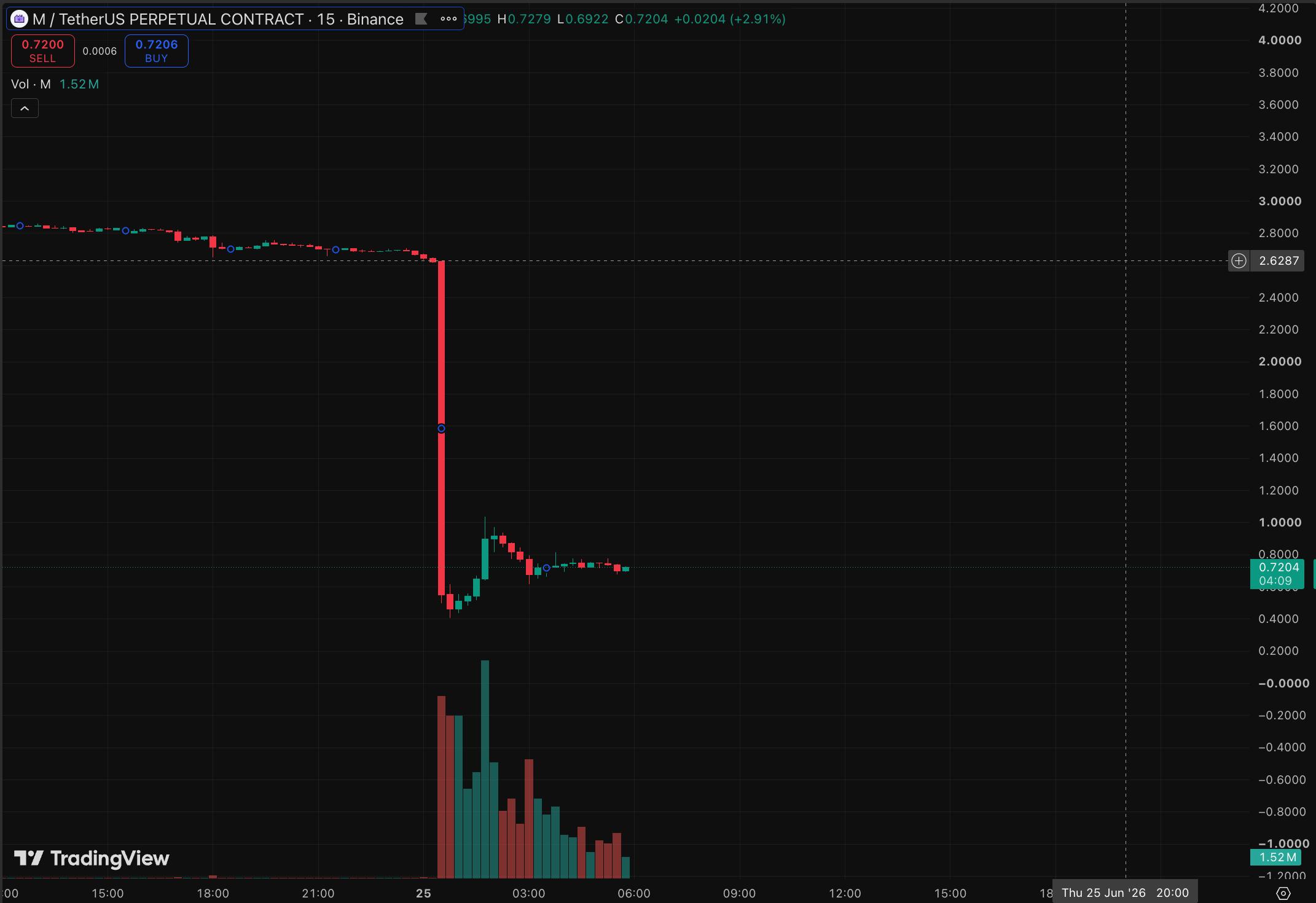
ZachXBT criticizes MemeCore after the M token plunged 75%, questioning Binance, Bybit, Kraken, and Bitget over listings amid concerns. | Credit: CCN.com
Share
Key Takeaways
MemeCore’s M token crashed more than 75% within hours, with its fully diluted valuation (FDV) plunging from approximately $14 billion to $3.8 billion.
On-chain investigator ZachXBT renewed criticism of MemeCore, citing alleged insider-controlled supply and other red flags.
Blockchain data raised liquidity concerns, with Arkham Intelligence reportedly showing no on-chain transfers exceeding $50,000 on BNB Chain in over two weeks.
The M token, the native asset of MemeCore, suffered a dramatic collapse on centralized exchanges, plunging by more than 75% within hours and wiping billions from its fully diluted valuation (FDV).
The token’s FDV dropped from approximately $14 billion to $3.8 billion, pushing it out of the top 25 cryptocurrencies by market capitalization and reigniting concerns over market manipulation and opaque tokenomics.
Following the crash, on-chain investigator ZachXBT criticized both the project and major crypto exchanges that listed the token, arguing that retail investors deserve answers about how such a thinly traded asset achieved multi-billion-dollar valuations.
His latest comments build on months of scrutiny surrounding MemeCore’s token distribution, liquidity, and insider ownership, raising fresh questions about listing standards across the crypto industry.
Try Our Recommended Crypto Exchanges
Sponsored
Disclosure
We sometimes use affiliate links in our content, when clicking on those we might receive a commission at no extra cost to you. By using this website you agree to our terms and conditions and privacy policy.
ZachXBT Questions MemeCore’s Valuation and Token Distribution
ZachXBT has been one of MemeCore’s most vocal critics since April, when he publicly challenged the project to justify its valuation and token allocation.
Responding to MemeCore on X earlier this year, he asked the team to provide evidence supporting its then-$6 billion market capitalization while questioning why “insiders hold >90% of supply.”
Although ZachXBT acknowledged he had not yet produced definitive on-chain proof for that claim, he cited multiple red flags that warranted further investigation.
Market data at the time illustrated the uncertainty surrounding the token’s valuation. CoinMarketCap valued M at roughly $4.3 billion, while CoinGecko placed it closer to $6 billion, making it one of the largest cryptocurrencies despite limited public transparency regarding circulating supply.
Blockchain analytics platform Bubblemaps also identified significant token concentration. One wallet alone reportedly controlled 50 million M tokens worth approximately $178 million, while a Binance deposit address appeared among the largest visible holders.
However, Bubblemaps analyst 0xToolman cautioned that concentrated ownership alone does not necessarily prove coordinated manipulation, noting that some allocations could represent locked team tokens that were not yet circulating.
Thin On-Chain Activity Raises Fresh Concerns
Following the latest price collapse, ZachXBT highlighted what he described as a disconnect between MemeCore’s valuation and its actual blockchain activity.
According to Arkham Intelligence data cited by the investigator, there has not been a single on-chain transfer exceeding $50,000 on Binance Smart Chain (BSC) in more than two weeks.
Meanwhile, DexScreener data reportedly shows less than $100,000 in total on-chain liquidity across BSC trading pools.
For a token that previously commanded a multi-billion-dollar valuation, such limited on-chain activity has fueled skepticism over whether its price was supported by genuine market demand.
ZachXBT also referenced previous investigations conducted alongside researchers Mlm and Wazz, who had warned about what they described as inorganic supply concentration and deceptive tactics allegedly used by MemeCore’s team to inflate user metrics.
The sharp collapse appears to validate many of those earlier concerns, although MemeCore has not publicly responded to the latest allegations.
Pressure Mounts on Major Exchanges Over Listings
Beyond criticizing the project itself, ZachXBT directed much of his attention toward the exchanges that enabled trading of the M token.
He called on Binance and Bybit to explain why they listed M perpetual futures contracts, while also questioning Kraken and Bitget for offering spot trading of the asset.
According to ZachXBT, highly manipulated tokens continue to damage the cryptocurrency industry’s credibility by exposing retail investors to extreme volatility without sufficient transparency regarding liquidity and token ownership.
Finally.
I suggest you also connect the funding rates manipulation on tokens like $M Memecore (especially in 2025).
Pinpoint which CEX exchanges had way higher funding rates than others – AND they actively manipulated funding cycle to exacerbate losses of traders. pic.twitter.com/qh1u7UT17e
The MemeCore controversy follows closely behind the collapse of the RAVE token, another project ZachXBT accused of displaying signs of insider-driven price manipulation after soaring from roughly $0.25 to nearly $28 before crashing more than 80%.
RaveDAO has denied any involvement in the token’s rise and fall, while Binance and Bitget have confirmed they are reviewing the situation.
ZachXBT identified several other tokens, including SIREN, MYX, COAI, PIPPIN, RIVER, and M—as projects exhibiting questionable price behavior that merit further investigation.
The latest MemeCore collapse is likely to intensify scrutiny of exchange listing standards, particularly as regulators and market participants increasingly focus on token concentration, liquidity transparency, and investor protection.
Giuseppe Ciccomascolo began his career as an investigative journalist in Italy, where he contributed to both local and national newspapers, focusing on various financial sectors.
Upon relocating to London, he worked as an analyst for Fitch's CapitalStructure and later as a Senior Reporter for Alliance News. In 2017, Giuseppe transitioned to covering cryptocurrency-related news, producing documentaries and articles on Bitcoin and other emerging digital currencies. He also played a pivotal role in establishing the academy for a cryptocurrency exchange website. Crypto remained his primary area of interest throughout his tenure as a writer for ThirdFloor.