TON to Rebrand Native Token as Gram, Network Name Remains Unchanged
Share
Key Takeaways
TON’s native token is being rebranded to Gram over the next three weeks, reviving the name Telegram originally chose in 2018 before the SEC shut down the project.
Durov’s Make TON Great Again roadmap has now revealed four of the seven planned steps, with Telegram already operating as the network’s largest validator and transaction fees cut by 6x.
Markets responded immediately, with TON rising 18% and daily trading volume surging 129% to $763.7 million following the announcement.
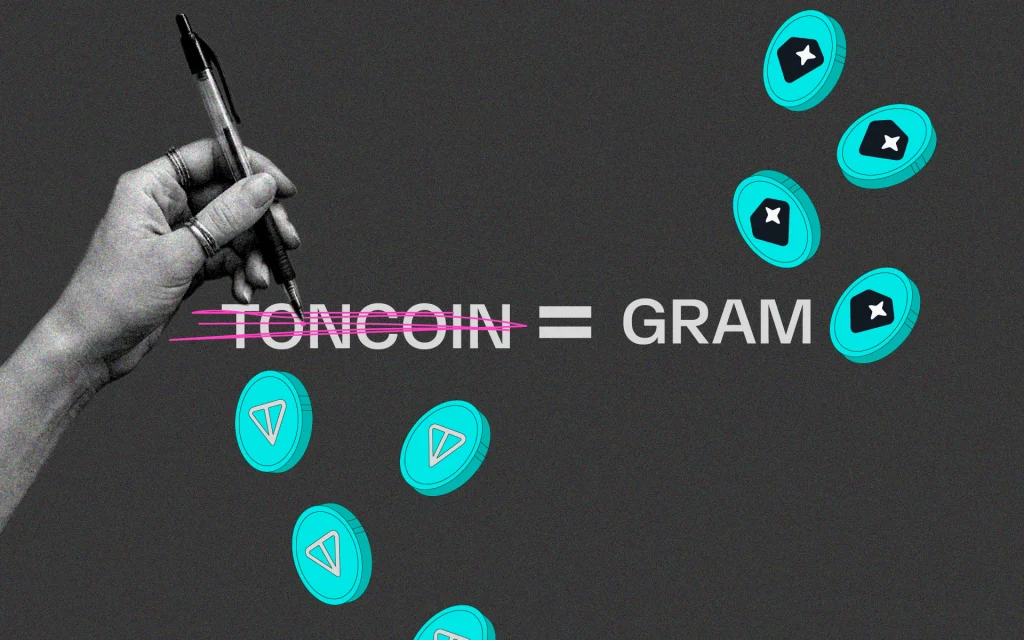
A name killed by regulators seven years ago is making a comeback. Pavel Durov announced on June 1 that The Open Network’s native cryptocurrency will be rebranded from Toncoin to Gram (GRAM), restoring the identity the project carried in its original 2018 white paper before the SEC forced Telegram to abandon its entire blockchain effort.
Toncoin (TON) -> Gram (GRAM)
Community vote is live.
Since Telegram took a leading role in TON's development, the chain got 10× faster, fees 6× lower.
And now Telegram proposes one more change: renaming Toncoin to Gram – the name from the original TON White Paper that never…
Only the token changes. The blockchain network itself keeps its name. The transition is scheduled to take approximately three weeks, during which wallets, infrastructure providers, and ecosystem applications will gradually update references from TON to Gram. Exchanges and market data platforms may take longer to reflect the change, though no alterations to the underlying network are required.
Gram’s Complicated History
Gram is not a fresh brand. It was the original name Telegram assigned to its native currency during a 2018 token sale under the Telegram Open Network project, which raised approximately $1.7 billion.
The SEC intervened in 2019, obtained an injunction blocking the launch, and by 2020, Telegram had abandoned the project entirely, refunded investors, and open-sourced the code.
Independent developers subsequently revived the network under a new structure, rebranding it as The Open Network with Toncoin as its native asset, deliberately distancing it from Telegram’s legal history.
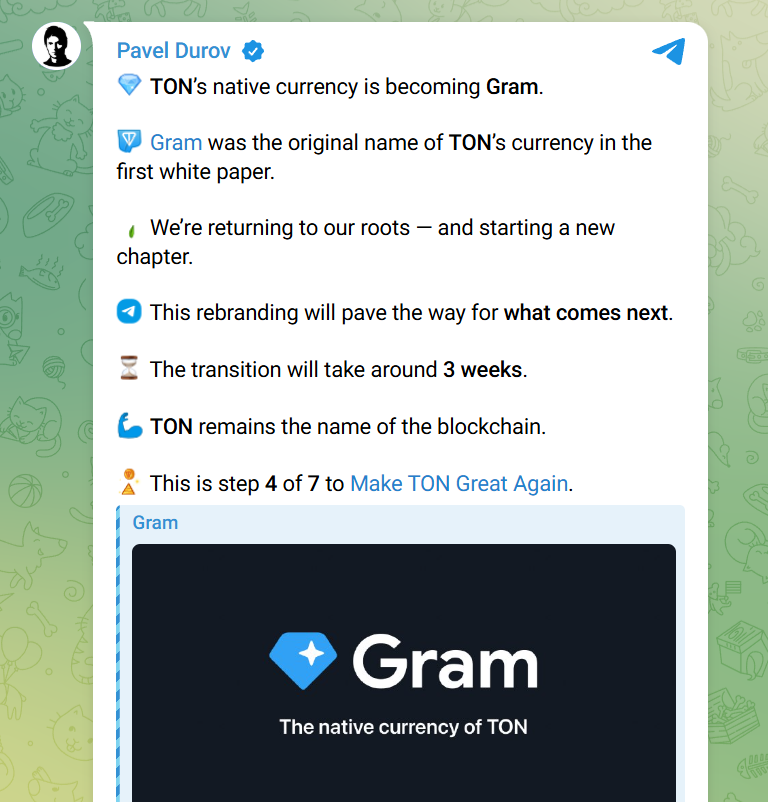
Durov is now reversing that distance. “Gram was the original name of TON’s currency in the first white paper,” he wrote in his announcement. “We’re returning to our roots and starting a new chapter.”
TON’s native currency is becoming Gram. | Source: Telegram
Seven Steps, Four Revealed
Gram’s rebrand is the fourth of seven steps in Durov’s Make TON Great Again campaign, which he began outlining publicly in April.
Steps disclosed so far include a network upgrade that made TON ten times faster with sub-second transaction settlement, a sixfold reduction in transaction fees to near zero, Telegram replacing the TON Foundation as the ecosystem’s primary steward and largest validator, and now the token rename. Three remaining steps have not been publicly disclosed.
The TON blockchain just got upgraded and is now 10× faster.
Block rate increased 6×.
Transactions are now instant, subsecond.
This was step 1 of 7 to Make TON Great Again (MTONGA).
Next step: cut the already low transaction fees by 6×.
Telegram’s validator commitment is already operational. A Telegram-associated wallet held around 28.2 million TON at the time of the May announcement, with 2.2 million TON actively staked in validator operations since late April.
Markets React Sharply
TON climbed 15% to 18% over the 24 hours following the announcement, trading at approximately $2.19, while daily trading volume surged 129% to $763.7 million.
That extended a rally that began in early May when Durov first announced Telegram’s expanded role in the network.
Regulatory conditions surrounding the rebrand look materially different from 2018. The GENIUS Act is in active rulemaking, the SEC has stepped back from broad crypto enforcement, and Telegram now approaches the project it originally created through a structural validator role rather than a token issuance.
Whether restoring the Gram name carries enough symbolic momentum to sustain the market’s enthusiasm will become clearer once the three-week transition completes and the ticker begins appearing across trading interfaces.
Disclaimer:
The information provided in this article is for informational purposes only. It is not intended to be, nor should it be construed as, financial advice. We do not make any warranties regarding the completeness, reliability, or accuracy of this information. All investments involve risk, and past performance does not guarantee future results. We recommend consulting a financial advisor before making any investment decisions.
Dr. Guneet Kaur is a senior editor at CCN.com and a Science Fellow at Exponential Science. She is a fintech and blockchain expert with extensive experience in digital finance education, blockchain ecosystems, and cryptocurrency markets. She has worked with global media such as Cointelegraph, as well as education and blockchain platforms, to design and lead strategic content and learning initiatives. As an educator and assessor for top-tier executive programs, she bridges real-world fintech trends with academic insight.
Dr. Kaur is also a published researcher and peer reviewer across fintech and data science journals, including Financial Innovation Journal and International Journal of Big Data Intelligence and Applications. Her work spans data-driven analysis, Web3 innovation, and technical content development. With a strong foundation in both industry and academia, she translates complex financial technologies into practical applications, empowering learners, professionals, and institutions across the rapidly evolving digital finance landscape.