Key Takeaways
- Crypto Captain predicts $8 XRP before year-end and $240 by mid-2027.
- Solana has unveiled institutional settlement infrastructure informed by JPMorgan’s expertise.
- XRPL operators must upgrade ahead of a security amendment expected to activate on Oct. 9.
A viral prediction that XRP could reach $240 by mid-2027 comes as Solana steps deeper into the institutional settlement market that Ripple is pursuing.
Solana’s new delivery-versus-payment program draws on JPMorgan’s settlement expertise, offering another route for institutions to exchange tokenized assets and payments together.
Meanwhile, XRP Ledger operators face an approaching deadline to install an emergency update ahead of the expected Oct. 9 activation of a security amendment.
Crypto Captain Predicts $240 XRP by Mid-2027
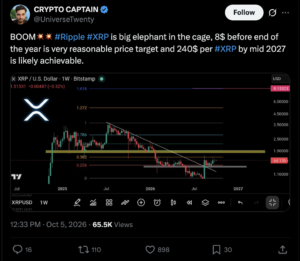
In an October 5 post on X, commentator Crypto Captain forecast $8 XRP before the end of 2026 and $240 by mid-2027.
He described the first target as “very reasonable” and the second as “likely achievable.”
Its accompanying weekly XRP chart shows Fibonacci levels, including an upper marker around $8.15.
However, the post does not explain how the much larger $240 target was calculated.
Crypto Captain’s $240 forecast is not the most ambitious XRP prediction circulating online.
Other commentators and analysts have proposed higher targets with more detailed calculations—although those calculations still are heavily speculative.
In June, XRP commentator Charusan published a model targeting $324.22, arguing that institutional settlement demand would require a substantially higher token price.
His scenario assumes that just 15 billion XRP would remain freely available and that an XRP-based settlement system would process $1.2 trillion in daily cross-border banking activity.
Applying a fourfold regulatory buffer produces a proposed liquidity requirement of $4.8 trillion.
Dividing that amount by the assumed liquid supply yields $320 per XRP, before a further 1.32% adjustment takes the figure to approximately $324.22.
JPMorgan Supplies Expertise for Solana’s Institutional Push
The Solana Foundation’s Oct. 6 announcement introduced Solana DvP, an open-source escrow program designed to exchange an asset for its payment in a single atomic transaction.
The foundation says the program provides finality in seconds, separate escrow accounts, and enforced deadlines.
It aims to provide institutions with a reusable settlement standard rather than requiring individual smart contracts.
JPMorgan reportedly helped by supplying input on securities settlement practices and institutional requirements.
However, the announcement explicitly says that the contribution should not be interpreted as the bank developing, operating, or endorsing the program.
Solana Targets a Market Ripple Wants to Capture
The announcement has made its overlap with Ripple’s ambitions clear.
Ripple wants institutions to issue, hold and trade tokenized assets on the XRP Ledger, using RLUSD to pay for them.
Its Batch feature can also group up to eight transactions.
In its all-or-nothing mode, the entire group succeeds or fails together, helping ensure an asset changes hands only when payment arrives.
Solana’s new program targets the same need, giving institutions another option for settlement.
Whether it wins business from XRPL will depend on which network firms choose.
XRPL Faces Oct. 9 Security Amendment Deadline
XRPL’s immediate challenge is implementing an emergency protocol update.
The Sept. 25 release notice for XRPL version 3.4.1 urges server operators to upgrade promptly.
It introduces fixBatchV1_2, an amendment expected to activate on Oct. 9 if supermajority validator support is in place.
Once enabled, servers running older software will become amendment-blocked and unable to remain synchronized with the network.
The release includes a correction that rejects inner Batch transactions associated with an incorrect wrapper, as well as arithmetic hardening elsewhere in the protocol.
Developers said the security-sensitive source code would be published later with a retrospective.
Settlement Growth Does Not Establish a $240 XRP Price
For XRP bulls, the competitive implication is that atomic settlement is available through multiple networks.
Solana’s program offers an alternative route, challenging bullish claims that institutional settlement must depend on XRP.
Ripple’s own RLUSD model also shows why settlement activity and XRP demand require separate analysis.
Neither announcement establishes how much institutional business will materialize — or how much XRP demand that business would generate.
The XRP Ledger’s growing AI payment activity illustrates why adoption milestones do not automatically support extraordinary price predictions.
As of Oct. 5, the XRPL AI Hub had recorded 12 million payments, settling a cumulative 6,885 XRP and 10,744 RLUSD.
Much of that activity involves AI agents buying data or computing services for tiny amounts.
RippleX engineering head J. Ayo Akinyele celebrated an earlier milestone in an Oct. 1 X post, describing XRPL as increasingly becoming infrastructure for the “machine economy.”
The same distinction applies to institutional settlement: more activity on XRPL does not mean the full value of that activity flows into XRP.
The information provided in this article is for informational purposes only. It is not intended to be, nor should it be construed as, financial advice. We do not make any warranties regarding the completeness, reliability, or accuracy of this information. All investments involve risk, and past performance does not guarantee future results. We recommend consulting a financial advisor before making any investment decisions.

Kurt Robson is a London-based reporter at CCN, specialising in the fast-moving worlds of crypto and emerging technology. He began his career covering local news in Cornwall after graduating from Falmouth University with First Class Honours in Journalism. There, he cut his teeth on everything from council meetings to missing swans.
He quickly rose through the ranks to become a frontline journalist at several of the UK’s leading national newspapers. Over the years, he has interviewed musicians and celebrities, reported from courtrooms and crime scenes, and secured multiple front-page exclusives.
Following the upheaval of the COVID-19 pandemic, Kurt shifted his focus to technology journalism—just ahead of the AI boom. With a natural curiosity and a trained eye for emerging trends, he has found a new rhythm in reporting on innovation.
At CCN, Kurt's work focuses on the cutting edge of crypto, blockchain, AI, and the evolving digital world. Drawing on his background in people-first reporting and his deep interest in disruptive tech, Kurt delivers stories that are insightful, entertaining, and human-centric.










 Peter Brandt Warns XRP Bulls in Rant Despite $5.40 Price Target