Most crypto tokens spend around 70% of their lifetime below launch price, with retail investors losing heavily on token listings, according to a new Delphi Consulting report. | Credit: CCN.com
Share
Key Takeaways
Delphi found that the average token spends roughly 70% of its lifetime below its launch price, as post-launch underperformance is the norm rather than the exception.
Many venture-backed tokens experience an initial price spike before entering prolonged declines.
Across 652 CEX token listings since January 2025, the median return was -82%, while more than half of all tokens lost over 80% of their value.
A new report from Delphi Consulting paints a bleak picture of the modern token market, finding that most crypto tokens spend the majority of their existence trading below their initial launch price.
The report, State of Token Markets, argues that structural flaws in token issuance, vesting schedules, and value accrual mechanisms have created a market where investors are increasingly exposed to long-term losses while insiders benefit from early price spikes.
Analyzing 542 tokens launched since 2020, Delphi found that the average token spends roughly 70% of its lifetime below its launch price.
The findings come after a cycle in which altcoins largely failed to reclaim their 2021 highs despite renewed institutional interest in digital assets and significant inflows into Bitcoin and Ethereum investment vehicles.
New Trending Crypto Wallet Offers
Sponsored
Disclosure
We sometimes use affiliate links in our content, when clicking on those we might receive a commission at no extra cost to you. By using this website you agree to our terms and conditions and privacy policy.
The report highlights a striking trend across token cohorts: the majority of assets fail to sustain gains after their debut.
According to Delphi’s analysis, the average token spent only a small fraction of its trading life above its launch price, while many remained deeply underwater for extended periods.
Layer-2 tokens performed particularly poorly, spending around 80% of their lifespan below launch levels.
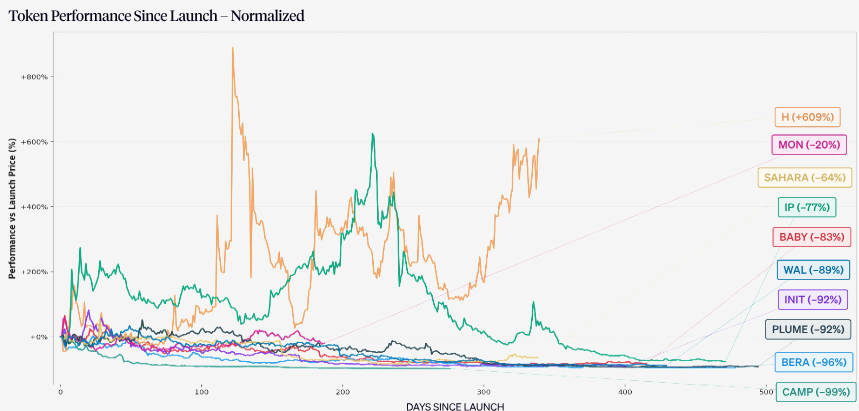
Token performance since launch. | Credit: CoinGecko
The data also revealed that many highly anticipated venture-backed launches followed a similar trajectory.
Tokens such as BERA, PLUME, WAL, and others experienced short-lived rallies immediately after listing before entering prolonged declines, with several losing more than 90% of their value from launch.
Delphi argues that these outcomes are not isolated incidents but symptoms of a broader market structure. Many projects launch with high fully diluted valuations (FDVs) and low circulating supplies, creating a temporary scarcity that supports early prices.
Once scheduled token unlocks begin, and airdrop recipients start selling, the market faces persistent supply pressure that overwhelms demand.
Retail Investors Bore the Brunt of the Losses
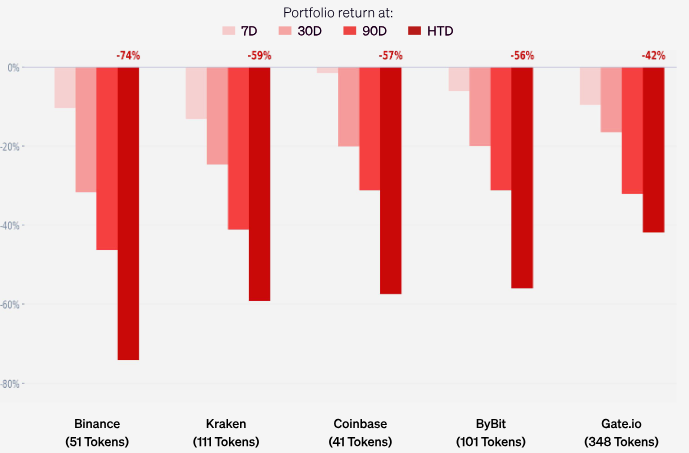
The report also examined centralized exchange (CEX) listings throughout 2025 and found that retail investors suffered significant losses.
Delphi tracked 652 token listings across major exchanges, including Binance, Coinbase, Kraken, Bybit, and Gate.io.
A hypothetical investor who allocated $1,000 to every listing would have seen a median return of -82%, with more than half of all listings losing over 80% of their value.
Only 12% of listed tokens generated positive returns when held through May 2026, according to the study. In aggregate, Delphi estimates that $329,000 of value was destroyed from a theoretical $652,000 portfolio invested across all analyzed listings.
The firm also found that token unlocks played a major role in depressing prices. Across more than 400 unlock events involving 33 tokens, assets underperformed Bitcoin by an average of 7% in the weeks surrounding unlocks.
Because many projects schedule monthly unlocks, markets often have little time to absorb new supply before the next tranche enters circulation.
Revenue-Sharing Tokens Show Signs of Survival
Despite the grim findings, Delphi identified a handful of trends that could help improve token market performance.
The report points to revenue-generating protocols and projects that route fees back to token holders through buybacks, burns, or staking rewards as the strongest performers of the current cycle.
A revenue-weighted portfolio of the top 10 crypto protocols returned approximately 30% between January 2025 and May 2026, outperforming Bitcoin, Ethereum, and Solana over the same period.
Projects such as Hyperliquid, Aave, and Uniswap are examples of protocols increasingly aligning token value with underlying business performance.
Delphi concludes that token markets are moving away from narrative-driven speculation and toward fundamentals-based investing.
The report argues that future winners will likely be projects with sustainable revenue streams, value-accrual mechanisms, and performance-based token unlock schedules, rather than those that rely solely on hype and scarcity.
Giuseppe Ciccomascolo began his career as an investigative journalist in Italy, where he contributed to both local and national newspapers, focusing on various financial sectors.
Upon relocating to London, he worked as an analyst for Fitch's CapitalStructure and later as a Senior Reporter for Alliance News. In 2017, Giuseppe transitioned to covering cryptocurrency-related news, producing documentaries and articles on Bitcoin and other emerging digital currencies. He also played a pivotal role in establishing the academy for a cryptocurrency exchange website. Crypto remained his primary area of interest throughout his tenure as a writer for ThirdFloor.