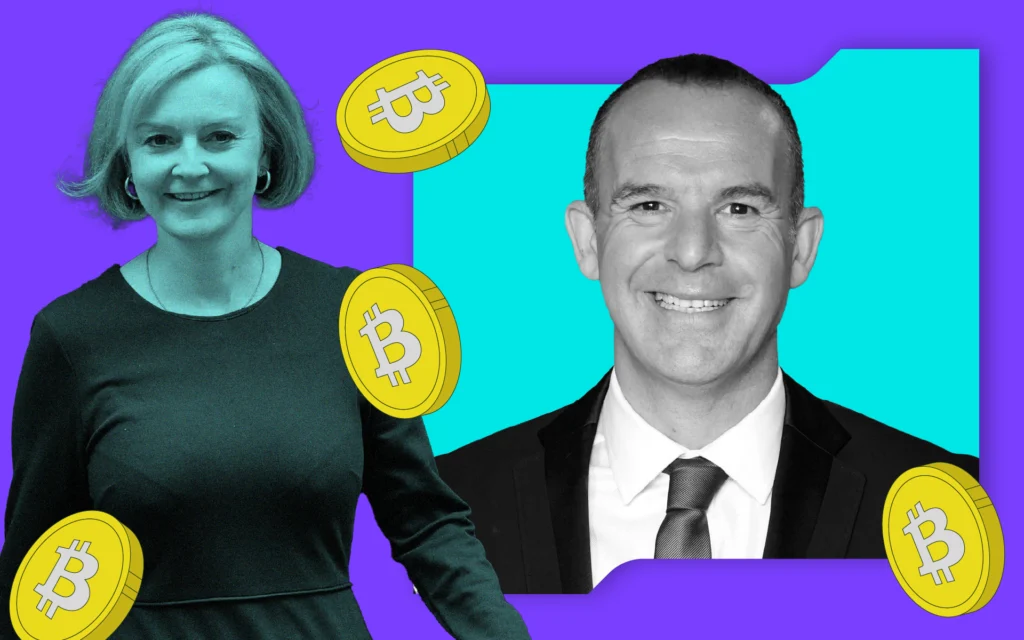
Martin Lewis came under fire for a deleted Bitcoin poll — why? | Source: CCN
Share
Key Takeaways
Martin Lewis sparks backlash after deleting crypto poll.
Bitcoin debate highlights deep divisions.
Crypto gains traction in UK politics.
British consumer finance expert Martin Lewis came under fire on Monday after deleting a crypto poll on social media, saying he had received “abuse” from users.
The episode has drawn criticism online and highlights growing divisions in the UK over Bitcoin, as political figures including former Prime Minister Liz Truss and Reform UK leader Nigel Farage increasingly champion the asset.
Sponsored
Disclosure
We sometimes use affiliate links in our content, when clicking on those we might receive a commission at no extra cost to you. By using this website you agree to our terms and conditions and privacy policy.
On Monday, Lewis said he had removed a poll on X that asked users whether they held Bitcoin, claiming that the reaction had turned hostile.
“I’ve taken my poll to see how many people hold crypto down. It was an interesting question, but sadly sometimes on X it’s just not worth the abuse,” he wrote, adding that some responses were “quite bizarre.”
The post received immediate backlash from crypto participants on social media, many of whom said that they saw no such abuse.
I've taken my poll to see how many people hold crypto down. It was an interesting question, but sadly sometimes on X it's just not worth the abuse (some of it quite bizarre, I think some people don't realise the poll is anonymous and I can't see who votes what!)
In a follow-up post, Lewis pushed back against claims that he had exaggerated the backlash.
“I love the people telling me there wasn’t abuse. Like I’ve a reason to make that up,” he said, adding that he had been accused of using the poll to track individuals.
Adding: “It wasn’t a particularly popular poll and I can do without the accusing me of doing it… so I took it down. Nowt else to see here.”
Online Backlash Sparks Bitcoin Debate
The incident triggered debate among X users, with some disputing whether the responses amounted to abuse and others criticising Lewis’s framing of Bitcoin.
One user wrote that, as a financial adviser, Lewis should distinguish between Bitcoin and the broader crypto market, arguing that Bitcoin had “proven to be the greatest store of value of any asset over the past decade.”
Another said: “Bitcoin, not crypto. It is important that people understand the difference,” likening Bitcoin to “digital gold” and other cryptos to “various brands of tin foil.”
Others questioned Lewis’s characterisation of the responses.
“I didn’t see any abuse… it was a very interesting response,” one user said, adding that more public education on Bitcoin was needed.
Lewis’s Longstanding Cautious Stance
Lewis has consistently distanced himself from crypto commentary, saying it falls outside his area of expertise.
In a 2024 February post he reshared after the backlash, Lewis said he avoided discussing Bitcoin because he does not cover investing or speculation and prefers to focus on household finances.
“I try to avoid these type of risk based issues, always have. There are many great people out there who do I prefer to leave it to them,” he wrote.
He also cited concerns about scams, noting that his name and likeness are frequently used in fraudulent promotions linked to crypto.
I've had a few people asking why I don't discuss Bitcoin here or on my shows. Two simple reasons.
1. It isn't my expertise. I do not cover any form of investing or speculation or currency trading. I try to avoid these type of risk based issues, always have. There are many…
“Sadly I have the worst compliment of being one of the most scammed faces in the UK, both image, name and deep fakes,” he wrote.
“Sadly the criminals who do that use Bitcoin as a soubriquet for get-rich-quick (they’re nothing to do with Bitcoin, they’re just thieves) and link me and it,” he added.
With all this in mind, he said, it was on balance best for him to “try to avoid discussing it.”
Earlier comments from Lewis also reflect a similarly cautious approach.
In 2021, Lewis’ website described Bitcoin as highly volatile and warned consumers they should only invest money they can afford to lose, stressing the lack of regulatory protections compared with traditional financial products.
He has also questioned whether Bitcoin constitutes investing or speculation, emphasising that its value depends on what buyers are willing to pay.
“Many people pushing Bitcoin will tell you things like “the fundamentals have changed”, “big investment firms are getting into it”, “there’s greater transactional demand” and indeed that may all be true,” the blog read.
He added that it is when they use that “to say the price will keep rising that it moves into the realms of speculation.”
“No one has a crystal ball. There are no guarantees,” he added.
Growing Political Support For Bitcoin
The controversy comes as Bitcoin is rapidly gaining increasing attention in British political discourse.
Former Prime Minister Liz Truss has recently voiced strong support for Bitcoin and crypto, describing it as a tool to push back against central bank power.
Speaking on her podcast on Monday, she argued that the existing monetary system has “not been working” for many countries.
She pointed to political figures such as El Salvador’s Nayib Bukele and Argentina’s Javier Milei as examples of leaders using it to challenge established systems.
Truss also linked the adoption of Bitcoin to broader political change, saying that “ownership of Bitcoin” and “belief in economic freedom” are connected to wider liberties, including freedom of speech.
She argued that reforming the monetary system would be key to restoring “core freedoms” in Britain.
“Well done to everybody who’s part of the Bitcoin collective. We need more of you,” she said.
UK Politicians Deepening Crypto Ties
Other British political figures have also moved closer to the crypto sector.
Nigel Farage, leader of Reform UK, has invested £215,000 in a Bitcoin-focused investment company chaired by former Chancellor Kwasi Kwarteng, one of the most direct financial links so far between a senior UK politician and the industry.
Farage has long advocated for crypto, framing it as a tool for financial autonomy, particularly after his 2023 “debanking” controversy.
He has also opposed the development of a UK central bank digital currency, warning it could enable state surveillance of personal finances.
CCN previously reported that Farage described crypto as “the ultimate freedom in the 21st century” at Zebu Live 2025
Parallels With Trump’s US
Many political commentators have said the growing embrace of crypto among UK politicians mirrors trends in the United States, where President Donald Trump has increasingly backed the sector.
Farage has sought to align himself closely with Trump politically, and his deepening ties to the crypto sector reflect similar messaging around financial freedom regularly exercised by the US President.
Writing in the Daily Mirror, associate editor Kevin Maguire described Farage as “mini-me Nigel Farage”, accusing him of “emulating mentor Donald Trump by promoting a funny money cryptocurrency company in which he owns shares” and “profiteering in plain sight.”
Maguire argued that Reform UK risked becoming “a business wheeze to enrich Farage with a political party attached,” pointing to his stake in Stack BTC, which he said could rise significantly in value.
He added that Farage’s activities raised “disturbing, serious questions about conflicts of interest” if a senior politician were seen to promote personal financial interests while seeking high office.
Similar concerns have also been raised in the US over Trump’s involvement in the crypto sector.
Trump and members of his family have backed a series of crypto-related ventures, including projects linked to World Liberty Financial (WLFI) and other digital asset initiatives.
The Trump family stablecoin surged to 7th largest in the world because of a shady crypto deal with the United Arab Emirates—a foreign government that will give them a crazy amount of money.
The Senate shouldn’t pass a crypto bill this week to facilitate this kind of corruption. pic.twitter.com/4is9KgpXQb
Senator Elizabeth Warren has repeatedly warned that Trump’s crypto ventures could expose the US to foreign influence.
She has specifically targeted WLFI, arguing that its links to offshore entities raise a national security red flag.
Last year, Warren posted on X about WLFI’s USD1 stablecoin, accusing the project of benefiting from backroom deals with the UAE.
“The Trump family stablecoin surged to the 7th largest in the world because of a shady crypto deal with the United Arab Emirates—a foreign government that will give them a crazy amount of money,” she wrote.
Kurt Robson is a London-based reporter at CCN, specialising in the fast-moving worlds of crypto and emerging technology. He began his career covering local news in Cornwall after graduating from Falmouth University with First Class Honours in Journalism. There, he cut his teeth on everything from council meetings to missing swans.
He quickly rose through the ranks to become a frontline journalist at several of the UK’s leading national newspapers. Over the years, he has interviewed musicians and celebrities, reported from courtrooms and crime scenes, and secured multiple front-page exclusives.
Following the upheaval of the COVID-19 pandemic, Kurt shifted his focus to technology journalism—just ahead of the AI boom. With a natural curiosity and a trained eye for emerging trends, he has found a new rhythm in reporting on innovation.
At CCN, Kurt's work focuses on the cutting edge of crypto, blockchain, AI, and the evolving digital world. Drawing on his background in people-first reporting and his deep interest in disruptive tech, Kurt delivers stories that are insightful, entertaining, and human-centric.