Can LitVM Bring Smart Contracts to Litecoin Without Changing Its Identity?
Share
Key Takeaways
LitVM aims to bring smart contracts and DeFi capabilities to Litecoin without altering Litecoin’s base-layer design as a simple payments network.
Nasdaq-listed Lite Strategy invested $1 million in LitVM’s developer, betting that additional infrastructure can increase Litecoin’s long-term utility.
Despite processing over 75 million testnet transactions, LitVM remains pre-mainnet, with audits ongoing and no total value locked, leaving its long-term success unproven.
For 14 years, Litecoin has focused on doing one thing well: moving money quickly, cheaply, and reliably. No smart contracts, no DeFi, and no complex programmability. That simplicity helped build a loyal user base and a resilient payments network.
According to BitPay’s “Decrypted 2024” report, Litecoin processed more payments than Bitcoin in 2024, accounting for 201,165 of the roughly 608,000 transactions handled on the platform.
Now, the LitVM team is working to expand Litecoin’s capabilities while preserving the simplicity and reliability that made it successful in the first place.
LitVM, a zero-knowledge EVM-compatible layer-2 built on Litecoin, launched its LiteForge testnet in mid-April 2026, processing over 75 million transactions and supporting more than 50 decentralized applications. According to co-founder Aztec Amaya, the project is designed to expand Litecoin’s functionality without altering its core purpose.
“LitVM is a layer-2 solution, not a change to Litecoin’s base layer,” Amaya told CCN. “The L1 remains exactly what it’s always been, a fast, simple, secure payments network. LitVM is an opt-in infrastructure for users and developers who want programmability.”
The project received its most concrete financial backing on June 18, when Lite Strategy, a Nasdaq-listed company trading under the ticker LITS, announced a $1 million lead strategic investment in ZK Innovations, LitVM’s British Virgin Islands-registered developer. The deal includes governance participation rights and an option to acquire future LitVM network tokens at a $50 million valuation cap.
The Litecoin meta is accelerating 🔥
Yesterday, @LiteStrategy — the world's largest Litecoin treasury company, holding 850,000 $LTC — announced a strategic investment in LitVM. This is much bigger than an investment. It's a signal of what the Litecoin ecosystem is becoming.… https://t.co/2SqmPBUrsApic.twitter.com/q1PPcN40sV
Lite Strategy holds approximately 850,000 LTC, roughly 1.1% of all Litecoin (LTC) ever mined, acquired in August 2025 at an average cost of around $107 per coin. The company is now funding the infrastructure, it says, that makes that asset more useful.
Jay File, CEO of Lite Strategy, was direct about the alignment of interests.
“As a major Litecoin holder, we have a direct financial incentive to see LitVM succeed,” File said. “However, that’s not something we don’t acknowledge, but it’s exactly why we’re making this investment in the first place. Our investment thesis isn’t speculative, but infrastructure-focused.”
File pointed to the Litecoin Foundation’s formal endorsement of LitVM and Charlie Lee’s public backing as independent validation. The governance package Lite Strategy received includes board observer rights, quarterly operational transparency, and semi-annual management consultations. It does not include board votes or veto power.
“Real power will rest with LitVM’s board, and eventually with decentralized token holder governance as the ecosystem matures,” File said.
Can LitVM Attract Developers Away From Ethereum?
The harder question for LitVM is not governance, but developer motivation. Ethereum’s layer-2 ecosystem, including Base, Arbitrum, and Optimism, offers deep liquidity, years of security audits, and established communities.
Amaya’s answer centers on differentiation rather than competition. “Ethereum L2s excel at general-purpose DeFi where token inflation doesn’t matter,” he said. “But for real-world assets, institutional treasuries, and yield strategies where collateral scarcity is essential, you want hard money, fixed supply, proven security, institutional credibility. That’s Litecoin.”
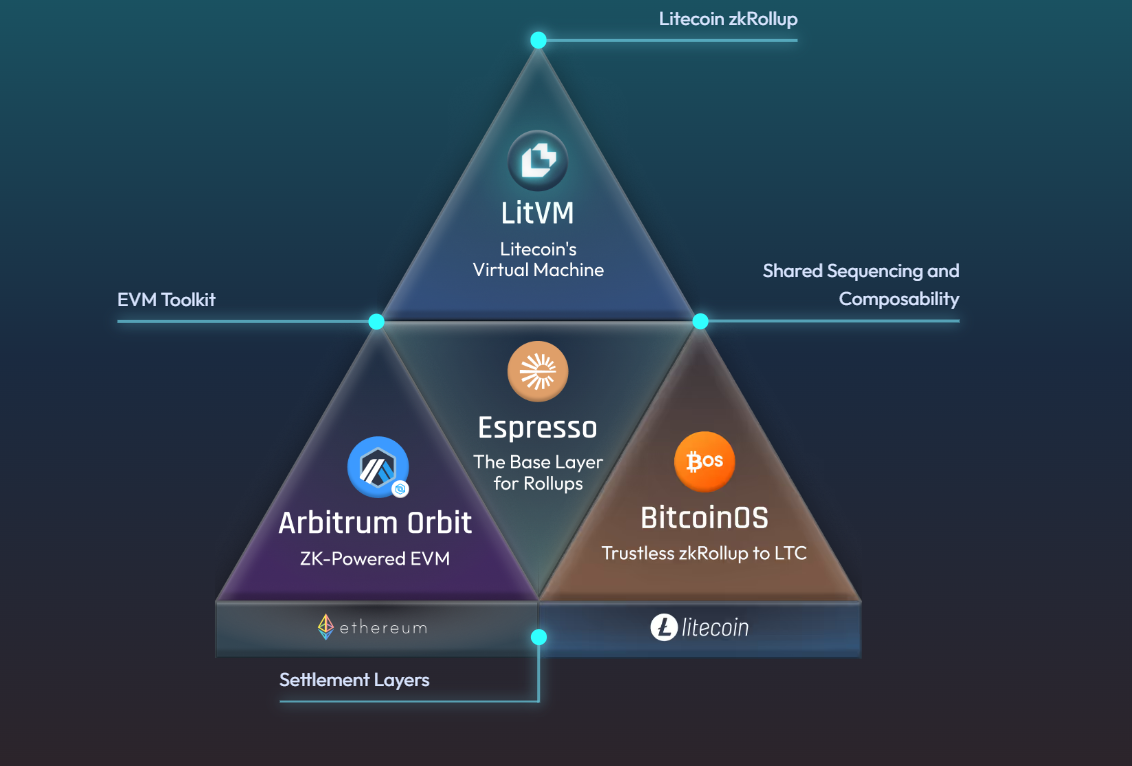
The technical stack LitVM is building uses Arbitrum Nitro for EVM execution, Succinct SP1 zkVM for validity proofs, Espresso for decentralized sequencing, and the BitcoinOS Grail bridge for connecting to Litecoin’s base layer.
Mainnet is targeted for later in 2026 via a phased rollout, though no firm date has been set. Before real funds are at risk, Amaya said the protocol will undergo multiple rounds of independent security audits covering smart contracts, bridge logic, ZK circuits, and overall architecture.
Where LTC Sits Now
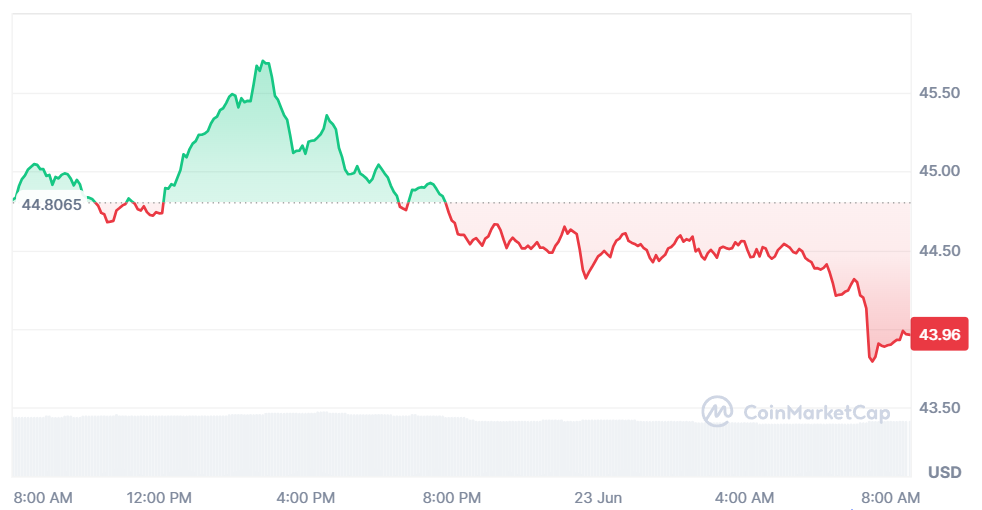
The investment lands at a difficult moment for Litecoin’s price. LTC trades around $44, down roughly 54% over the trailing 12 months and nearly 90% below its all-time high of $412.96 set in May 2021.
Canary Capital’s LTCC, the first US spot Litecoin ETF, has raised approximately $5.49 million in net assets after nearly eight months of trading on Nasdaq, a figure that shows that ETF access alone has not generated new demand.
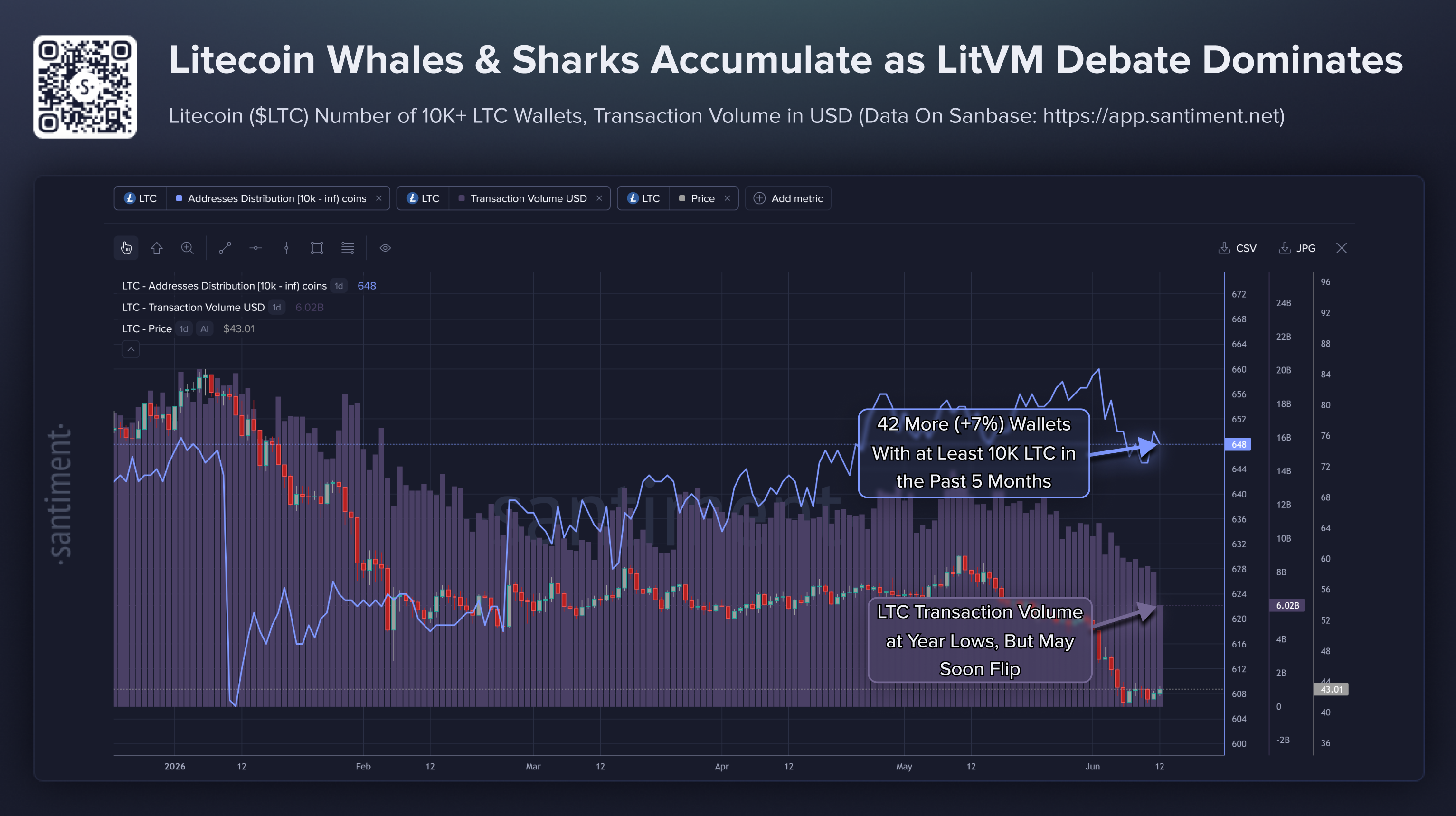
Onchain signals are more constructive. Wallets holding at least 10,000 LTC rose 7% over five months to 648 as of mid-June, according to Santiment Intelligence, even as USD transaction volume hovered near yearly lows.
Daily active addresses average roughly 300,000, and Litecoin leads proof-of-work networks in that metric by a wide margin.
Litecoin whale and shark wallets continue to grow, while LitVM fuels fresh interest. | Source: Santiment
Analyst forecasts for Litecoin vary widely depending on the methodology used. LiteFinance projects LTC could trade between $52 and $134, reflecting expectations for moderate price fluctuations.
Bitget’s analysts are more optimistic, forecasting a near-term range of $100 to $150 and suggesting Litecoin could eventually exceed $1,000 by 2030 if adoption and market conditions remain favorable.
Meanwhile, more conservative models cited by Coinbase and Kraken estimate LTC could trade around $35 to $40 in the near term, with gradual appreciation over the coming decade.
While those forecasts focus on Litecoin’s market performance, Lite Strategy’s investment thesis centers on whether infrastructure projects such as LitVM can expand the network’s utility and attract new users, developers, and applications over time.
For LitVM, the market verdict will come later.
“LitVM’s success ultimately depends on attracting third-party developers and users who have no relationship with Lite Strategy,” File said. “The market will then validate whether this infrastructure actually delivers on its promise.”
Mainnet has not yet launched, and security audits remain in progress. Although the testnet has shown encouraging activity, LitVM’s ability to attract users, developers, and capital at scale has yet to be tested in a live environment.
Disclaimer:
The information provided in this article is for informational purposes only. It is not intended to be, nor should it be construed as, financial advice. We do not make any warranties regarding the completeness, reliability, or accuracy of this information. All investments involve risk, and past performance does not guarantee future results. We recommend consulting a financial advisor before making any investment decisions.
Dr. Guneet Kaur is a senior editor at CCN.com and a Science Fellow at Exponential Science. She is a fintech and blockchain expert with extensive experience in digital finance education, blockchain ecosystems, and cryptocurrency markets. She has worked with global media such as Cointelegraph, as well as education and blockchain platforms, to design and lead strategic content and learning initiatives. As an educator and assessor for top-tier executive programs, she bridges real-world fintech trends with academic insight.
Dr. Kaur is also a published researcher and peer reviewer across fintech and data science journals, including Financial Innovation Journal and International Journal of Big Data Intelligence and Applications. Her work spans data-driven analysis, Web3 innovation, and technical content development. With a strong foundation in both industry and academia, she translates complex financial technologies into practical applications, empowering learners, professionals, and institutions across the rapidly evolving digital finance landscape.