What Keir Starmer's Resignation Means for Crypto in the UK
Share
Key Takeaways
Keir Starmer’s resignation creates uncertainty around UK crypto policy, but the FCA’s crypto framework and 2027 implementation timeline remain intact.
Andy Burnham, the leading contender to replace Starmer, has not outlined a crypto agenda, leaving key questions around stablecoins, regulation, and industry competitiveness unanswered.
Industry leaders warn the UK is losing ground to the EU, Singapore, and the UAE, while some builders increasingly see permissionless infrastructure as a hedge against political uncertainty.
Keir Starmer’s resignation as UK Prime Minister, confirmed in an emotional statement in which he cited his family as his priority, has triggered immediate questions across the digital assets sector about what a leadership change means for one of the world’s most closely watched crypto regulatory frameworks.
The short answer is: nobody knows. And in a sector where policy timelines already lag market reality, that uncertainty carries real costs.
Starmer’s departure comes at a pivotal moment for UK crypto regulation. The Treasury and Financial Conduct Authority (FCA) have spent the past two years building a comprehensive framework covering stablecoins, crypto trading venues, and market abuse rules.
While a change in prime minister does not reset that process, it could slow momentum at a critical stage.
Markets reacted cautiously. Sterling fell 0.3% to $1.319 and slipped 0.1% against the euro to 86.76 pence, extending a decline of roughly 3% since February.
Ten-year gilt yields were little changed at 4.845%, while 30-year yields stood at 5.54%. The FTSE 100 was down just five points, reflecting a largely wait-and-see response from investors.
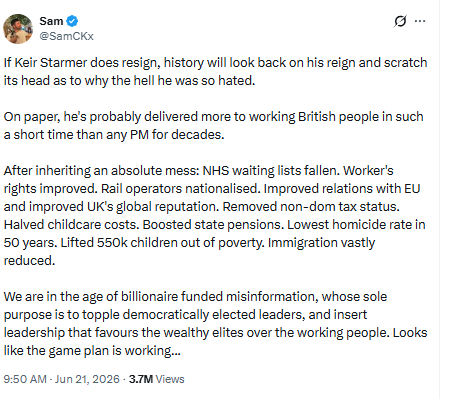
@SamCKx on Keir Starmer’s resignation as the UK PM.
Why the UK’s Crypto Competitiveness Is Now Under Scrutiny
“Leadership transitions create regulatory pauses, and in crypto that matters more than most sectors because the policy work is still live,” Robin Nordnes, CEO and Founder at Raiku, told CCN. “The UK has been building a credible cryptoasset framework at HMT and FCA level and that work doesn’t reset with a change at the top, but it does slow.”
Nordnes identified the more structural question underlying the immediate transition noise. “The more interesting question is whether any incoming government sees digital assets as an economic growth story rather than a compliance problem. The jurisdictions that have made that shift are the ones attracting institutional infrastructure and the ones that treat it as a regulatory management exercise to keep watching the volume go elsewhere.”
The crypto sector generally viewed Starmer’s stance as measured and regulatory-first, rather than geared toward industry expansion.
The most visible signal was the Labor government’s ban on digital asset donations to political parties, a decision that drew immediate industry criticism and was widely read as a political statement rather than a regulatory principle.
The UK Has Been Here Before
Not everyone views the transition as a fresh start. For Roxana Nasoi, Core Contributor at Logos, the resignation of a single leader does not address the deeper structural problem.
“Removing one man doesn’t solve the problem, albeit it will surely ease public tension this summer,” Nasoi told CCN. “We will for sure experience setbacks. Any setback is an opportunity for change.”
Nasoi pointed to a history that the current policy debate often glosses over. The UK had a genuine early lead in crypto: a London Bitcoin scene, early exchanges, Ethereum meetups like ETHLDN, and working groups on token classification after the 2018 ICO crackdown. What followed was instructive.
“Hardened regulation drove most of it to the US and Asia. A leadership change is the moment to rethink: policies that let small businesses operate, give retail real access to diversification, and bring builders back to the City.”
Builders Are Looking Beyond Westminster for Answers
But Nasoi’s most pointed observation went beyond the regulatory debate entirely. “The deeper fix isn’t just regulatory tinkering. It’s private sovereign infrastructure that can thrive independently of changes in Westminster, enabling new financial and governance institutions.”
That argument, that the UK’s crypto sector cannot afford to remain dependent on political cycles for its viability, echoes a position gaining traction among builders who have watched multiple regulatory regimes come and go without producing durable policy clarity.
If Keir Starmer does resign, history will look back on his reign and scratch its head as to why the hell he was so hated.
On paper, he's probably delivered more to working British people in such a short time than any PM for decades.
Will Andy Burnham Embrace Crypto as an Economic Growth Tool?
Andy Burnham, the MP for Makerfield and the leading contender to replace Starmer after confirming his leadership bid on social media, has yet to outline a position on crypto or digital assets.
His public statement following Starmer’s resignation focused on economic growth, cost of living, public services, and housing, with no reference to financial innovation or digital infrastructure.
Keir has given huge service to our country and I want to thank him for his leadership and dedication during such a challenging period.
His decision marks the beginning of a transition and it is important that this process is conducted in an orderly and responsible way. I will…
That absence does not surprise Rohit Sabhlok, Managing Director at digital asset regulatory consultancy GRT Consulting.
“With the political reality of huge government debt increases due to interest rate rises, and with it the loss of more public services over time, Andy Burnham hasn’t really got a crypto agenda,” Sabhlok told CCN. “The only web3 focus would be part of a growth mandate and the removal of the ban on digital asset donations to political parties.”
Why the Donation Ban Matters Beyond Campaign Finance
The removal, if it comes, would be both practically and symbolically significant. The donation ban was read by the industry not just as a policy position but as a signal of where crypto sat in the Labour political hierarchy.
Reversing it under a new leader would send the opposite signal, even without any accompanying regulatory action.
290,000 Advocates Are Watching
For Stand With Crypto UK, which counts more than 290,000 advocates across the country, the transition represents an opportunity rather than a disruption, provided the incoming leader frames digital assets as an economic priority.
“The next generation of leaders has an opportunity to cement the UK’s position as a global hub for crypto innovation, Web3 entrepreneurship and tokenized finance,” Adrianna Ennab, Director at Stand With Crypto UK, told CCN. “The Government has already set out an ambition to make the UK the best place to build and grow a digital asset business. We are optimistic that Andy Burnham will recognise the economic opportunity this presents and help ensure the UK remains competitive in attracting talent, investment and innovation.”
Can the UK Keep Pace With the EU, Singapore, and the UAE?
The optimism is conditional. The UK’s competitive position in digital assets has been under sustained pressure from the EU’s MiCA framework, which came into full effect in December 2024 and gave European operators a single passportable license across 27 markets.
Singapore and the UAE have moved faster still. The window in which the UK can credibly pitch itself as the default destination for crypto infrastructure investment is narrowing, and a prolonged leadership transition makes it narrower.
Why Permissionless Rails Gain Appeal During Political Transitions
Nordnes drew the sharpest long-term conclusion. “What doesn’t change is the structural logic that the more political discretion sits over centralized infrastructure, the stronger the case for building on permissionless rails becomes.”
In other words, if the political cycle continues to create uncertainty for centralized crypto operators, it strengthens the case for decentralized alternatives that do not require regulatory permission to operate.
Britain’s Crypto Future Depends on What Happens Next
Starmer’s crypto legacy remains unfinished. His government laid the foundations of a regulatory framework and advanced multiple industry consultations, but the unresolved policy pipeline is arguably more significant than what was delivered.
The scale of live regulatory work is considerable. Parliament made the Financial Services and Markets Act 2000 (Cryptoassets) Regulations 2026 in February, bringing cryptoassets within the FCA’s regulatory remit, with the full regime expected to come into force in October 2027. That statutory deadline is now politically orphaned.
Crypto firms will be able to start applying for FCA authorization from September 2026, with the regulator planning to publish final rules this summer. A leadership contest that drags into autumn risks colliding directly with that application window.
The stablecoin framework is equally time-sensitive. The FCA’s proposed regime for qualifying stablecoin issuers requires backing assets equal to minted stablecoins, held under a statutory trust for holders and placed with an independent third party outside the issuer’s group, with the authorization application period scheduled to run from September 2026 to February 2027.
Separately, the Bank of England softened its proposed stablecoin regime by replacing strict user-holding limits with a temporary cap on total issuance and by allowing issuers greater flexibility in how reserves are invested. The revised approach aims to support innovation while safeguarding financial stability, though some industry participants argue the framework remains less competitive than those emerging in other jurisdictions.
The Bank of England has made some welcome improvements to its stablecoin framework, but the overall policy still appears designed to ensure that UK-based stablecoin issuers cannot succeed. Here's why:
Scrapping the proposed £20,000 cap on individual stablecoin holdings was an…
The perimeter question is also unresolved. The FCA closed its consultation on draft perimeter guidance earlier this month, covering stablecoin issuance, cryptoasset safeguarding, trading platform operations, dealing as principal and agent, arranging deals, and cryptoasset staking. Final guidance is expected in autumn 2026.
This guidance will determine which firms require FCA authorization and which fall outside the regulatory perimeter. A change of government does not alter the consultation outcome, but it could influence the political appetite for making difficult decisions on contested areas of the crypto market.
The market abuse and admissions regime adds another layer. The FCA’s consultations covered the detailed design of the admissions and disclosure regime and market abuse regime for cryptoassets, alongside a proposed prudential regime for cryptoasset companies.
In addition, the FCA has noted that crypto markets are highly global and fragmented, and that the regime may not always achieve the same regulatory outcomes as traditional finance, an acknowledgment that the framework being built has structural limits that political will cannot fully resolve.
Not everyone is inclined toward cautious optimism about what comes next. Susie Violet Ward, Director and co-founder of Bitcoin Policy UK and Bitcoin journalist, offered the sharpest verdict on the Starmer years.
“Keir Starmer’s resignation ends a chapter of broken promises, regulatory and authoritarian overreach and economic stagnation,” Ward told CCN. “Britain needs a shift to sound money, innovation, and better rules on energy, tech, digital assets and Bitcoin to avoid another cycle of decline. Stability comes from empowering individuals over failing institutions.”
Ward’s view reflects a broader frustration that extends beyond the Bitcoin community. For many working across technology, finance, and digital infrastructure, the Starmer years were not seen as a period of cautious progress but as a missed opportunity to strengthen the UK’s position in the global digital asset industry.
Whether the next occupant of Downing Street treats that unfinished work as a growth priority or a compliance backlog will determine whether the UK’s stated ambition translates into actual market share, or whether that market share continues migrating elsewhere.
As Nasoi put it, the UK has been here before. The question is whether this time it chooses differently.
Disclaimer:
The information provided in this article is for informational purposes only. It is not intended to be, nor should it be construed as, financial advice. We do not make any warranties regarding the completeness, reliability, or accuracy of this information. All investments involve risk, and past performance does not guarantee future results. We recommend consulting a financial advisor before making any investment decisions.
Dr. Guneet Kaur is a senior editor at CCN.com and a Science Fellow at Exponential Science. She is a fintech and blockchain expert with extensive experience in digital finance education, blockchain ecosystems, and cryptocurrency markets. She has worked with global media such as Cointelegraph, as well as education and blockchain platforms, to design and lead strategic content and learning initiatives. As an educator and assessor for top-tier executive programs, she bridges real-world fintech trends with academic insight.
Dr. Kaur is also a published researcher and peer reviewer across fintech and data science journals, including Financial Innovation Journal and International Journal of Big Data Intelligence and Applications. Her work spans data-driven analysis, Web3 innovation, and technical content development. With a strong foundation in both industry and academia, she translates complex financial technologies into practical applications, empowering learners, professionals, and institutions across the rapidly evolving digital finance landscape.