

Use Cases That Matter
Where crypto hits real life in Singapore:
- Stablecoin payments at everyday merchants: Thanks to OKX Pay, users can now make real-world payments in USDC or USDT by scanning GrabPay QR codes at participating shops, cafes, restaurants, and other merchants. Payments are converted into the Singapore-dollar-pegged XSGD so merchants receive SGD instantly, expanding everyday crypto utility beyond speculation.
- Cross-border payments and remittances: With 1.9 million foreign workers in Singapore, remittances are big and crypto is playing a role. Stablecoins are used for cheaper, faster international transfers by individuals and businesses. Singapore’s licensed payments infrastructure and partnerships (e.g., Thunes with stablecoin rails) support cross-border transfers and remittances, reducing traditional bank fees and settlement times.
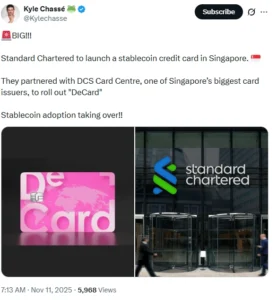
- Stablecoin credit cards: Singapore launched one of the first stablecoin-linked credit cards, the DeCard, through a partnership between Standard Chartered and DCS Card Centre. This lets users spend stablecoins like USDC or USTC at merchants via the traditional banking network, blending blockchain assets with everyday spending in local and online retail.
- Tokenized asset services and institutional payments: Under MAS initiatives (like Project Guardian), Singapore is piloting real-world tokenization of financial instruments such as deposits, funds, and securities. These tokenized assets can be used for more efficient enterprise payment settlement, treasury operations, and cross-border liquidity management, a step toward programmable corporate finance workflows.
- Regulated crypto trading and custody services: Licensed platforms operating in Singapore, including Coinbase Singapore, Circle (USDC issuer), Crypto.com, Independent Reserve, OKX SG, Upbit Singapore, Bitstamp Asia, Bitgo Singapore, StraitsX (XSGD), FOMO Pay, and TripleA, enable residents and institutions to trade, hold, and use crypto under MAS compliance, integrating digital assets into mainstream financial activity.
Citizen Voices
How crypto is perceived across institutions, citizens, and politics in Singapore.
Singapore is widely recognised for its institutional-grade approach to digital assets. The country combines rigorous governance, practices such as segregating client assets off-balance sheet, and a forward-looking regulatory framework that enables innovation in asset management and corporate finance.
Pascal Eberle, Chief of Staff, Sygnum Bank
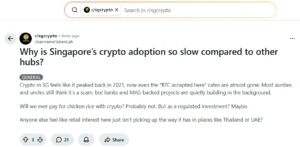
Among everyday users, sentiment is more cautious. Many local crypto holders express frustration that adoption among the general public is slower than expected, often citing regulatory caution and advertising restrictions. This reflects a market where crypto interest is still anchored more in investment and long-term positioning than in consumer payments or hype-driven speculation.
Reddit user (Singapore)
Political discourse is also beginning to reflect this shift. Jeremy Tan, an entrepreneur-turned-independent candidate in the 2025 general election, placed Bitcoin adoption at the centre of his platform, proposing crypto-focused policies such as a Singapore-dollar-denominated Bitcoin ETF and deeper integration of digital assets into the financial system. His campaign gained notable traction, signalling that digital asset issues are entering mainstream political conversation.
Jeremy Tan (Singapore election candidate)
Crypto cost of living: What 1 BTC buys here
A glimpse into the lifestyle economy — measured in sats, not cents.
Core Lifestyle Benchmarks
Here’s how everyday prices in Singapore translate into cryptocurrency terms, based on retail price estimates and the current Bitcoin (BTC) market price.
It’s a snapshot of urban reality: even in one of Asia’s most connected and high-income nations, crypto wealth stretches far but not endlessly, everyday costs still anchor digital dreams to physical life.
BTC-to-Housing: The Long View
How far 1 BTC has gone over time in the housing market

Regulatory + Economic Snapshot
The Monetary Authority of Singapore (MAS) views crypto as a long-term part of the financial ecosystem but insists on strict oversight. It promotes tokenization, stablecoin regulation, and wholesale CBDC pilots while maintaining tight consumer protections and curbs on retail speculation.
Singapore imposes no capital gains tax on crypto. Profits from casual investing are tax-free, while income from trading, staking, or mining as a business is taxed under normal income brackets. GST is exempt for regulated digital payment tokens, ensuring no double taxation.
MAS continues testing tokenized MAS bills and wholesale digital money through Project Guardian and Project Orchid, collaborating with major banks. The focus is on institutional and interbank settlement use cases, with no retail CBDC planned.
Singapore’s major banks, such as DBS, OCBC, and UOB, actively explore tokenized assets and blockchain settlements under MAS supervision. MAS encourages fintech-bank partnerships, emphasizing secure custody, compliance, and anti-fraud controls rather than confrontation.
In H1 2025, Singaporean authorities reported roughly S$456 million lost to scams. Local reporting highlighted a crypto scam where an individual lost approximately S$125 million through a fraudulent online interview scheme that installed malware to access the victim’s crypto wallet, one of the largest single reported crypto theft losses by value in Singapore’s scam statistics. In July 2024, the Singapore High Court dealt with the aftermath of a $235 million crypto exchange heist involving WazirX, a major cryptocurrency trading platform. The platform suffered a large-scale cyber theft, and its restructuring plan to recover and stabilise operations was rejected by the Singapore High Court in 2025, marking a significant legal and financial setback in the wake of one of the larger crypto platform breaches connected to the Singapore legal environment.
Chia Der Jiun, Managing Director of MAS, advocates for responsible innovation through regulation, tokenized finance, and stablecoin clarity. Sopnendu Mohanty, former MAS Chief FinTech Officer, continues to champion blockchain adoption that complements, not disrupts, mainstream banking.
Risk Barometer
Gives time-sensitive readers a feel for how volatile or stable the legal landscape is.
Crypto Adoption Timeline
-
2014
First local exchange launched: Coinhako, one of Singapore’s earliest crypto platforms, began operations, offering fiat-to-crypto access and paving the way for local retail adoption.
-
2017
MAS issues first crypto and ICO warnings: The Monetary Authority of Singapore cautioned investors about speculative risks, scams, and unregulated ICOs as Bitcoin surged to record highs.
-
2019
Payment Services Act (PSA) passed: Singapore introduced a comprehensive law regulating digital payment tokens (DPTs), licensing exchanges, and establishing AML/KYC standards, one of the world’s first unified crypto laws.
-
2020
Institutional entry begins: DBS Bank launched DBS Digital Exchange (DDEx) for accredited investors, signaling the start of regulated institutional participation in crypto trading and custody.
-
2021
Retail adoption spikes: Global bull-run enthusiasm and clear licensing frameworks drove record trading volumes on local exchanges like Coinhako and Independent Reserve. Singapore positioned itself as Asia’s “responsible crypto hub.”
-
2022
Crypto ATM ban and advertising restrictions: MAS prohibited public crypto advertising and removed all Bitcoin ATMs to curb retail speculation. Stablecoin issuer StraitsX (XSGD) grew as a regulated digital-payment token.
-
2023
Stablecoin and tokenization frameworks announced: MAS introduced clear rules for regulated stablecoins and expanded pilots under Project Guardian, focusing on tokenized bonds, funds, and deposits.
-
2024
Major global players licensed: Circle (issuer of USDC), Coinbase Singapore, and Crypto.com received Major Payment Institution (MPI) licenses, cementing Singapore as a global crypto finance hub.
-
2025
Ripple expands licensed operations: Ripple Markets APAC received MAS approval to broaden its MPI license, allowing use of XRP and RLUSD for cross-border payments. OKX launched stablecoin payments via GrabPay; Sony and Crypto.com enabled USDC payments online - real consumer use cases finally emerged.
Meet Your Fellow Crypto Citizens
Singapore has emerged as Asia’s most mature and innovation-driven crypto hub, balancing strict regulation with open experimentation in blockchain, stablecoins, and tokenized finance. Its ecosystem now spans global conferences, regulated exchanges, and creative Web3 culture, making the city-state a model for responsible, real-world crypto adoption.
Key Crypto and Fintech Events
Singapore’s grassroots crypto scene remains active, with a steady rhythm of developer meetups, protocol workshops, and community-led talks.
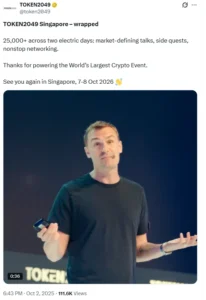
- TOKEN2049 Singapore remains the flagship gathering for Asia’s crypto and Web3 ecosystem, transforming Marina Bay Sands into a global hub for founders, developers, investors, and policymakers. The 2025 edition drew more than 25,000 participants from over 100 countries, with packed panels on DeFi, AI–blockchain convergence, tokenization, and stablecoins. CCN was also present at TOKEN2049 2025, engaging with industry leaders, covering major announcements, and highlighting Singapore’s growing role as a bridge between regulated finance and open blockchain innovation.
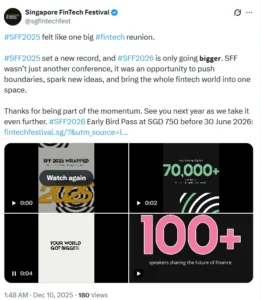
- Meanwhile, the Singapore FinTech Festival continues to anchor the region’s financial innovation calendar. Organized by the MAS, the 2025 event showcased deep integration between traditional finance and digital assets, featuring live demos of tokenized deposits, stablecoin pilots, and CBDC initiatives.
- Stablecoin Summit, held at Andaz Singapore as part of TOKEN2049 Week in 2025, this summit focused on stablecoin innovation and real-world use cases, bringing together stablecoin issuers, institutions, fintech leaders, and builders to discuss cross-border payments, transparency, and the future of digital money.
- In November 2025, Merkle Meets, a law-enforcement and compliance workshop in Singapore, brought together regulators, investigators, and crypto firms to discuss asset tracing, stablecoin oversight, and cross-border enforcement.
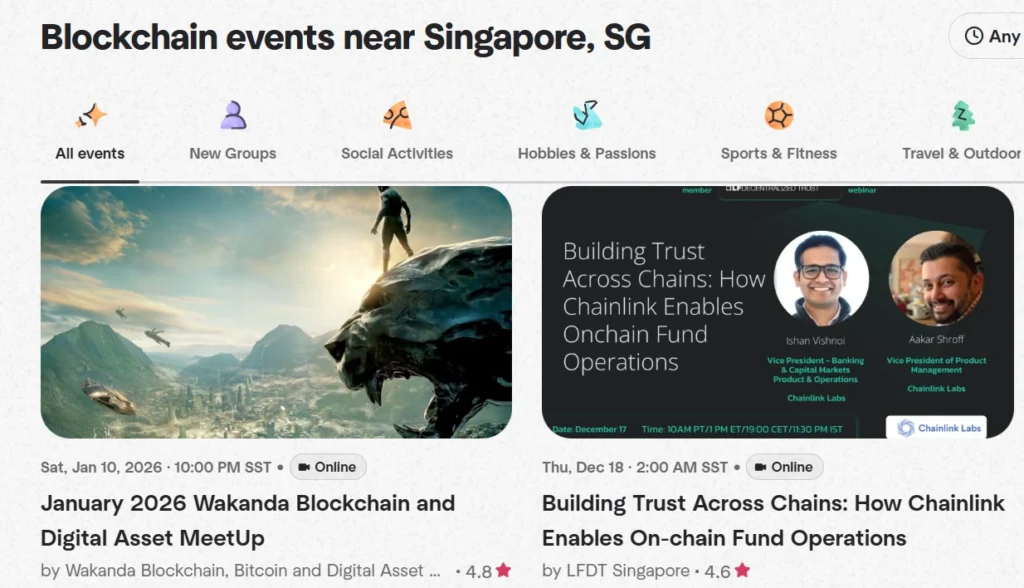
- Regular gatherings like the Wakanda Blockchain & Digital Asset Meetup brought together traders, builders, and enthusiasts to discuss market trends, DeFi, and regulatory updates.
- Chainlink’s on-chain operations sessions attracted developers keen on learning real-world smart contract integrations and oracle infrastructure.
- Community-led groups hosted frequent events in hubs such as Block71 and SGInnovate, fostering collaboration across blockchain developers, DAO contributors, and NFT creators.
- Many sessions also took place online and in hybrid formats, allowing participation from the wider Asia-Pacific Web3 community.

Top 5 Trends to Watch
1. Stablecoins power digital payments
- MAS’s new framework enables regulated stablecoins like USDC, XSGD, and RLUSD to be used for daily spending, e-commerce, and remittances.
- Payment networks such as GrabPay and FOMO Pay are expected to expand stablecoin settlement options.
2. Tokenized finance enters the mainstream
- Projects from DBS, OCBC, and UOB move beyond pilots to real tokenized products such as deposits, funds, and bonds.
- Institutional investors begin allocating to regulated on-chain instruments for yield and liquidity.
3. Web3 gaming grows into a creative industry
- Singapore’s gaming studios and content creators merge blockchain with entertainment, turning NFTs and tokens into tools for player ownership and fan engagement.
- Expect new franchises and partnerships between gaming, art, and music sectors.
4. Real-world asset tokenization expands
- Platforms like CitaDAO and BondbloX bring fractional real estate and fixed-income products to blockchain rails.
- Regulatory clarity encourages traditional finance to join tokenized markets.
5. AI meets blockchain governance
- 2026 will see AI-powered compliance and smart-contract auditing integrated into crypto and DeFi platforms.
- Singapore’s push for responsible AI aligns with its blockchain strategy, fostering secure, data-driven innovation across fintech and digital identity.
Neighbour Watch: What’s Happening Next Door?
What crypto looks like across the border — and why it matters.
Around Singapore, the dominant pattern is “legal but controlled.” Malaysia and Thailand run license-based markets; Indonesia channels activity to trading (not payments) and tightens taxes; the Philippines keeps the gate with a VASP moratorium; and Vietnam shows grass-roots usage despite payment bans.
🇲🇾 Malaysia — Legal, licensed, investor-focused
- Regime: Exchanges must be registered Digital Asset Exchanges (DAX) with the Securities Commission (SC). Public list updated Dec 3, 2025.
- Access: Retail trading via SC-approved DAX; strict KYC/AML and product lists. Investor education via SC’s InvestSmart.
🇮🇩 Indonesia — Trading legal; payments banned; taxes rising
- Regime: Crypto is tradable as a regulated asset; rupiah is the only legal tender; no crypto payments.
- 2025 shift: Transaction taxes increased (0.21% domestic sellers; up to 1% for overseas venues) while VAT on buys removed; mining VAT up.
🇹🇭 Thailand — Fully regulated markets; cautious on retail payments
- Regime: SEC-licensed exchanges and custodians; mutual & private funds allowed to invest in digital assets (effective Jan 16, 2025).
- What’s next: Ongoing CBDC work; authorities rolling out tourist crypto-to-baht conversion (Tourist DigiPay).
🇻🇳 Vietnam — Payments banned; adoption high
- Regime: Crypto not legal for payments, but trading/ownership widespread; consistently ranks high on adoption indices.
- 2025 National blockchain strategy and implementation: Vietnam has officially launched a National Blockchain Strategy for application and development through 2025, with a vision toward 2030. The government issued Decision No. 1236/QD-TTg on October 22, 2024, establishing blockchain as a core technology to support its digital transformation and digital economy goals. The strategy aims to position Vietnam as a regional leader in blockchain research, deployment, and socio-economic application by 2030.
References
- Blackbox. Singapore’s Crypto Conundrum: High Adoption, Deep Skepticism
- Independent Reserve. Independent Reserve Cryptocurrency Index (IRCI) Singapore 2025
- Crowdfund Insider. Crypto Awareness Hits 94% in Singapore but Ownership Slips
- Reuters. Singapore population hits record 6.11 million, driven by foreign workers
- Freedom House. Singapore, Freedom on the Net 2024
- The Straits Times. More people own crypto in Singapore, with younger users leading the way: survey
- Sumsub. Singapore Crypto Regulations: All You Need to Know
- CoinGecko. Best Crypto Exchanges in Singapore
- Analytics Insight. Best DeFi Projects Operating From Singapore
- Reuters. Crypto ATMs offline as Singapore seeks curb on impulse trading
- Fintech News Singapore. MAS explains why Binance was pinned on Investor Alert List but not FTX
- The Financial Coconut. Complete List of MAS-Licensed Digital Payment Token Service Providers (33 Companies)
- Monetary Authority of Singapore. Financial Institutions Directory
- MoneySmart. Compare Crypto Exchanges in Singapore 2026
- Sony Singapore. Sony Electronics Partners with Crypto.com to Welcome Direct Crypto Payment in Singapore
- Reuters. OKX Singapore launches stablecoin payments to local GrabPay merchants
- FinTech Weekly. Ripple Wins Broader Singapore License as MAS Clears Expansion of Digital Payment Services
- CCN. MAS Launches New Frameworks To Make Singapore a Hub for Tokenized Assets
- Reuters. Singapore trial tokenised bills to bring stablecoin laws, central bank chief says
- XaiGate. Stablecoin Payment Gateway Singapore for SMEs & E-Commerce
- Freedom House. Singapore, Freedom on the Net 2024
- The Straits Times. More people own crypto in Singapore, with younger users leading the way: survey
- International Accounting Bulletin. Singapore leads crypto job opportunities
- Randstad Singapore. How can you get cryptocurrency jobs?
- Vertical Institute. Cryptocurrency Analyst Salary Singapore
- Koinly. Crypto Tax Singapore: A Complete Guide (2025)
- Charltons Quantum. Crypto Guide: Singapore (April 2025) (PDF)
- CCN. TOKEN2049 Singapore Breaks All Records as World’s Largest Web3 Event
- SMU Academy. Advanced Certificate Web 3.0 (Module 2)
- SUSS. FIN539
- Singapore Blockchain Association. Education
- Vertical Institute. Blockchain Course
- NTU. Nanyang Blockchain Conference 2025
- Lexology. Library entry (Singapore blockchain regulation)
- F6S. Decentralized Autonomous Organization (DAO) Companies in Singapore
- TRON DAO (Medium). TRON DAO Unites With Global Community at TOKEN2049 Singapore
- Chainwire. HaloDAO Partners With TrustToken To Expand Marketplace Of International Stablecoins
- Blockchain Reporter. Crypto And Blockchain Events Of This Week, Majority In Singapore
- Vogue Singapore. Singaporean NFT Artists
- The Peak Singapore. The NFT Effect on Singapore Art
- The Art Newspaper. Collector of Beeple ‘Everydays’ work launches art and technology space in Singapore
- NFT Now. CO Museum: Chaw Wei Yang Feature
- Warren Wee. Digital Art Week Asia 2024
- Art Outreach Singapore. Immemorial NFT: Rizman Putra
- Reuters. Singapore population hits record 6.11 million, driven by foreign workers
- Osborne Clarke. Blockchain makes steady advance in Singapore amid enhanced regulatory clarity
- Foodpanda Singapore. McDonald’s
- Wise. Cost of living in Singapore
- URA Singapore. Release of 2nd Quarter 2025 real estate statistics
- FRED. Residential Property Prices for Singapore (QSGN628BIS)
- Yahoo Finance. BTC-USD Historical Data
- Global Property Guide. Singapore’s Residential Property Market Analysis 2025
- MAS. Joint press release on restricting access to facilities for scam mules
- Sangfor. Singapore faces surge in cryptocurrency investment scams, authorities urge vigilance
- The Economic Times. Singapore HC axes WazirX restructure plan after $235 million cyber heist
- MAS. Creating the Future of Finance
- CCN. Bitget CMO Jamie Elkaleh at TOKEN2049: Mastercard Need Us
- CCN. Yellow Co-Founder Claims Crypto Far From Mainstream TOKEN2049
- Stablecoin Summit. Official website
- Merkle Science. Merkle Meets 2025 Singapore
- Meetup. Blockchain Events & Meetups in Singapore
- NUS Enterprise. BLOCK71 Global Incubation
- YouTube. obiAIp9xA74
- CCN. NDACHAIN: Vietnam National Blockchain Explained