The arrest marks the first major custodial action by the CBI since the Supreme Court consolidated multiple FIRs into a single probe against the multi-billion-dollar scam.
Try Our Recommended Crypto Exchanges
Sponsored
Disclosure
We sometimes use affiliate links in our content, when clicking on those we might receive a commission at no extra cost to you. By using this website you agree to our terms and conditions and privacy policy.
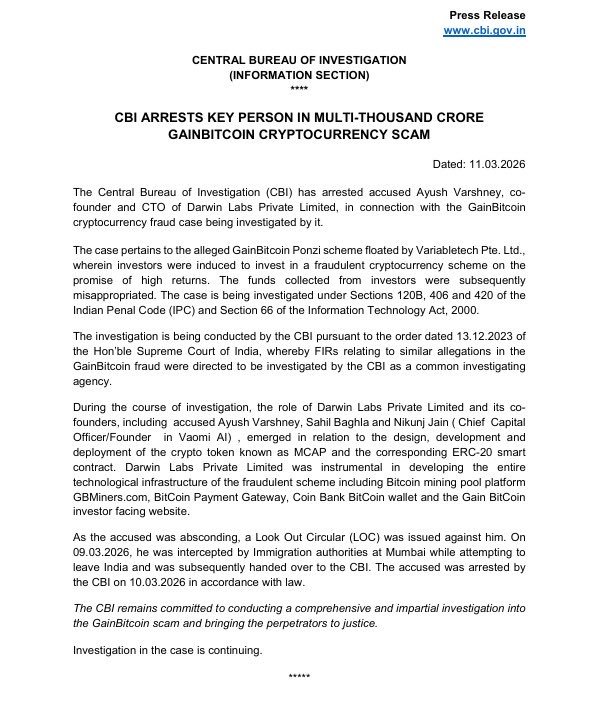
Authorities intercepted Abhishek Varshney, co-founder and CTO of Darwin Labs Private Limited, at Mumbai’s Chhatrapati Shivaji Maharaj International Airport on March 9 as he attempted to board a flight to Colombo, Sri Lanka.
Formally arrested on March 10, Varshney is accused of designing the technological infrastructure for GainBitcoin, including the MCAP token, ERC-20 smart contracts, wallet systems, and payment gateways.
Authorities had already issued a Look Out Circular (LOC) after Varshney failed to appear before investigators, ensuring immigration officers would be alerted if he attempted to leave the country.
When he reached the departure gate, officials flagged his name and detained him before handing him over to CBI teams.
CBI arrestes Darwin Labs CTO, the technical mastermind behind GainBitcoin scam. Credit: CBI.
The arrest follows a major nationwide crackdown in February 2025, when investigators conducted raids across more than 60 locations.
The operation led to the seizure of cryptocurrencies worth ₹23.94 crore (about $2.6 million) along with significant digital evidence.
The Enforcement Directorate (ED) is investigating money-laundering aspects of the case, while the Central Bureau of Investigation (CBI) is focusing on the core fraud and tracing funds that may have moved through international channels.
Varshney’s detention marks the latest development in a long-running investigation tied to GainBitcoin’s original promoters, Amit Bhardwaj — who died in 2022 — and his brother Ajay Bhardwaj.
Authorities had previously arrested several family members and associates involved in the scheme.
However, investigators believe Varshney’s technical role could prove crucial in tracking assets that may have been routed through overseas wallets and investments.
The GainBitcoin Ponzi Scheme: Scale and Modus Operandi
Amit Bhardwaj and his brother Ajay Bhardwaj launched the GainBitcoin scheme in 2015 through Variabletech Pte. Ltd., a Singapore-registered entity that operated websites including gainbitcoin.com along with related platforms such as GBMiners and GB21.
Darwin Labs, where Varshney served as CTO, allegedly built key parts of the system, including the user dashboard, mining interface, and the in-house MCAP token.
The company claimed it operated large mining farms in China and Hong Kong, but investigators later found no evidence that it ever allocated real mining power to investors.
Investors bought Bitcoin and deposited it into “cloud mining” contracts that promised fixed monthly returns of about 10% for 18 months—far above any realistic mining yield.
Participants also earned commissions of up to 12% by recruiting new investors, creating a pyramid structure in which fresh deposits funded payouts to earlier users.
Authorities estimate the scheme collected investments equivalent to around 80,000 Bitcoin (BTC), with total losses potentially reaching $2.1 billion based on victim complaints and agency assessments.
Authorities estimate that more than 100,000 investors across India—including Maharashtra, Delhi, Punjab, Karnataka, and Jammu & Kashmir—lost money in the scheme.
The scheme eventually collapsed in late 2017 as new inflows slowed, leaving thousands of investors unable to withdraw their funds.
The operation thrived during the post-2016 demonetisation period in India, when interest in cryptocurrencies surged but regulatory oversight remained limited.
The scammers often displayed polished dashboards to victims, showing supposed “mining profits” and referral rankings that investigators now say existed only on screen.
Prashant Jha is a seasoned crypto journalist based in Delhi, India, with a Bachelor’s Degree in Computer Science Engineering. Passionate about the evolving world of blockchain and cryptocurrencies, he has been a dedicated voice in the industry since 2018. Prashant’s expertise lies in regulatory reporting, where he unravels complex legal and financial developments with clarity and precision. Before joining CCN in 2024, he honed his craft at Cointelegraph, establishing himself as a trusted name in crypto journalism.
His coverage spans major industry events, including the high-profile collapses of FTX, Three Arrows Capital (3AC), and LUNA, offering readers insightful analyses of their regulatory and market implications. Prashant’s technical background enables him to bridge the gap between intricate blockchain technology and its real-world applications, making his work accessible to novices and experts.
Beyond his professional pursuits, Prashant is an avid music enthusiast, often exploring diverse genres to unwind. A sports lover, he has a particular passion for cricket and frequently engages in discussions about the game. His multifaceted interests and sharp journalistic instincts make him a valuable contributor to CCN, where he continues shaping the crypto landscape's narrative.












 ‘India Taxes Crypto as Legal — So Why Regulate It Like It’s Illegal?’ Lawmaker Demands Clarity