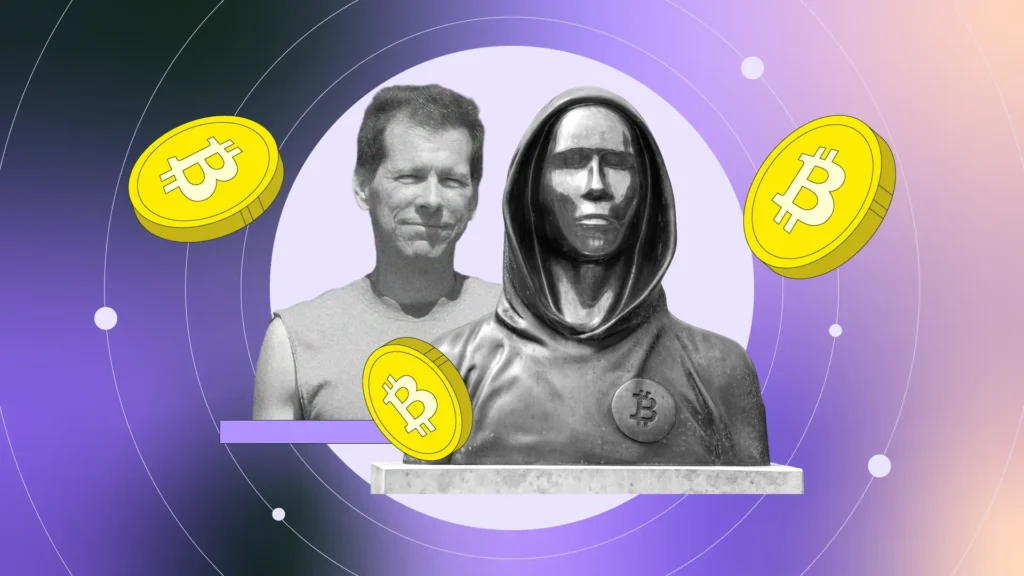
Hal Finney's 1993 article almost perfectly predicts Bitcoin — is it proof he created it?
Share
Key Takeaways
Hal Finney appeared to outline key principles behind Bitcoin more than a decade before its launch.
A resurfaced 1993 article written by Finney has revived speculation about Bitcoin’s creator.
Is Hal Finney actually Satoshi Nakamoto?
A 1993 magazine article written by computer scientist Hal Finney — who would later become the first recorded recipient of bitcoin — is going viral more than three decades after its publication, as readers note how closely it appears to anticipate the rise of cryptocurrency, more than a decade before Bitcoin’s 2009 launch.
The resurfacing of Finney’s essay has also reignited long-running speculation over the true identity of Bitcoin’s pseudonymous creator, Satoshi Nakamoto, with some commentators convinced that Finney himself may have been behind the invention.
Try Our Recommended Crypto Exchanges
Sponsored
Disclosure
We sometimes use affiliate links in our content, when clicking on those we might receive a commission at no extra cost to you. By using this website you agree to our terms and conditions and privacy policy.
In the article, Finney argued that growing computerization would lead to unprecedented surveillance of financial activity, warning that electronic records could make everyday transactions traceable by governments and corporations.
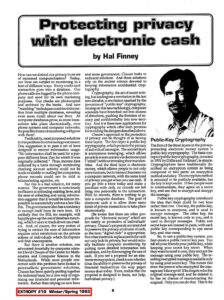
“If you go into a store today and make a purchase with cash, no records are left trying to personally identify the transaction,” Finney wrote.
“The goal of electronic cash is to allow these same kinds of private transactions to take place electronically.”
Hal Finney’s 1993 report was published in Extropy, the magazine of the Extropy Institute, an early cypherpunk–linked organization. | Source: SCRIBD
At the time, Finney was drawing on research by cryptographer David Chaum, who proposed systems for anonymous digital money using cryptographic techniques.
Finney described “electronic money” as the third layer in a privacy-preserving digital stack, following public-key cryptography and anonymous messaging.
“The third layer is electronic money, which allows people to not only communicate, but to transact business via computer networks, with the same kind of privacy you get when you use cash,” he wrote.
While Finney did not describe a blockchain or a decentralized consensus mechanism, readers today point to the article’s emphasis on cryptography and cash-like privacy as strikingly similar to Bitcoin’s design goals.
Surveillance-Friendly Money
Finney also cautioned that not all forms of digital money would protect privacy.
He warned that poorly designed systems could increase financial surveillance rather than reduce it.
“Other electronic replacements for cash not only lack its privacy, but would actually facilitate greater monitoring by putting more detailed information into databases,” Finney wrote.
That warning continues to resonate amid modern debates over central bank digital currencies and regulated digital payment platforms.
Hal Finney, the First Bitcoiner
Finney’s early thinking was not merely theoretical.
He was a longtime participant in the cypherpunk movement and worked on cryptographic systems throughout the 1990s and 2000s.
When Bitcoin software was released in January 2009, Finney was among the first people to download and run it. Nakamoto sent him 10 bitcoins in what is widely regarded as the first Bitcoin transaction.
Finney later died in 2014 after a long battle with amyotrophic lateral sclerosis (ALS).
As a believer in long-term technological progress, Finney arranged for his body to be cryonically preserved following his death, in the hopes he would be brought back to life in the future.
Is Hal Finney Satoshi Nakamoto?
Speculation that Hal Finney may secretly have been Bitcoin’s creator has gained fresh momentum this week.
The theory spread widely after an X user, posting under the name NoLimits, published a thread asserting that he was “99% certain” Finney created Bitcoin, citing what he described as a trail of technical and circumstantial evidence.
“I’m not just guessing, I have solid proof to back this up,” NoLimits wrote. “There’s a trail of facts that keeps lining up, no matter how hard you try to ignore it.”
Finney’s early involvement places him, as NoLimits wrote, “in a microscopic group” of people with direct contact with Nakamoto at Bitcoin’s launch.
Supporters of the theory point to Finney’s background as a world-class cryptographer, an early cypherpunk, and a contributor to PGP encryption software years before Bitcoin existed.
“Hal was a world class cryptographer, a cypherpunk OG, and a contributor to PGP years before Bitcoin existed,” NoLimits wrote.
“He had the exact technical skillset needed to design Bitcoin from scratch.”
Some proponents also note that Finney lived just blocks away from a man named Dorian Satoshi Nakamoto, whose name surfaced during a separate, ultimately discredited attempt to identify Bitcoin’s creator in 2014.
“If you were trying to pick a pseudonym that wouldn’t draw attention to yourself, what better camouflage than someone down the street?” NoLimits wrote.
🚨 I’M 99% CERTAIN I’VE FIGURED OUT WHO CREATED BITCOIN.
I’m not just guessing, I have solid proof to back this up.
There’s a trail of facts that keeps lining up, no matter how hard you try to ignore it…
Others point to perceived stylistic similarities between Finney’s writing and Nakamoto’s emails and forum posts, as well as the timing of Nakamoto’s disappearance from public communications in 2010, which coincided with the progression of Finney’s ALS.
“Satoshi vanished from the internet right around the time Hal’s ALS symptoms worsened,” the post said. “No dramatic exit. No goodbye post. He’s just… gone.”
Another frequently cited detail is that bitcoins believed to have been mined by Finney in Bitcoin’s earliest days have never been spent.
“Exactly what you’d expect from someone who didn’t build Bitcoin for money,” NoLimits wrote, adding that Finney would today be worth more than $100 billion at current prices.
Finney himself consistently denied being Satoshi Nakamoto and publicly expressed admiration for Bitcoin without claiming authorship.
“No one can 100% prove it,” NoLimits acknowledged. “But if Satoshi was a single person, and not a group, Hal Finney checks more boxes than anyone else.”
Many members of the crypto community get behind the theory | Source: X
As with previous attempts to identify Nakamoto, the claims remain speculative, but the renewed attention has energized online debate.
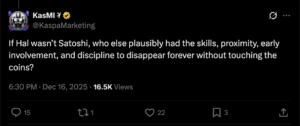
“If Hal wasn’t Satoshi, who else plausibly had the skills, proximity, early involvement, and discipline to disappear forever without touching the coins?” one X user wrote.
Kurt Robson is a London-based reporter at CCN, specialising in the fast-moving worlds of crypto and emerging technology. He began his career covering local news in Cornwall after graduating from Falmouth University with First Class Honours in Journalism. There, he cut his teeth on everything from council meetings to missing swans.
He quickly rose through the ranks to become a frontline journalist at several of the UK’s leading national newspapers. Over the years, he has interviewed musicians and celebrities, reported from courtrooms and crime scenes, and secured multiple front-page exclusives.
Following the upheaval of the COVID-19 pandemic, Kurt shifted his focus to technology journalism—just ahead of the AI boom. With a natural curiosity and a trained eye for emerging trends, he has found a new rhythm in reporting on innovation.
At CCN, Kurt's work focuses on the cutting edge of crypto, blockchain, AI, and the evolving digital world. Drawing on his background in people-first reporting and his deep interest in disruptive tech, Kurt delivers stories that are insightful, entertaining, and human-centric.