A wallet on the Hyperliquid network was compromised following a private key leak | Source: Pexels
Share
Key Takeaways
Hackers have targeted the Hyperliquid network again, stealing approximately $21 million in cryptocurrency this time.
The Hyperdrive lending protocol, built on Hyperliquid, was also hacked recently for $782,000.
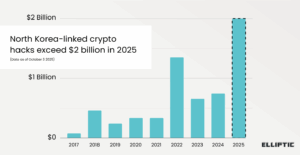
According to Elliptic, North Korea-linked hackers have stolen over $2 billion in cryptocurrency so far in 2025.
Hackers have stolen approximately $21 million worth of cryptocurrencies from a user on Hyperliquid, just over a week after another attack drained nearly $800,000 from a lending protocol built on the same network.
Try Our Recommended Crypto Exchanges
Sponsored
Disclosure
We sometimes use affiliate links in our content, when clicking on those we might receive a commission at no extra cost to you. By using this website you agree to our terms and conditions and privacy policy.
On Friday, Oct. 10, blockchain security firm PeckShieldAlert reported that a wallet on the Hyperliquid network was compromised following a private key leak.
The attacker drained the account and moved about 17.5 million DAI and 3.1 million SYRUPUSDP to the Ethereum network, according to on-chain data reviewed by the firm.
The breach is the latest in several major security events linked to the Hyperliquid ecosystem since its launch in late 2024.
Hackers Hit Hyperliquid Twice
Last week, an exploit targeting Hyperdrive, a lending protocol built on Hyperliquid, which lost about $782,000 in late September.
According to security company CertiK, the attacker repeatedly triggered an insecure function in Hyperdrive’s router contract to drain funds from two liquidity pools.
Hyperdrive’s team paused the protocol shortly after the attack and later said it had identified the issue and was preparing a compensation plan for affected users.
HYPERDRIVE UPDATE:
We are writing this to provide an update on the recent issues affecting the Hyperdrive protocol.
We have identified the root cause and corrected the issue. We have also identified the affected accounts and are enacting a compensatory plan shortly. We expect… https://t.co/715OXYosaB
“We have identified the root cause and corrected the issue,” Hyperdrive wrote on X on Sunday.
“We confirm our earlier statement that the issue is limited in scope, affecting only two Hyperdrive markets,” it added.
Crypto Hacks Surge
2025 has seen a surge in major crypto hacks, with losses totaling billions across both centralized and decentralized platforms.
High-profile incidents have hit exchanges and protocols, including Bybit, Coinbase, and Cetus, as well as smaller DeFi projects built on emerging Layer 1 networks.
On Tuesday, October 7, blockchain analysis firm Elliptic reported that North Korea-linked hackers have already stolen over $2 billion in cryptocurrency assets in 2025.
“This brings the cumulative known value of cryptoassets stolen by the regime to more than $6 billion,” the firm said.
The firm said total losses “almost triple last year’s tally,” underscoring the “growing scale of North Korea’s dependence on cyber-enabled theft to fund its regime.”
North Korea-linked hacks have reached record levels so far in 2025 | Source: Elliptic
Elliptic also said that the majority of losses this year have been suffered by crypto exchanges, but warned that a growing share of victims are high-net-worth individuals.
“As crypto prices have risen, individuals have become increasingly attractive targets,” Elliptic wrote, adding that many of them “lack the security measures employed by businesses.”
Some individuals, the report stated, are targeted because of their connections to companies holding large amounts of cryptoassets, effectively serving as indirect entry points for hackers seeking access to corporate wallets.
Kurt Robson is a London-based reporter at CCN, specialising in the fast-moving worlds of crypto and emerging technology. He began his career covering local news in Cornwall after graduating from Falmouth University with First Class Honours in Journalism. There, he cut his teeth on everything from council meetings to missing swans.
He quickly rose through the ranks to become a frontline journalist at several of the UK’s leading national newspapers. Over the years, he has interviewed musicians and celebrities, reported from courtrooms and crime scenes, and secured multiple front-page exclusives.
Following the upheaval of the COVID-19 pandemic, Kurt shifted his focus to technology journalism—just ahead of the AI boom. With a natural curiosity and a trained eye for emerging trends, he has found a new rhythm in reporting on innovation.
At CCN, Kurt's work focuses on the cutting edge of crypto, blockchain, AI, and the evolving digital world. Drawing on his background in people-first reporting and his deep interest in disruptive tech, Kurt delivers stories that are insightful, entertaining, and human-centric.














 Hyperliquid (HYPE) Price Stalls Under $50 as Rival Aster Gains $15B DEX Volume Edge