Ethereum is testing key support near $1,500 as BitMine acquires 126,971 ETH, boosting its holdings to 5.54 million ETH amid growing signs of long-term accumulation. | Credit: CCN.com
Share
Key Takeaways
Tom Lee has listed reasons why Ethereum’s price is under pressure — but still believes highs are incoming.
It comes just days after he claimed “crypto Spring” had arrived.
Ethereum’s price has dropped 10.96% over the past month.
Ethereum is facing renewed selling pressure even as Fundstrat’s Tom Lee reiterated his long-term bullish outlook.
The latest pullback came after Lee acknowledged on X that Ethereum’s recent weakness had been driven by short-term macro pressures, particularly rising oil prices, despite his recent claims that “crypto spring” had already begun.
Try Our Recommended Crypto Exchanges
Sponsored
Disclosure
We sometimes use affiliate links in our content, when clicking on those we might receive a commission at no extra cost to you. By using this website you agree to our terms and conditions and privacy policy.
Why Tom Lee Says Ethereum Is Under Selling Pressure
In a post published on X on May 18, Lee argued that Ethereum’s decline was largely tied to macroeconomic factors rather than a deterioration in the asset’s long-term fundamentals.
“If one is wondering why Ethereum has been under selling pressure,” Lee wrote, “to me, rising oil prices is the biggest headwind.”
He added that Ethereum’s inverse correlation with oil prices had reached its “highest ever,” suggesting the recent rally in crude markets had weighed directly on its sentiment.
🧵 1/ If one is wondering why Ethereum $ETH has been under selling pressure:
– to me, rising oil prices is the biggest headwind – ETH inverse correlation to oil is the highest ever pic.twitter.com/G5Uw0wbtJP
— Thomas (Tom) Lee (not drummer) FundstratDirect.com (@fundstrat) May 18, 2026
Lee said that as oil prices climbed over the past six weeks, Ethereum prices moved lower, arguing that a reversal in energy markets could help spark a recovery.
However, he characterized the weakness as “short-term tactical noise,” claiming that Ethereum’s larger structural drivers remain intact.
According to Lee, two themes continue to underpin his bullish long-term thesis for Ethereum: tokenization and agentic artificial intelligence.
“These structural drivers are in place,” Lee wrote.
“Thus, we expect ETH prices to be stronger as we move through 2026.”
Tom Lee has received criticism for his predictions | Source: X
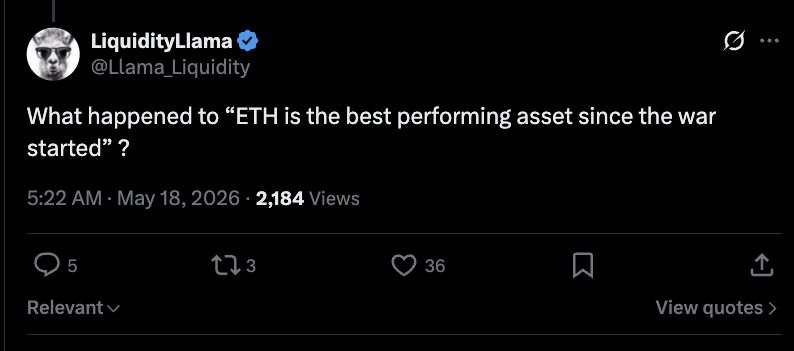
His comments came in response to growing skepticism from crypto traders, with one X user replying:
“What happened to ‘ETH is the best performing asset since the war started’?”
But “Crypto Spring” Has Arrived?
Lee’s latest remarks come only days after he argued that the crypto market had already exited its prolonged downturn.
“Crypto Spring has commenced,” Lee said in a monthly chairman’s message released alongside Fundstrat’s latest update.
The veteran strategist argued that Ethereum’s recent price action historically signaled the end of crypto bear-market conditions.
“There’s never been a crypto winter where Ethereum has closed up three consecutive months in a row,” Lee said.
According to Lee, a May close above $2,100 would reinforce what he described as a historically bullish setup for the broader sector.
He also pointed to long-term portfolio performance data, arguing that a hypothetical 5% allocation to Ethereum at the end of 2016 would have turned a $100,000 portfolio into roughly $1.7 million today.
“You’d want to own just a small piece of Ethereum as a source of diversification and as a hedge,” Lee said.
Tom Lee’s Bullish Ethereum Price Forecast
Despite the recent decline, Lee has continued to outline an aggressive long-term upside scenario for Ethereum.
He argued that Ethereum could significantly outperform if Bitcoin stages another major rally.
“If Bitcoin gets to $250,000, that would value Ethereum somewhere between $12,000 and $22,000 if it returns to its 2021 ratio,” Lee said.
🚨 NEW: Tom Lee explains why on March 19th 2026 the Ethereum bottom is likely in and why $ETH price will skyrocket going forward.
Lee added that an even more optimistic scenario could unfold if Ethereum becomes viewed as critical payments infrastructure for the digital economy.
In that case, he suggested Ethereum prices could potentially rise as high as $62,000.
Lee also maintained that Ethereum’s broader investment case remains intact despite ongoing volatility.
“Over the last 10 years, Ethereum has outperformed every other asset class,” he said, citing cumulative returns of roughly 49,000%.
“So again, Ethereum has been a great store of value,” Lee added.
Missed Predictions Have Triggered Backlash
Lee’s latest defense of Ethereum comes after one of his earlier forecasts failed to materialize, fueling criticism from traders and investors.
Previously, Lee predicted Ethereum would bottom near $2,500 before rallying sharply toward $9,000 by early 2026.
Instead, prices continued to struggle under broader market pressure, prompting questions over the timing and reliability of his market calls.
He previously described the decline from roughly $4,800 to $2,800 as an “engineered liquidation” designed to flush weaker participants from the market.
“The crash from $4,800 to $2,800 does not change Ethereum’s long-term value,” Lee said.
Even so, the failed short-term prediction has intensified scrutiny around his bullish forecasts, particularly as Ethereum remains well below its all-time highs.
Ethereum Price Falls as Broader Crypto Market Weakens
Ethereum was down 3.25% over the past 24 hours to $2,116.90, underperforming an already weaker broader crypto market, according to CoinMarketCap.
The decline appeared to be driven primarily by broad risk aversion across digital assets, with investors rotating capital away from higher-risk altcoins.
The overall crypto market capitalization fell 1.75% during the same period, while market sentiment slipped deeper into “Fear” territory with the Fear & Greed Index falling to 39.
Ethereum’s higher volatility relative to Bitcoin amplified the downside move.
ETH also lost market share, with its market dominance falling from 10.12% to 9.99% in 24 hours.
Bitcoin liquidations reportedly surged 328% to roughly $181 million over the past day. Ethereum spot trading volume also jumped nearly 39% to $13.5 billion.
In the near term, CCN analysts say they are closely watching the $2,100 support zone.
A hold above that level could allow Ethereum to stabilize and attempt a rebound toward $2,200 resistance.
However, a decisive break below $2,100 could open the door for a retest of the key psychological $2,000 level, particularly if Bitcoin fails to stabilize.
Whale Activity Adds to Ethereum Market Uncertainty
The recent volatility in Ethereum has also coincided with renewed whale activity and large-scale token reshuffling across the market, underscoring the growing tension between long-term accumulation and profit-taking.
At the end of April, on-chain data highlighted billions of dollars worth of Ethereum moving between major holders, including dormant wallets reactivating after years of inactivity alongside continued institutional buying.
Analytics platform Lookonchain flagged a wallet identified as “0xCD59” — an Ethereum initial coin offering (ICO) participant from 2014 — transferring its entire holdings of 10,000 ETH, worth roughly $22.9 million at the time, to a new address after remaining inactive for nearly 10.8 years.
An #Ethereum ICO participant "0xCD59" transferred all 10,000 $ETH($22.88M) to a new wallet after being dormant for 10.8 years.
The investor originally acquired the tokens for about $3,100 during Ethereum’s ICO, representing gains of more than 7,000-fold.
Movements involving long-dormant wallets are closely watched by crypto traders because they can signal potential selling pressure from early adopters sitting on substantial profits.
Kurt Robson is a London-based reporter at CCN, specialising in the fast-moving worlds of crypto and emerging technology. He began his career covering local news in Cornwall after graduating from Falmouth University with First Class Honours in Journalism. There, he cut his teeth on everything from council meetings to missing swans.
He quickly rose through the ranks to become a frontline journalist at several of the UK’s leading national newspapers. Over the years, he has interviewed musicians and celebrities, reported from courtrooms and crime scenes, and secured multiple front-page exclusives.
Following the upheaval of the COVID-19 pandemic, Kurt shifted his focus to technology journalism—just ahead of the AI boom. With a natural curiosity and a trained eye for emerging trends, he has found a new rhythm in reporting on innovation.
At CCN, Kurt's work focuses on the cutting edge of crypto, blockchain, AI, and the evolving digital world. Drawing on his background in people-first reporting and his deep interest in disruptive tech, Kurt delivers stories that are insightful, entertaining, and human-centric.