Key Takeaways
- Ethereum surged roughly 30% in a week, a move Tom Lee says has historically acted as a “launch point” for substantially larger ETH rallies.
- The BitMine chairman also believes easing financial conditions will benefit crypto after the US Treasury signaled it could tap its roughly $950 billion cash balance to fund bond buybacks.
- Lee’s backing of a $250,000 Ethereum scenario is back in focus.
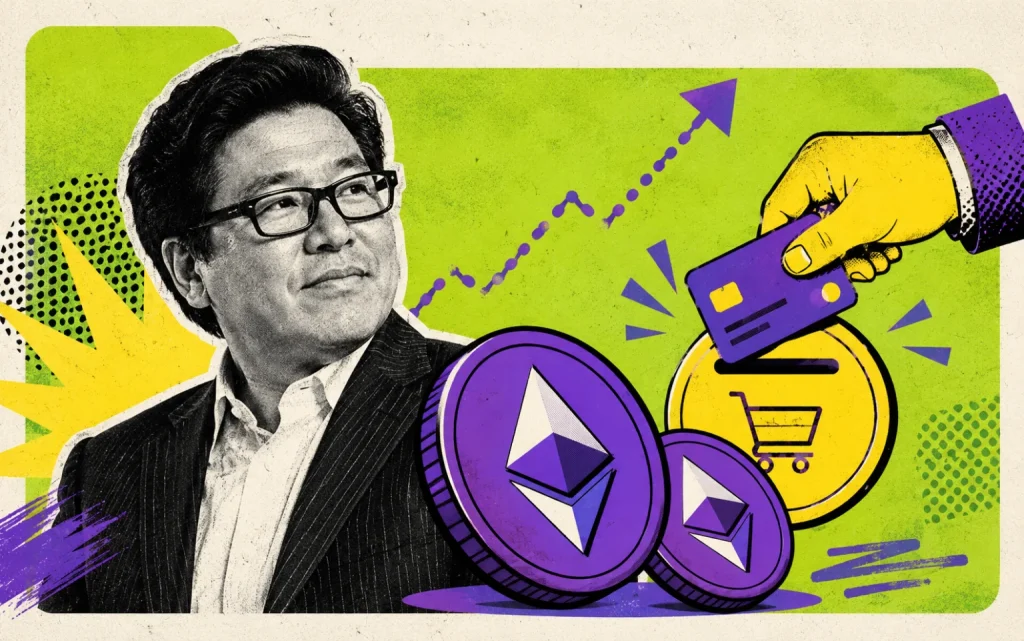
Ethereum has staged its strongest weekly rally in more than a year, prompting BitMine Chairman Tom Lee to argue that the crypto may have reached a historical “launch point” for further gains.
ETH climbed roughly 30% over the past week to above $2,500, its biggest weekly advance since May 2025, while Bitcoin gained around 22% over the same period.
Against that backdrop, one of the most extreme Ethereum valuations Lee has backed is returning to the spotlight: $250,000.
Tom Lee Spots Ethereum ‘Launch Point’ After 30% Surge
Ethereum’s latest rally caught Lee’s attention because of how rarely ETH has produced a weekly gain of this magnitude.
ETH gained approximately 30% over the past week, taking the crypto above $2,500 and marking its strongest weekly performance since May 2025.
According to Lee, the two most recent comparable weekly moves occurred in May 2025 and July 2021.
Both were followed by substantially larger gains.
“ETH gained 30% in the past week,” Lee said.
Adding: “This is the largest weekly gain since May 2025, prior to that it was July 2021.”
Lee said those two previous rallies ultimately marked the beginning of Ethereum’s upside.
“In those two precedent instances, this weekly gain of >30% signaled a launch point for a larger move in ETH.”
BitMine is putting considerable capital behind that conviction.
The company bought another 32,447 ETH last week, worth roughly $81 million at current prices, increasing its holdings to 5,847,611 ETH.
That represents around 4.8% of Ethereum’s circulating supply and takes BitMine closer to its stated goal of controlling 5% of all ETH.
Around 5.07 million ETH, or 87% of the company’s holdings, is also staked, with BitMine projecting approximately $330 million in annualized staking revenue.
Ethereum Rotation ‘Nearly a Decade in the Making’
Lee believes the price action could be evidence of a much broader shift toward Ethereum.
Responding to Ethereum’s strengthening performance against Bitcoin, Lee wrote that the move was “nearly a decade in the making.”
ETH gained approximately 29.3% over seven days through Aug. 24, compared with Bitcoin’s 21.4% advance.
Lee’s argument is based in part on how Ethereum’s previous cycles unfolded.
Initial coin offerings helped drive demand during the 2017–2018 cycle, while NFTs and decentralized applications became major catalysts during 2020 and 2021.
The next phase, Lee believes, could be considerably larger.
He expects Wall Street firms to increasingly tokenize stocks and other financial assets on blockchain infrastructure, while autonomous AI agents could generate another source of transactions and demand.
“The tailwind for ETH in the next few years is larger than those prior cycles of ICOs, NFTs,” Lee said in an Aug. 17 post.
He argued that the ETH/BTC ratio could consequently make a “sizable move higher.”
Why Scott Bessent’s $950B Treasury Move Could Help Ethereum
Lee also sees the changing macroeconomic environment as another potential catalyst.
“We expect easing financial conditions to be a tailwind for crypto,” Lee said in BitMine’s latest update.
On Monday, he specifically highlighted the US Treasury’s decision to buy longer-term bonds as one of the developments that had improved risk appetite.
The comments come as Treasury Secretary Scott Bessent considers using funds from the Treasury General Account to finance an expanded government bond buyback program.
The TGA, effectively the federal government’s operating cash account at the Federal Reserve, currently holds approximately $950 billion.
Two senior Treasury officials told CNBC that the account could be used to fund bond buybacks.
Bessent has already expanded the Treasury’s bond-buyback program, including doubling purchases of some longer-dated securities to around $4 billion per operation.
For Ethereum and other risk assets, the potential significance is reflected in financial conditions.
Lower long-term yields can reduce the relative attractiveness of risk-free government debt and make financial conditions more accommodative, potentially encouraging investors to shift capital toward equities, Bitcoin, Ethereum, and other higher-risk assets.
That fits directly into Lee’s bullish crypto thesis.
However, describing the Treasury’s entire $950 billion balance as an imminent liquidity injection would be misleading.
Officials have not committed to spending the entire account, and some Wall Street analysts have questioned whether the expanded buybacks are large enough to meaningfully suppress yields.
MarketWatch reported that some market participants regard the move as relatively modest compared with the enormous size of the Treasury market.
Tom Lee’s $250,000 Call Returns to Spotlight
Ethereum’s rebound has also brought Lee’s most aggressive long-term valuation scenarios back into focus.
The BitMine chairman has previously backed research suggesting Ethereum could eventually reach $250,000.
In April, Lee endorsed an Etherealize report outlining a long-term valuation framework that could put ETH above that level.
Lee described the research as a “fresh and comprehensive take” on Ethereum’s future, with the thesis centered partly on ETH’s ability to generate staking yield and capture economic value from activity on its network.
The BitMine chairman has also cited Ethereum co-founder Joe Lubin’s prediction that ETH could eventually increase 100-fold to $250,000.
“In that future, what is Ethereum worth?” Lee said.
“If it’s $1,800 today, is it worth $25,000, $75,000 or even higher?”
His bullish scenarios have varied considerably depending on the assumptions and timeframe involved.
Lee has previously discussed Ethereum reaching $12,000 and $22,000 under less extreme scenarios.
Could ETH Really Reach $250,000?
Ethereum reaching $250,000 would require a transformation on a scale far beyond its latest 30% surge.
From around $2,500, ETH would need to increase approximately 100-fold.
With Ethereum’s circulating supply currently around 120.7 million ETH, a $250,000 price would imply a market capitalization of roughly $30 trillion.
That is close to the $31.5 trillion addressable market used in the Etherealize valuation model Lee previously endorsed.
Lee’s thesis effectively argues that Ethereum must emerge as a major global financial infrastructure, capturing significant activity from stablecoins, tokenized securities, and potentially AI agents.
There is evidence that institutional interest is growing.
BitMine alone now controls approximately 4.8% of Ethereum’s circulating supply, while US spot Ethereum ETFs have recently recorded some of their strongest inflows in months.
But enormous obstacles remain.
Ethereum faces competition from rival blockchains, as well as regulatory and technical risks.
Even another several-hundred-percent advance would leave ETH nowhere close to the 100-fold gain required.
While Ethereum’s 30% weekly surge supports Lee’s argument that momentum has shifted dramatically.
Whether the “decade in the making” rotation eventually produces $250,000 ETH depends on something much bigger, however.
The information provided in this article is for informational purposes only. It is not intended to be, nor should it be construed as, financial advice. We do not make any warranties regarding the completeness, reliability, or accuracy of this information. All investments involve risk, and past performance does not guarantee future results. We recommend consulting a financial advisor before making any investment decisions.

Kurt Robson is a London-based reporter at CCN, specialising in the fast-moving worlds of crypto and emerging technology. He began his career covering local news in Cornwall after graduating from Falmouth University with First Class Honours in Journalism. There, he cut his teeth on everything from council meetings to missing swans.
He quickly rose through the ranks to become a frontline journalist at several of the UK’s leading national newspapers. Over the years, he has interviewed musicians and celebrities, reported from courtrooms and crime scenes, and secured multiple front-page exclusives.
Following the upheaval of the COVID-19 pandemic, Kurt shifted his focus to technology journalism—just ahead of the AI boom. With a natural curiosity and a trained eye for emerging trends, he has found a new rhythm in reporting on innovation.
At CCN, Kurt's work focuses on the cutting edge of crypto, blockchain, AI, and the evolving digital world. Drawing on his background in people-first reporting and his deep interest in disruptive tech, Kurt delivers stories that are insightful, entertaining, and human-centric.