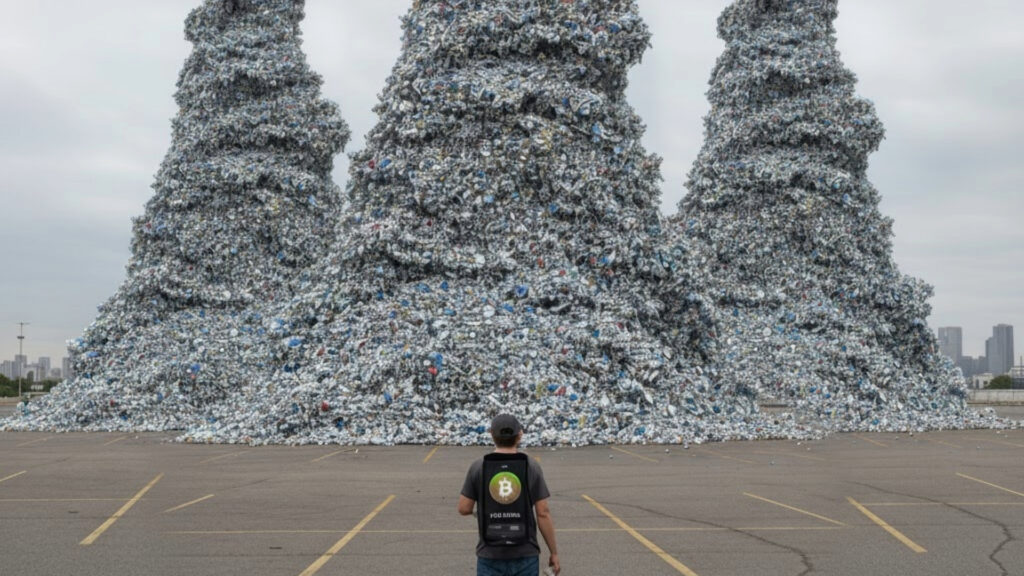
Could you sell enough cans to make one BTC in the US? | Source: Image crated with Gemini
Share
Key Takeaways
Bruno Oliveira from Brazil has spent over two years collecting and selling aluminum cans to buy Bitcoin.
Despite viral reports, Oliveria claims he is not close to acquiring a full Bitcoin and is instead pushing for 10%.
CCN explores how long it would take to buy a full BTC in the U.S. or U.K. through cans alone.
A Brazilian man who has spent two years collecting and selling aluminum cans to buy Bitcoin is on a mission to accumulate 10% of one BTC, despite reports that he is closing in on 1 BTC.
As his achievement continues to go viral, CCN has decided to explore how long it would take a dedicated Bitcoin pursuer to do the same in the U.S.
Could you “can your way” to a full Bitcoin through nothing but sheer determination and a lot of profitable recycling?
Try Our Recommended Crypto Exchanges
Sponsored
Disclosure
We sometimes use affiliate links in our content, when clicking on those we might receive a commission at no extra cost to you. By using this website you agree to our terms and conditions and privacy policy.
Social media users have been praising Oliveira’s persistence, with one post hailing the mission as an embodiment of Bitcoin’s “proof of work” system.
“Here the Proof of Work is sweated can by can, satoshi by satoshi, 1 BTC is very far away, the goal is to reach at least 10%,” he wrote on X.
How Many Cans For 1 BTC in the U.S. And U.K.?
In the U.S., replicating Oliveira’s strategy would be an immense task.
According to industry trackers, scrap yards currently pay about $0.50 per pound for clean aluminum beverage cans.
At that rate, earning enough for one Bitcoin at its current trading price of $106,000 would require roughly 210,000 pounds of cans, equal to about 6.3 million individual cans.
Lower local prices in some scrap yards could push the total above 10 million cans, depending on region and quality.
Even at the higher end of market prices, around $0.60 per pound, an individual would still need to collect close to 5 million cans.
Replicating Oliveira’s feat in Britain would be even harder.
At current market rates, the scrap value of aluminum cans in the U.K. averages about £0.20 per kilogram, according to scrap price aggregator ScrapFinder.uk.
With Bitcoin trading near £82,000, a collector would need to sell roughly 410 tonnes of aluminum cans at the lower end of that price range, the equivalent of about 27 million individual cans.
Even at the higher scrap price, the total would still exceed 16 million cans.
While Britain’s aluminum recycling rate stands at more than 80%, according to government data, individuals rarely see significant returns from small-scale collection.
Unconventional Bitcoin Earners
Oliveira’s effort is the latest in a string of unconventional routes to Bitcoin ownership that have become part of crypto folklore.
Rapper 50 Cent made headlines in 2014 after accepting Bitcoin as payment for his album Animal Ambition, reportedly taking in around 700 BTC.
The coins were reportedly largely forgotten until their value surged years later.
“I’m a keep it real. I forgot I did that s***,” 50 Cent said in a now deleted Instagram post.
Reports at the time suggested the holdings were worth as much as $7 million, though the artist later disputed the exact figure in court filings.
Elsewhere, ordinary internet users have earned small fractions of Bitcoin, known as satoshis, through micro-task apps and blockchain-based games.
These platforms, which pay users for playing, watching ads, or completing surveys, have helped broaden access to the digital currency beyond conventional traders and miners.
Unfortunately, for as many stories about unconventional routes into Bitcoin, there are just as many tragic stories of people’s route out of the game.
In May 2010, Florida programmer Laszlo Hanyecz made what is believed to be the first real-world Bitcoin transaction when he spent 10,000 BTC, then worth about $41, on two pizzas.
The deal, which he confirmed on an online forum at the time, has since been commemorated annually as “Bitcoin Pizza Day” and is now symbolic of how far crypto’s value has risen.
Ten thousand Bitcoin at current prices would be worth approximately $1.06 billion today.
Kurt Robson is a London-based reporter at CCN, specialising in the fast-moving worlds of crypto and emerging technology. He began his career covering local news in Cornwall after graduating from Falmouth University with First Class Honours in Journalism. There, he cut his teeth on everything from council meetings to missing swans.
He quickly rose through the ranks to become a frontline journalist at several of the UK’s leading national newspapers. Over the years, he has interviewed musicians and celebrities, reported from courtrooms and crime scenes, and secured multiple front-page exclusives.
Following the upheaval of the COVID-19 pandemic, Kurt shifted his focus to technology journalism—just ahead of the AI boom. With a natural curiosity and a trained eye for emerging trends, he has found a new rhythm in reporting on innovation.
At CCN, Kurt's work focuses on the cutting edge of crypto, blockchain, AI, and the evolving digital world. Drawing on his background in people-first reporting and his deep interest in disruptive tech, Kurt delivers stories that are insightful, entertaining, and human-centric.