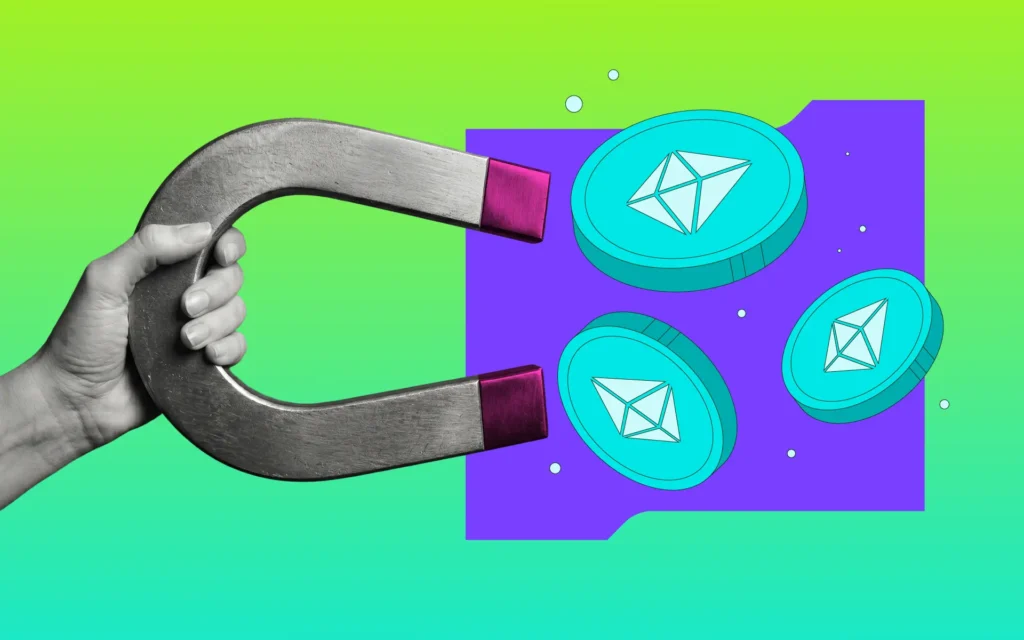
Tom Lee's Bitmine is staking rapidly. | Source: CCN
Share
Key Takeaways
BitMine has staked over 70% of its Ethereum holdings.
Tom Lee says Ethereum may be nearing the end of a “mini crypto winter.”
Broader bullish sentiment is building.
BitMine Immersion Technologies has locked up the bulk of its Ethereum holdings in staking while continuing an aggressive buying strategy, bringing the firm close to its target of controlling 5% of its circulating supply.
Sponsored
Disclosure
We sometimes use affiliate links in our content, when clicking on those we might receive a commission at no extra cost to you. By using this website you agree to our terms and conditions and privacy policy.
The company, chaired by investor Tom Lee, has recently committed roughly 3.5 million Ethereum to staking, equivalent to about $8 billion, representing just over 70% of its total holdings.
The move follows a series of large transfers to custodial platforms used for staking operations, according to blockchain data providers.
Staking involves committing crypto to support blockchain operations such as transaction validation, in exchange for yield.
In October, Lee said the company would eventually be able to generate a 2.79% pre-tax yield, potentially ranking the firm among the 800 most profitable in the US.
By locking away such a large share of its Ethereum, BitMine is effectively reducing the amount of supply available on the open market.
This kind of large-scale staking can tighten liquidity, particularly when combined with its aggressive accumulation.
Lee previously admitted that there is a point where an entity owning too much of a network could “actually have a negative effect because they’re crowding out innovation.”
However, he said discussions with researchers from Fundstrat and Standard Chartered indicate that “10% is actually still an acceptable level.”
“…because if you think about even in any competitive world, if someone has 10% of a system, they aren’t in control of it,” he said.
Accelerating Bitmine Purchases
Alongside staking, BitMine has stepped up its pace of acquisitions.
The company purchased more than 100,000 Ether in a single week recently, its largest weekly accumulation this year, spending roughly $230 million.
That transaction has pushed its total holdings to just under 5 million ETH, placing BitMine within reach of its stated “alchemy of 5%” goal.
The buying trend has been building over the past month, as weekly purchases have more than doubled compared to earlier averages.
Lee Says ‘Mini Crypto Winter’ Nearing End
BitMine’s strategy reflects Lee’s broader view that Ethereum is approaching the end of a cyclical downturn.
Last week, Lee described Ethereum’s current conditions as the late stages of a “mini crypto winter,” arguing that recent price weakness may be nearing exhaustion.
Ethereum remains significantly below its previous peak, with declines of more than 50% from highs reached in 2025.
Despite this, Lee has pointed to improving market signals, including renewed inflows and Ethereum’s relative resilience compared with other asset classes.
Lee’s latest outlook builds on a broader thesis that Ethereum is either at — or very near — a cyclical bottom.
In March, Lee highlighted analysis from market technician Tom DeMark, who compared Ethereum’s recent price action and major equity market drawdowns such as the 2011 U.S. debt ceiling crisis.
According to Lee, Ethereum’s pattern shows a high degree of correlation with those historical episodes and claimed the worst of the decline may already have passed.
“If those analogues hold, ETH likely either bottomed in early March or is bottoming now,” Lee said.
Other Bulls Persist
Optimism around Ethereum is not limited to BitMine’s strategy or Tom Lee’s market outlook.
Recent research published by crypto firm Etherealize outlines a far more expansive long-term valuation case, suggesting the token could eventually trade above $250,000 under certain conditions.
The report argues that current pricing models undervalue Ethereum by focusing primarily on network activity, such as transaction fees, while assigning little weight to its potential role as a global monetary asset.
Etherealize analyst Mike McGuiness said that if Ethereum begins to attract similar demand as a form of money, valuation frameworks would need to shift accordingly.
In that scenario, investors would need to account not just for cash flows generated by the network, but also for its potential to absorb capital currently allocated to assets like gold and Bitcoin.
Central to the thesis is Ethereum’s positioning as what the report calls “productive money.”
Unlike traditional stores of value, Ethereum can generate yield through staking, where holders earn returns for helping secure the network.
Ethereum were to capture a meaningful share of the multi-trillion-dollar pool of capital held in gold and Bitcoin, the report suggests its price could rise dramatically from current levels near $2,300.
Lee himself has stayed strong on his bullishness for Ethereum’s long-term.
“If Bitcoin gets to a million, that would value ETH at $250,000,” he said last year.
The Bitmine chairman previously claimed that ETH would rally toward $9,000 by early 2026, prompting some investors to question the validity of his predictions.
Kurt Robson is a London-based reporter at CCN, specialising in the fast-moving worlds of crypto and emerging technology. He began his career covering local news in Cornwall after graduating from Falmouth University with First Class Honours in Journalism. There, he cut his teeth on everything from council meetings to missing swans.
He quickly rose through the ranks to become a frontline journalist at several of the UK’s leading national newspapers. Over the years, he has interviewed musicians and celebrities, reported from courtrooms and crime scenes, and secured multiple front-page exclusives.
Following the upheaval of the COVID-19 pandemic, Kurt shifted his focus to technology journalism—just ahead of the AI boom. With a natural curiosity and a trained eye for emerging trends, he has found a new rhythm in reporting on innovation.
At CCN, Kurt's work focuses on the cutting edge of crypto, blockchain, AI, and the evolving digital world. Drawing on his background in people-first reporting and his deep interest in disruptive tech, Kurt delivers stories that are insightful, entertaining, and human-centric.