Key Takeaways
- A House committee approved legislation that would place federally forfeited Bitcoin in a strategic reserve for at least 20 years.
- Robert Kiyosaki claims the “biggest crash in history” has begun but continues to treat Bitcoin, gold and silver as protection from the fallout.
- Kiyosaki’s $500,000 Bitcoin forecast was made in 2024 and targeted 2025—a deadline the cryptocurrency missed.
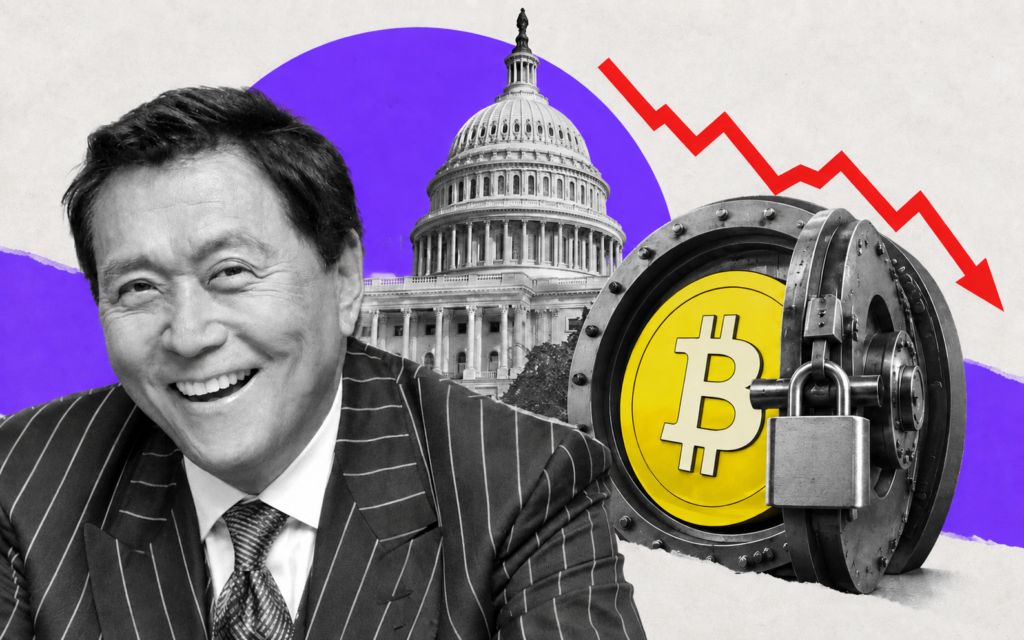
A US House committee has advanced a bill that would prevent the federal government from selling reserve Bitcoin for at least 20 years.
The proposal arrives as Rich Dad Poor Dad author Robert Kiyosaki warns that a global stock-and-bond crash is already spreading while continuing to recommend Bitcoin as protection from the turmoil.
His warning comes after the financial author predicted that Bitcoin’s price would reach $1 million by 2030.
US Bitcoin Reserve Bill Clears Committee
The House Financial Services Committee approved the American Reserve Modernization Act of 2026 by 28 votes to 21 on Wednesday, Sept. 16.
Introduced by Alaska Republican Nick Begich, the legislation would formally establish a Strategic Bitcoin Reserve within the Treasury Department.
Under the original bill text, Bitcoin obtained through completed criminal or civil forfeiture proceedings would be transferred into the reserve rather than routinely sold at government auctions.
The amended version approved by the committee makes a minimum 20-year holding period.
During that period, the Treasury would be prohibited from selling, auctioning, or otherwise disposing of reserve Bitcoin.
The legislation would also create a separate Digital Asset Stockpile for non-Bitcoin assets held by the government.
However, the bill must still pass the full House, clear the Senate, and receive the president’s signature before becoming law.
This makes its path to full approval uncertain, particularly after the Senate failed to advance the CLARITY Act earlier this week.
Kiyosaki Says the Biggest Crash Has Started
While lawmakers consider removing government-held Bitcoin from circulation, Kiyosaki claims the global financial system is entering a historic downturn.
“BIGGEST CRASH IN HISTORY has started,” Kiyosaki wrote in a Sept. 15 post on X.
The author claimed the crash began in Europe and Japan before spreading across the world.
He blamed the downturn on the AI frenzy, the war in Iran and financial pressure created by retiring baby boomers.
Kiyosaki also warned that people over 40 with money concentrated in retirement products such as 401(k)s, superannuation funds, and registered retirement savings plans could face trouble.
Despite his bleak outlook, the author continues to favor Bitcoin, gold, and silver over fiat currencies.
Kiyosaki’s argument is that a debt crisis would eventually force governments and central banks to create more money, potentially increasing demand for scarce assets.
Can Bitcoin Reach $1M by 2030?
Kiyosaki’s $1 million forecast dates to September 2024, when he predicted Bitcoin would first reach $500,000 in 2025 before climbing to $1 million by 2030.
The first stage of that forecast has already failed.
Bitcoin’s price reached a record high of approximately $126,000 in October 2025. While it was an impressive gain, but almost 75% below Kiyosaki’s $500,000 target.
His $1 million forecast technically remains alive because the deadline is still more than four years away.
However, BTC was only trading at around $78,000 on Friday, meaning it would need to increase by approximately 1,182% to reach $1 million.
That would require Bitcoin to multiply in value almost 13 times and sustain average annual growth of roughly 81% through the end of 2030.
At $1 million per coin, Bitcoin’s market capitalization would also approach $20 trillion based on its circulating supply.
Would a 20-Year Lock Help Bitcoin’s Price?
The reserve bill could strengthen BTC’s scarcity narrative by preventing the government from suddenly returning confiscated coins to the market.
Government auctions have historically created concerns about additional supply, particularly when large quantities of seized Bitcoin are involved.
A mandatory 20-year holding period would remove that potential selling pressure from affected coins.
However, the bill would only primarily lock up Bitcoin the government already receives through forfeitures. It does not create guaranteed additional demand.
BTC Bulls See $100K to $21M
Kiyosaki is far from the only prominent investor to predict enormous Bitcoin price gains.
As CCN previously reported, forecasts issued during the 2026 stretch predicted a return to six-figure valuations and even multimillion-dollar valuations.
- Standard Chartered: $100,000 by the end of 2026.
- Bernstein: $150,000 by the end of 2026.
- Cathie Wood: $1.25 million by 2030.
- Tom Lee: $2 million.
- Michael Saylor: $21 million.
These targets are not comparable, however.
For example, Standard Chartered and Bernstein offer year-end forecasts, while Kiyosaki, Wood, Lee and Saylor are describing scenarios that could take years or decades to unfold.
The information provided in this article is for informational purposes only. It is not intended to be, nor should it be construed as, financial advice. We do not make any warranties regarding the completeness, reliability, or accuracy of this information. All investments involve risk, and past performance does not guarantee future results. We recommend consulting a financial advisor before making any investment decisions.

Kurt Robson is a London-based reporter at CCN, specialising in the fast-moving worlds of crypto and emerging technology. He began his career covering local news in Cornwall after graduating from Falmouth University with First Class Honours in Journalism. There, he cut his teeth on everything from council meetings to missing swans.
He quickly rose through the ranks to become a frontline journalist at several of the UK’s leading national newspapers. Over the years, he has interviewed musicians and celebrities, reported from courtrooms and crime scenes, and secured multiple front-page exclusives.
Following the upheaval of the COVID-19 pandemic, Kurt shifted his focus to technology journalism—just ahead of the AI boom. With a natural curiosity and a trained eye for emerging trends, he has found a new rhythm in reporting on innovation.
At CCN, Kurt's work focuses on the cutting edge of crypto, blockchain, AI, and the evolving digital world. Drawing on his background in people-first reporting and his deep interest in disruptive tech, Kurt delivers stories that are insightful, entertaining, and human-centric.