According to the incident report, the network stalled when a new sequencer, still syncing and unable to produce blocks, unexpectedly took over after the active sequencer slowed down due to heavy on-chain activity.
Block production resumed around 06:40, after the team implemented basic improvements to testing coverage and sequencer cluster settings.
The issue stemmed from a failure in the Conductor, a key component of the OP Stack, which attempted to auto-switch block production to the new, unready sequencer. This handoff failed, bringing the network to a halt.
To stabilize the system, developers manually paused the high-availability (HA) software to stop any further automatic leadership transfers. They then safely promoted a healthy sequencer:
“We manually transferred leadership from the unhealthy sequencer to a healthy sequencer. Planning the transfer took several minutes to ensure we did not re-org the chain,” the team said.
Base Network Recovers After Sudden 30-Minute Outage
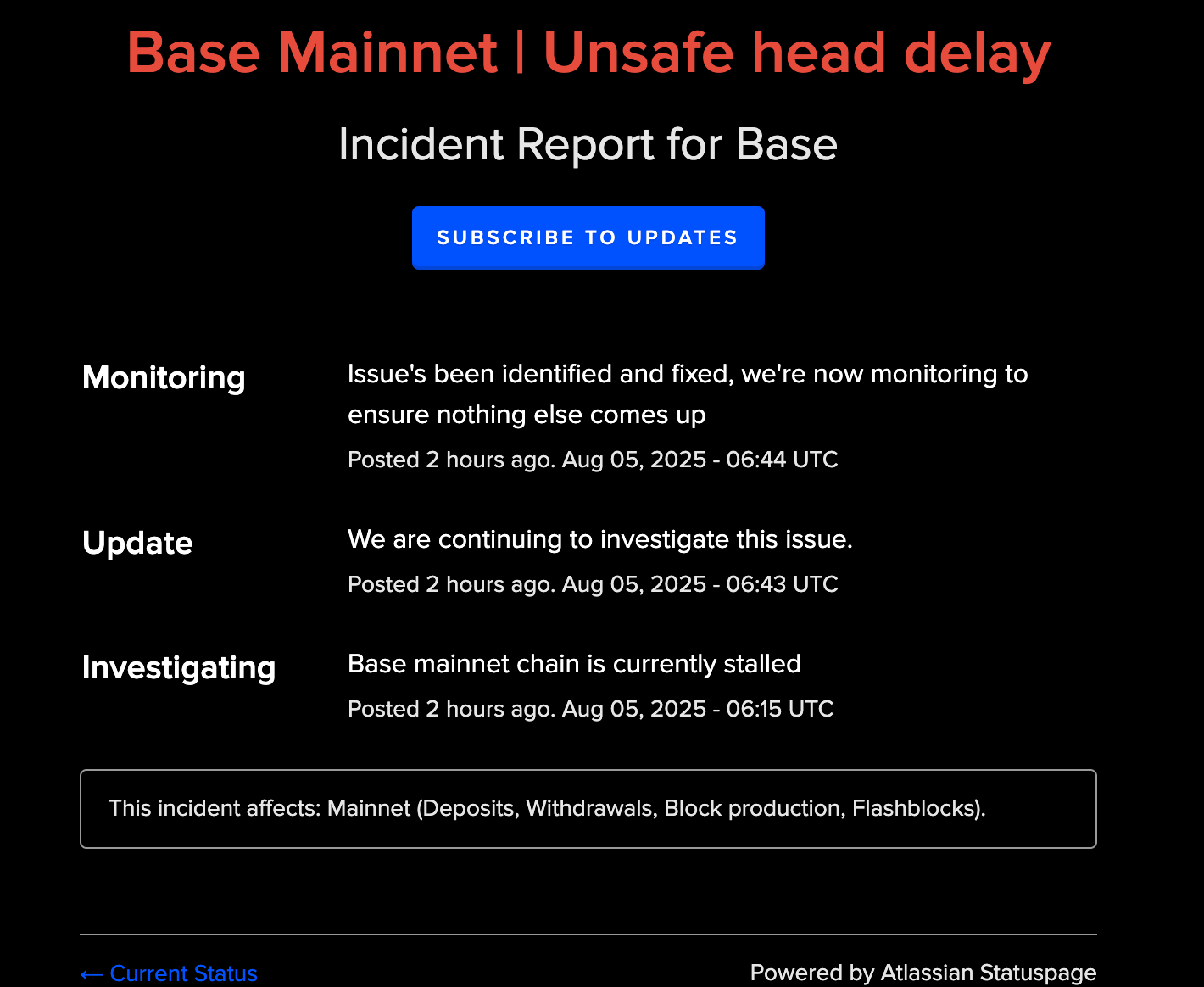
At midnight, Base publicly acknowledged the problem, noting that the last processed block was stuck at height 33,792,704.
Soon after, the team identified the issue and restarted block production, with regular activity resuming shortly thereafter.
While Base didn’t confirm the exact cause, many in the community believe the recent surge in on-chain activity, fueled by decentralized social platforms like Zora and Farcaster, may have contributed to the downtime.
Base Mainnet Status. Source: Base.
Base’s Rising Popularity May Be Putting Pressure on the Network
Base has seen a significant uptick in usage over the past few months, largely thanks to its integration of on-chain social tools through the rebranded Base App.
The rollout of creator-friendly features has helped turn the network into a hub for decentralized social activity, but that growth may also be pushing the limits of its infrastructure.
Despite this brief disruption, Base has built a strong reputation as one of the more stable Ethereum Layer-2 solutions, and today’s outage was short-lived compared to issues faced by other chains.
Downtime Isn’t New — But It’s Getting Rarer
Outages are nothing new in crypto. Even major networks have gone dark over the years. That said, reliability has improved.
Prashant Jha is a seasoned crypto journalist based in Delhi, India, with a Bachelor’s Degree in Computer Science Engineering. Passionate about the evolving world of blockchain and cryptocurrencies, he has been a dedicated voice in the industry since 2018. Prashant’s expertise lies in regulatory reporting, where he unravels complex legal and financial developments with clarity and precision. Before joining CCN in 2024, he honed his craft at Cointelegraph, establishing himself as a trusted name in crypto journalism.
His coverage spans major industry events, including the high-profile collapses of FTX, Three Arrows Capital (3AC), and LUNA, offering readers insightful analyses of their regulatory and market implications. Prashant’s technical background enables him to bridge the gap between intricate blockchain technology and its real-world applications, making his work accessible to novices and experts.
Beyond his professional pursuits, Prashant is an avid music enthusiast, often exploring diverse genres to unwind. A sports lover, he has a particular passion for cricket and frequently engages in discussions about the game. His multifaceted interests and sharp journalistic instincts make him a valuable contributor to CCN, where he continues shaping the crypto landscape's narrative.