Key Takeaways
- Aster has returned to DeFiLlama after it was delisted over wash-trading allegations.
- Questions over suspicious trading patterns remain unanswered.
- A recent ASTER Airdrop may be to blame for the inflated trading activity.
Earlier this month, DeFiLlama delisted Aster amid allegations of wash-trading.
While the decentralized perpetual futures exchange has now been relisted, there are still questions hanging over the legitimacy of Aster’s purported trading volume.
Aster Relisted on DeFiLlama
Aster’s return to DeFiLlama’s perp DEX rankings ends a multi-week spell in which the platform was absent from the popular dashboard.
When DefiLlama originally delisted Aster, the company’s pseudonymous founder, 0xngmi, pointed to suspicious similarities between its trading volume and those observed on Binance’s perpetual futures exchange.
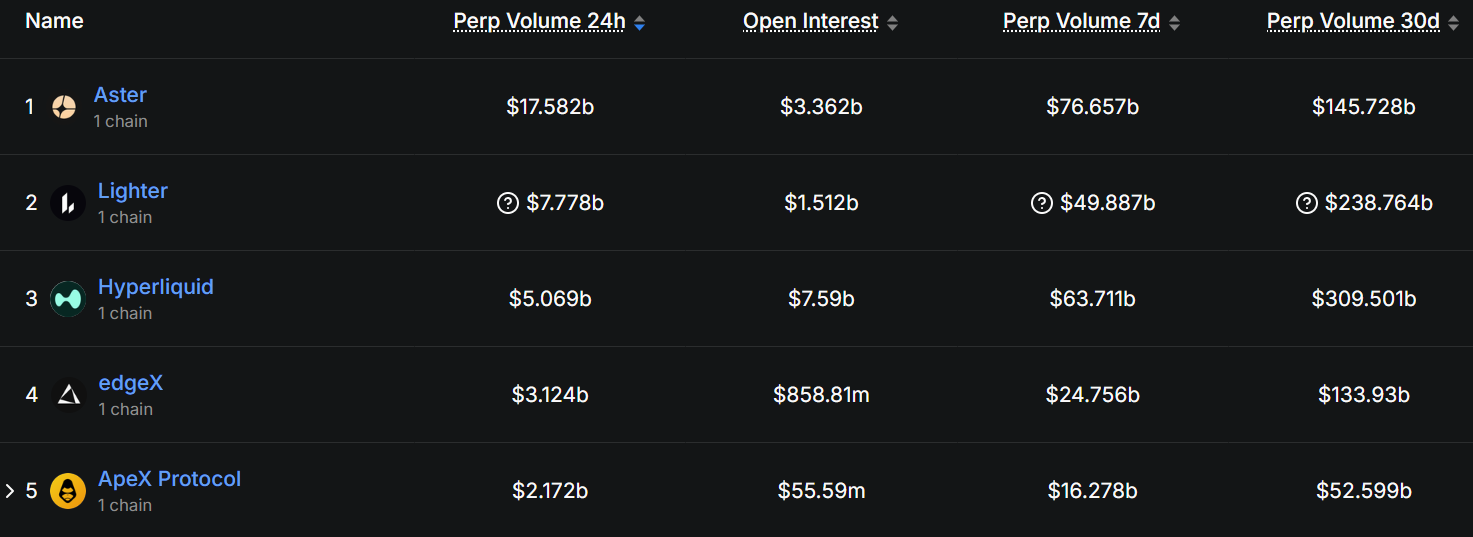
- Aster has returned to DeFiLlama’s leaderboard. Source: DeFiLlama.
At the time, 0xngmi said DeFiLlama would require better access to verifiable platform data to address the wash-trading allegations.
Providing an update on the situation on Sunday, Oct. 19, 0xngmi said the platform had been relisted at Aster’s request. “We’re working on a solution that will include other metrics to make this better,” however, the DEX is “still a black box and we can’t verify the numbers,” they warned.
ASTER Airdrop Farming May Have Inflated Trading Volume
In the wake of DeFiLlama’s delisting, Aster CEO Leonard stated on X that the suspicious patterns observed by 0xngmi could be explained by airdrop farming.
Highlighting the timing of the event, Leonard suggested that what looked like wash-trading was actually “opportunistic API traders” looking to maximize their airdrop rewards. Aster’s Season 2 airdrop rewarded users based on trading volume and open positions.
According to this view, airdrop farmers opened positions on Aster, while simultaneously hedging on Binance. This reflects a common strategy in decentralized finance (DeFi) whereby traders open long positions on a DEX for airdrop eligibility, while hedging with equivalent short positions on centralized exchanges.
In Aster’s case, “some level of correlation is reasonable as many traders use Binance for liquidity and hedging,” Leonard argued.
Top Trending Crypto Articles

James Morales is CCN’s blockchain and crypto policy reporter. He has been working in the news media since 2020, writing about topics such as payments, banking and financial technology. These days, he likes to explore the latest blockchain innovations and the evolving landscape of global crypto regulation.
With an educational background in social anthropology and media studies, James uses his platform as a journalist to explore how new technologies work, why they matter and how they might shape our future.